A collection of historical tidbits about the Pony Express taken mostly from books, except as otherwise noted. This slider cycles through all of the Quick Facts in random order. I will be adding to these as I read through more sources. You can pause a slide by hovering your mouse over the Fact. To find Quick Facts on a particular topic, click on the appropriate tag in the sidebar. All Facts connected with places on the trail also appear under the appropriate state in the Route Reports section.
Rock Creek Hollow
We walk on down the Trail till we come to a plaque honoring a mass grave of eighteen Mormons. They were members of a handcart company who froze to death in a snowstorm as they marched toward Salt Lake City in the 1850s.
The plaque says they died right here, says Sam, but it makes no sense that they would have sought shelter in this spot. See that cliff just over there? That’s where they tried to save their lives. I have found pieces of their carts with my metal detector.
Seeking freedom from bigotry, the Mormons began the long and harsh journey West out of St. Jo and Independence, Missouri. Many were so poor that they could not afford wagons, so they walked and pushed handcarts. One such walker was Thomas Dobson, who became a Pony rider in Utah. When he emigrated with this family in 1856, he walked barefoot all the way from the Sweetwater River, near where I found the two dead buffalo, to Salt Lake City.
Jerry Ellis, Bareback!, p. 180
Mountain Fever
“And as [the emigrants] got to thinner air they encountered a new malady, a prostrating seizure of nausea and violent headaches, frequently complicated by still another kind of dysentery. Bryant, who was stricken with it, attributed it to excessive drinking of milk from cows which had been made unhealthy by overwork and had drunk alkali water and eaten noxious weeds. But it was really “mountain fever,” a process of adjustment to diminished oxygen which most people repeat today when they go to high altitudes.”
Bernard De Voto, The Year of Decision, 1846, p. 161
Resupplying the Utah Expedition
“In January 1858 the Government to arrange with Russell, Majors & Waddell to transport approximately sixteen million pounds of freight, most of it destined for Utah. To fulfill this assignment the firm was compelled to acquire 40,000 oxen and 1,000 mules, and to hire more than 4,000 teamsters; altogether the Government ordered the contractors to send to the Territory at least 100 trains, each composed of twenty-six wagons.”
Norman F. Furniss, The Mormon Conflict, 1850-1859, p. 172
Trailside Messages
“The bones of buffalo whiten the roadside, and their bleached skulls serve in a double way as records of the passers-by. Many are the names and bulletins pencilled on them; and by continually reading one begins to learn the biography of those in front, and feel an interest and a companionship in their progress. Perhaps we catch up another train, we all chat together, names drop out; ‘Oh!’ one answers, ‘I know your name, I read it on a buffalo head three weeks ago; you’re from —, are not you?’ Sometimes one reads short camp anecdotes or accidents, such as, ‘Woman shot to-day by her husband taking his gun loaded into the waggon—not expected to recover:’ then, ‘Woman shot on Thursday, doing well.'”
William Chandless, Chandless, W. (1857). A Visit to Salt Lake, p. 67
Bancroft on the Pony Express and California
News was received every ten days by pony. That coming by the Butterfield route was double the time ; what came by steamship was from three to four weeks old when it arrived. In the spring of 1861 the Apaches on the southern route attacked and delayed the mails. It was the pony to which every one looked for intelligence; men prayed for the safety of the little beast, and trembled lest the service should he discontinued. Telegraphic dispatches from New York were sent to St. Louis, and thence to Fort Kearny, whence the pony brought them to Sacramento, where they were telegraphed to San Francisco. Great was the relief of the people when Hale’s bill for a daily mail was passed, and the service changed from the southern to the central route, as it was early, in the summer. News by the daily mail was eighteen days old at the shortest, but it was regular and consecutive at short intervals, which was far more satisfactory than the former arrangement. After all it was to the flying pony that all eyes and hearts were turned; and to the praise of the St Joseph company be it recorded that they kept up the service, at a loss, until the the telegraph was completed across the continent in October, 1861. Their first object was to exemplify the practicability of a mail, or railroad line, on or about the 41st parallel. After that was demonstrated, they had no further interest in the pony express, except through patriotism.
Hubert Howe Bancroft, The Works of Hubert Howe Bancroft: History of California, Vol. XXIV, (San Francisco: The History Company, Publishers, 1890), 281
Dogtown and Dobytown
“Beginning in 1858 there were two famous—or infamous—appendages of Fort Kearny, primitive communities which supplied vital needs for civilians and soldiers alike. Eight miles to the east, just off the reservation line, was Valley City, or Dogtown. Just beyond the western line, two miles away and therefore a much bigger and livelier place, was Kearney City, or Dobytown. . . .
Monthly mail between Independence, Missouri, and Salt Lake City, Utah, began in the summer of 1850. In 1858 mail service went on a weekly basis, and with this began the systematic transportation of passengers, first by mail wagon, later by the famous Concord coaches. To facilitate this service, the company built stage stations at intervals of town or twelve miles. This was the actual beginning of Valley City and Kearney City. The former was related to a ‘swing station’ where horses were changed; the latter evolved from a ‘home station’ where drivers were changed and meals offered the passengers. . . .
The Pony Express of 1860-1861, operated by Russell, Majors & Waddell, of freighting fame, shared most of its stations with the Holladay company along the main Platte; accordingly, there were Pony Express stations at Valley City and in the Fort Kearny vicinity. Contrary to widespread impression, the Pony Express riders did not gallop up to Moses Sydenham’s sod [sutler] post near the Fort Kearny parade ground; they kept right on going to the log station west of the fort, and mail by stage or Pony Express was carried back to the fort from there.”
Merrill J. Mattes, The Great Platte River Road, p. 216-217
The Name Nebraska
“Ne-bras-ka was the original name of the river, given it by the Otoe Indians, who lived near where it empties into the Missouri. Ever since the first French trappers came into the valley it has been known simply as the Platte. The two names, however, are synonymous. Mrs. E. G. Platt, of Oberlin, Ohio, was long with the Pawnees, as teacher in the missionary schools. She wrote me, August 22, 1899: ‘I lived with the Pawnees when the territory (Nebraska) was named, and spoke their language, so am free to say Nebraska is not a Pawnee word; but a gentleman who had lived some years among the Otoes and spoke their language fluently informed me it is an Otoe word, which literally translated is weeping water, the stream upon which lies the town of Weeping Water being (by the Otoes) named ‘Nebrathka’ because of the sad tones of its waters as they rushed over their rocky bed.’”
Root and Connelley, The Overland Stage to California, p. 243 (and note)
The American Antelope
“The American antelope, or pronghorn, is the purest type of Plains animal, and seems to have developed only in the Great Plains of North America. It is not a member of the antelope family of Europe and Asia. Its true common name is pronghorn, and its scientific name is Antilocapra americana. It seems to occupy an intermediate position between the goat and the deer. Its horns are hollow, like those of cattle or goats ; yet it sheds them like the deer. It has the caution and timidity of the deer and the curiosity of the goat. The habitat of the pronghorn extends from Saskatchewan to Mexico and from the Missouri River to the Rocky Mountains, and in the north to the Cascade Range of Oregon and Washington. It bas its abode solely in the Plains country, and has a special antipathy for the woods and canons.
The antelope is peculiarly well fitted for its chosen environment. First, its sense of sight is such that it can” detect danger at an immense distance.” Secondly, it is the swiftest runner among the wild animals on this continent and can be pulled down only by the greyhound. But with the antelope, curiosity and caution are strangely mingled. It wants to observe any unusual object, and this makes it a mark for hunters. In the primitive state of nature this characteristic led to no fatal results, but with the advent of man and the high-powered rifles it became disastrous.2 Thirdly, the antelope is equipped with a signal system which enables it to communicate danger at great distances. This is the white patch on the rump, lighter in color than the body. When frightened or interested in anything unusual the antelope contracts its muscles and the patch becomes a flare of white. . . .
Fourthly, the antelope, like all Plains animals, possesses a great vitality. Dodge says that “antelope will carry off more lead in proportion to their size than any other animal.”
Walter Prescott Webb, The Great Plains, p. 35, 36
Marcy Expedition Crossing the Rockies
“Marcy offered the [Ute] chief the value of three horses if he would guide the party to Cochetopa Pass, the only feasible route in miles over the continental divide. But the Indian was adamant, indicating that the white men would die if they tried to cross.
“On the 11th of December the ascent of the western slope of the Rockies was commenced. Soon snow began to impede progress and presently became deeper with a crust on the surface which cut the legs of the mules. Deeper and deeper it grew and the order of march was changed. Instead of having the animals break the trail the men were ordered in front and proceeding in single file, tramped down a path. But despite this solicitude for the animals the poor beasts began to weaken. The bitter pine leaves from the evergreens formed their only sustenance and on this unwholesome forage the famished brutes grew thin, weak, and began to die. Burdens must be lightened if the crossing was to be made, and accordingly, all surplus baggage was cached.
“But still the mules continued to perish. One day five were lost, and on the following morning eight others lay stark and rigid on the mountain side. Not only was the pace being greatly reduced but the food supply of the men was becoming alarmingly small. All the beef cattle had been consumed and the bread supply was very limited. To husband the strength of men and animals Marcy now ordered all baggage discarded except arms and ammunition and one blanket for each man.
“The snow, now four feet deep, was so dry and light that the men when walking upright sank to their waists in the fluffy whiteness. Jim Baker decided to try snow-shoes, but found the snow too loose and powdery to sustain them. In breaking trail through the deepest part the men in front now found it necessary to crawl on their hands and knees to pack the snow so that it would bear up the other men and the animals. The leading man was usually able to go about fifty yards before he became exhausted and dropped out into a rear position.
“Rations had been reduced and finally were exhausted before the summit of the divide was reached. The only food now available to the hungry men was the meat of the famished animals.”
LeRoy R. Hafen, "A Winter Rescue March Across the Rockies," p. 9-10
Mile 1437: Simpson Springs
“Passing out of Skull Valley, we crossed the cahues and pitch-holes of a broad bench which rose above the edge of the desert, and after seventeen miles beyond the Pass reached the station which Mormons call Egan’s Springs, anti-Mormons Simpson’s Springs, and Gentiles Lost Springs.
Standing upon the edge of the bench, I could see the Tophet in prospect for us till Carson Valley: a road narrowing in perspective to a point spanned its grisly length, awfully long, and the next mail station had shrunk to a little black knob. All was desert : the bottom could no longer be called basin or valley: it was a thin fine silt, thirsty dust in the dry season, and putty-like mud in the spring and autumnal rains. The hair of this unlovely skin was sage and greasewood : it was warted with sand-heaps ; in places mottled with bald and horrid patches of salt soil, while in others minute crystals of salt, glistening like diamond-dust in the sunlight, covered tracts of moist and oozy mud.”
Richard Burton, The City of Saints, p. 454
Burr and the Mormons
“The short period between 1852 and 1855 was in general a peaceful interlude in the relations between the Mormons and the nation. Although Steptoe, [Secretary Benjamin G.] Ferris, and [Indian Agent] Holeman had raised brief disturbances, the years were as free of painful incident as any before 1896, when Utah gained statehood. But the harmony, such as it was, soon faded. Within a few months voices more powerful and strident than those heard in the past were demanding federal intervention in the Mormons’ country: and a stormy petrel reached Salt Lake City in the person of David. T. Burr, the newly appointed surveyor general of the Territory.
Almost at once Burr ran into trouble with the inhabitants on the Valley. their title to the land they occupied was tenuous at best, in the absence of an Indian treaty or congressional enactment. Knowing this, they looked upon a survey of their region as a move preliminary to their eviction by the Government. Their fears had some justification, for Burr soon wrote to his superiors that the Church had illegally appropriated areas of the public domain, a reference to the recent introduction of an experiment, tried without success in earlier communities, to persuade the Mormons to deed their properties to the Church.
In alarm, the Saints sought to impede the surveyor general’s labors in every way possible, using intimidation, violence, and their influence over the Indians. . . .Garland Hurt, whoe position as agent brought him into greater difficulties than Holeman had encountered . . . charged that a bishop had stirred up the Indians in southern Utah by circulating the lie that surveyors were really a posse sent in disguise to arrest Gunnison’s murderers. Other Mormons in Fillmore, Hurt added, had stoned a house where Burr and his men had stopped for the night.The surveyor general himself reported the Mormons’ removal of corner posts, the theft of animals, and other obstructive acts, none of which could be prosecuted in the Church-controlled courts.
In the spring of 1857 Burr gave up his work in Utah, offering a number of explanations for his decision. His life was in fanger, for the priesthood was denouncing him from the pulpit. One of his associates . . . had been beaten nearly to death, perhaps permanently crippled, by a grouop of the infamous Danites. . . . and Brigham Young had ominously declared in public that his, Burr’s, work was at an end. In this lawless atmosphere three apostates had been murdered; Burr’s friends predicted the same fate for him if he remained.
As was frequently the case in more significant episodes, the truth about Burr’s clash with the Mormons is not easily found. . . .From the statements of burr, Hurt, Crain, Mogo, Wilson, and Landon it appeared that the people of the territory were, if not actually rebellious, at least ready to impede the work of duly appointed federal representatives.”
Norman F. Furniss, The Mormon Conflict, 1850-1859, p. 45-47.
Slade's Death
“Virginia, grief-stricken and bitter as she gazed on her dead husband, shrieked at those around the death-bed: ‘Why, oh, why didn’t one of you shoot him, not let him endure the shame of being hanged? If I had been here, I would have done it. No dog’s death should have come to such a man. He did not deserve to die on the scaffold.’
She was so bitter against Montana, Virginia City, and especially the Vigilantes, contending her husband was a charter member of the Vigilantes, that she refused to allow him to be buried in Montana soil. She had a zinc coffin especially built and ironically had the body preserved in alcohol, and then had the coffin temporarily buried across the road from the stone house in Meadow Valley, placing the grave where she could gaze on it from her largest window. This was in February, and it was not until summer that she was able to take the body to Salt Lake City for burial. He was buried on July 20, 1864, in the old Salt Lake Cemetery.”
[N.B. According to another author, “An elegant casket was made lined with tin.” Perry Jenkins, “Kiskadden-Slade,” Annals of Wyoming, Vol. 21, No. 1 (1949), p. 90]
Virginia Rowe Towle, Vigilante Woman," p. 145
Two Weeks' Hard Going Through the Snowbound Sierra
What does “two weeks” hard going mean?
“The first week of May, 1851, George Chorpenning, with a party of seven picked up 200 pounds of sacked mail at the Sacramento office and started east. The initial mail was delivered without incident. After two weeks’ hard going through the snowbound Sierra Nevada, Chorpenning arrived in Carson Valley.”
“It took [Chorpenning’s party] sixteen days to make their way to Carson Valley having had to beat down the snow with wooden mauls to open a trail for their animals over the Sierras. They left May 1 1851 from Sacramento. On the third day they encountered snow drifts in the Sierra Nevadas some fifteen miles above Placerville. It was on the 22nd day that they reached Carson Valley (about 180 miles on the then traveled route). When they reached the snow line, they dismounted put part of the mail from the mules on their own horses and walked for about two weeks. They trampled and beat the snow for the animals—traveling two, six to eight miles per day. For sixteen days they traveled and camped on deep snow.” (quoted in Ralph L. McBride, Utah Mail Service Before the Coming of the Railroad, 1869″ (M. A. thesis, Brigham Young University), p. 20)
The party again had to resort to “forcing paths through deep snowfields in the Goose Creek Mountains,” before reaching Salt Lake City on June 5, 1851.
John M. Townley, "Stalking Horse for the Pony Express: The Chorpenning Mail Contracts between California and Utah, 1851-1860", Arizona and the West, Vol. 24, No. 3 (Autumn, 1982), p. 230-231
Stage Line and Settlement
“In founding the [Leavenworth & Pike’s Peak Express] stage line, locating home stations, and opening regular traffic between the Missouri River and the Rocky Mountains, Jones and Russell made an incalculable contribution toward settlement of the wide plains along the route. As had always been the case with the westward creeping frontier, once reasonably dependable transportation was assured, either overland or by water, the people flocked into the area and established new homes. Settlers followed coaches and freight wagons out across Kansas, along the Platte River and its South Fork, down to Denver, and from there out into the mountains to scores of towns and ranches. All of them at first dependent on the Leavenworth & Pike’s Peak Express Company to keep them in contact with the older sections of the country back East. The proprietors were therefore colonizers although they would have been the last to make that claim for themselves.”
Settle and Settle, Empire on Wheels, p. 47
Significance of the Pony Express
“At this point, any criticism of the Pony Express might be considered by many Americans as unpatriotic to say the least. Nonetheless, an assessment of the significance of the C.O.C. & P.P. Express Co. has to be made—one that cuts through the myth to reality. In the author’s judgement, the Pony Express played a role in the development of transportation and communication links between the west and the east coasts, but not a very successful one. Plain and simple, the C.O.C. & P.P. Express Co. failed to provide “reliable” mail service across the country as Russell, Majors, and Waddell promised.
“Many unforeseen and known factors, contributed to Russell, Majors, and Waddell’s failure. The primary problem they did not foresee was the Pyramid Lake Indian War, which severely interrupted and then slowed Pony Express service for several months . . .
“Setting Indian depredations aside, unpredictable weather-related events actually defeated the company. Russell, Majors, and Waddell promised speedy reliable service come rain, snow, or sunshine. In good weather, the Pony Express system worked as it was designed. But during the long, hard, stormy winter of 1860-1861, actually the first real test of the system against harsh weather elements, the Pony Express system could not maintain a regular or speedy schedule, even with the help of the extension of the telegraph lines. Due to the severe winter that year, the system broke down delaying the mail for substantial periods of time, much as it had under previous mail contractors, such as George Chorpenning. According to one historian, the average time of the twenty-two midwinter trips between destination points was 13.8 days. On four of these trips, sixteen days were used between telegraph points. Additionally, one trip took seventeen days, and another trip was missed entirely. Like it or not, postmaster general Aaron V. Brown was correct in 1857 when he thought the southern route of the Butterfield Overland Mail Company was superior to the central overland route because of winter travel conditions.
“On another level, the Pony Express failed as a successful business venture. The undertaking of an enterprise on a scale and size of the Pony Express by a private business was not a ‘Great Gamble’ as one author posed, but instead, it simply was an imprudent business venture. Quickly looking at the possible numbers of letters sent versus the cost of the operation, any smart businessman could recognize the disparity. Alexander Majors knew that the amount of business transacted over this line was insufficient to pay one-tenth of the expenses, to say nothing about the amount of capital invested. In Russell, Majors, and Waddell’s defense, some historians argue that the “Pony Express was not an end in itself, but a means to an end,” a legitimate business investment designed to place the firm in a favorable position to compete with the Butterfield line for the next overland mail contract. Russell, Majors, and Waddell knew it would be made obsolete by the telegraph. If this supposition were true, then the Pony Express failed here as well. In March 1861, when the overland mail contract was signed due to the exigencies of the impending Civil War, Russell, Majors, and Waddell were not in a financial position to compete with the Butterfield line, and therefore they lost out on their only chance to obtain a overland mail route contract.
“As the above arguments infer, the Pony Express’ significance in American history does not rest on the company’s capabilities. Instead, its significance is grounded in two different areas: 1) the Pony Express’ basic contribution to transportation and communication history, and 2) its very existence during a critical time period in American history.
“Clearly the Pony Express reduced the communication distance between the east and west coasts, and “speeded up news service to and from the Pacific Coast.” The Pony Express was a benefit to the public for this reason. Contemporary accounts also tend to agree that the Pony Express bound these two distant sections of the Union together before and during the Civil War. The Pony Express also fostered closer communication links between Mormon communities at Salt Lake City, and other Trans-Missouri communities and eastern states.”
Anthony Godfrey, Historic Resource Study Pony Express National Historic Trail, p. 231-322
Russell Escapes Conviction
Within a week Russell’s case was called in the Criminal Court of the District of Columbia. There his attorney must have been no less enterprising than himself, for the lawyer boldly argued that the defendant should go free. It was a Machiavellian maneuver. He pleaded the Act of 1857, which exempted witnesses before Congressional committees from later prosecution on the matter about which they had testified.
What cleverness! First indicted as a criminal, he could, by law, have chosen not to testify before the Committee and thereby incriminate himself. But taking the opposite course and, with a great show of cooperation, freely answering its questions, he neatly established an immunity against prosecution, and probable conviction.
Roy S. Bloss, Pony Express—The Great Gamble, 119
Cattle for Utah
“Here William McCarthy, a brother of Frank McCarthy, our assistant boss, met us. He had been sent out by Majors, Russel & Waddell in charge of a herd of eight hundred beef cattle to drive them to Salt Lake. He had eight men, and a team and wagon to haul their supplies. “
William Clark, "A Trip Across the Plains in 1857," Iowa Journal of History and Politics, 20 (1922), p. 184
Aid from the Ogallala
“For a time the prospect looked very gloomy, from the fact that our provisions were nearly gone, and there was no possible chance apparently for getting more supplies. About two days after going to our new camp, however, a party of Ogallala Sioux Indians came by with their ponies loaded down with fresh buffalo meat, which they were taking to their camp to dry. The Indians were quite friendly, gave us some fresh meat, and also the information that their camp was but a few miles off, over the bluffs by a spring, at the mouth of another canon opening into the valley of the North Platte River. They invited us to come over and stay at their village, telling us also that the French traders, Dripps and Madret were there; and could possibly let us have some provisions.”
Moses H. Sydenham, "Freighting Across the Plains in 1856—A Personal Experience," in Proceedings and Collections of the Nebraska State Historical Society, Vol 1, No. 1, p. 175-176
Mile 1193: Fort Bridger
“The majority of the migration arrived at Fort Bridger in the month of July. . . . The valley of Blacks Fork is beautiful out of all reason, like a charming but improbable stage setting, for which the snow-topped Uinta Mountains provide a magnificent backdrop. Apparently from sheer altruism the river divides near the head of the valley and sends its cool waters through this lovely flat land in several clear-flowing channels which unite again some miles below, forming a group of islands. On the westernmost of these we found the fort.
When, in the early forties, Jim Bridger built his first rude cabins at this garden spot and fenced them in with a stockade of small logs, he executed quite a stroke of business. . . .
There is evidence that he had completed something in the way of building by the summer of 1842, because an eccentric minister, Williams by name, returning from Oregon, passed on July 3rd of that year and made mention of reaching Bridger’s fort. . . .
Dirty little log outposts of civilization such as this, chinked with mud and roofed with sod, were the first exponents of a new type of business, the emigrant trade, which rolled merrily along throughout all the years of the migration, amassing fortunes for those who embraced its opportunities. Fort Bridger was the first trading post west of the Missouri built especially to cater to this business, and it was a blow when the opening of Sublette’s Cutoff to wagons drew thousands of prospective customers away. In the summer of 1849 Bridger’s partner, Louis Vasquez, with a retinue of Indians camped at South Pass, trading with the emigrants and trying to persuade them to go by way of Fort Bridger.”
Irene D. Paden, The Wake of the Prairie Schooner, p. 246-247
Women's Recording of Gravesites
There is a kind of murderous precision in the women’s recounting of mishap. Surely, the accounts must be viewed as a reflection of the continuing anxieties they felt. But the more one reads these diaries, the more one comes to feel the passionate indictment, the bitter appraisal by the women of the men’s determination to make the journey. However bravely the women started, however they mustered their strength to meet the demands of each day, however they rallied to appreciate the splendors of the scenery, the women were intimately affected by the journey’s dreadful toll. Their responses depended upon whether their own lives were placed within the processes of childbearing and childrearing, or whether they were still in their girlhood years. Buoyant spirits are almost always in the diaries of unmarried girls and young wives. Accounts shade and darken in the pages of women whose energies were spent nursing and caring for infants and small children.
Lillian Schlissel, Women's Diaries of the Westward Journey, p. 115
An Indian for Breakfast
“‘An Indian for breakfast and a pony to ride’ was their [105 men who volunteered under Major Ormsby after the killings at William’s Station] slogan as the command started across the wastes toward Pyramid Lake.”
Dorothy Mason, The Pony Express in Nevada,, p. 72
Mile 760: Mexican Hill
“For the better part of a mile we kept to the edge of the bluffs, separating and spreading over a wide strip of territory as we hunted for the place where our maps showed that a right-hand fork of the trail made its descent to the river bottom. . . .
The men were the first to find the descent, which is merely a steeply washed break in the bluffs. But it bore evidence that the wagons had descended at this point and it is called (we found later) Mexican Hill.
[N.B. The mileage is an approximation. Mexican Hill appears to lie somewhere between the Pony Express Bikepacking Route and the North Platte River off one of the tangential dirt roads. More info here . . .]
Irene D. Paden, The Wake of the Prairie Schooner, p. 171
Yoking Oxen
When Ford demonstrates the historical method for yoking a well-trained team, he places his oxen—in this example, Thor and Zeus—side by side in the driving position. Standing beside the team, he tells the ox on the left, or nigh side, “Move your head, Thor,” and Thor responds by swinging and holding his head far to the left. With the nigh ox’s head out of the way, Ford steps in front and places the beam over the neck of Zeus, who is standing on the right, or of side. He lifts the other end of the yoke up over the nigh ox’s neck and tells him, “Move your head, Thor,” and Thor returns his head to the natural forward position. The beam now rests on the team’s necks. Ford fts the bow under the neck of the of ox, Zeus, and secures it with a pin, then repeats the process with Thor. “This process is done very quickly and is very spectacular for the novice to watch,” he says, “since it shows the degree of exact obedience the properly trained ox team has, and it is done with a surprisingly small amount of effort on the part of the drover.”
Dixon Ford and Lee Kreutzer, "Oxen: Engines of the Emigration," Overland Journal, V. 33. No. 1 (2015), p. 8-9
Historic Examples of Pony Express
The idea of a courier carrying messages on horseback over long distances was old when Columbus pointed the prows of his tiny vessels toward the Wes tern Hemisphere. In the 12th century Genghis Khan, Mongolian conquerer of Northern China and Central Asia, organized a vast, empire-wide network of military communication lines over which relays of fast riding horsemen sped messages to the capital. The idea was not new, even with him, for horses in the West and camels in the East had been employed in travel and communication since time immemorial.
Post roads were common is England and on the Continent long before the Pilgrims exiled themselves in Holland in 1608. At Scrooby, where the band of expatriates originated, William Brewster, like his father before him, was keeper of the inn, and supplied horses for both stage coaches and post riders on the London-York road. Postmen with relays of horses were known in America as early as 1692, when Thomas Neale was authorized to take charge of the colonial postal business. During the Revolution, military expresses rode continually between the various armies in the field and Congress in Philadelphia. As the frontier moved westward, postmen on horseback rode the wilderness trails farther and farther west.
In 1825, David Hale, a New York newspaper editor, used fast horsemen to carry news from various parts of the state, and five years later Richard Haughton, of the New York Journal of Commerce, used them to collect election returns. James Watson Webb, of the New York Courier and Enquirer, in 1832, established a pony express between Washington and New York.
During the War with Mexico, expresses regularly traveled the nine hun· dred miles along the Santa Fe Trail between Fort Leavenworth and Santa Fe, and Colonel Alexander W. Doniphan sent at least one back from Chi· huahua. He also sent another from that city to General Zachary Taylor at Monterey seven hundred miles to the south. In 1848 Francis X. Aubry made the first of his four famous rides from Santa Fe to Independence, Missouri. On the last of these he covered the distance in five days and sixteen hours, using relays of horses. Alexander Majors, who saw him on o.ne of these rides, said those long journeys greatly influenced him and his partners in founding the Pony Express. In 1853, when an important Presidential message reached San Francisco by steamer, the Adams and Wells Fargo Express Companies agreed to make a race of delivering it to Oregon by relays of fast riding horsemen. The Adams Company won the race.
During the Mormon War in Utah, express men carrying reports by General A. S. Johnston regularly rode the twelve hundred miles between Camp Scott and Camp Floyd, and Fort Leavenworth. As previously shown, Morehead and Rupe made the trip in midwinter of 1857-58, and Majors himself rode to Utah and back in the latter year, arriving at Nebraska early in January, 1859. Travel over the Central Route was so common there was not the slightest doubt in Russell’s mind or the minds of his partners that a pony express could be successfully operated the year round. Majors and Waddell never questioned the possibility of that. They did, however, doubt that it would be a money-making enterprise.
The experiment of carrying the mail from the Pacific Coast to Salt Lake City by muleback was made by George Chorpenning with his “Jackass Mail” in 1851-58. Throughout the venture he simply loaded the pouches onto the backs of mules and made the trips without relays. In 1858 he arranged for swift riders, perhaps also mounted upon mules, to carry President Buchanan’s annual message to Congress in as short a time as possible. This was done in midwinter, and the document was delivered in California in seventeen days, eight and one half hours. It should be observed that this feat, which at that time was regarded as amazing, was accomplished at about the time that Morehead and Rupe were bucking the snow on their way to Fort Leavenworth, and more than a year and a half before Colonel Bee went to Washington. Both Russell and his Salt Lake City associates no doubt heard about it.
Settle and Settle, "Orgin of the Pony Express," Missouri Historical Society Bulletin Vol. 26, No.3, April 1960, p. 206-207
Burton's Racism
Sir Richard Burton’s City of Saints is often quoted as a primary source for conditions along the emigrant/stagecoach trail in 1860. No one I’ve read, however, remarks on his casual racism, as shown in the following passage:
“The half-breed has a bad name in the land. Like the negro, the Indian belongs to a species, sub-species, or variety whichever the reader pleases that has diverged widely enough from the Indo-European type to cause degeneracy, physical as well as moral, and often, too, sterility in the offspring. These half-breeds are, therefore, like the mulatto, quasi-mules. The men combine the features of both races ; the skin soon becomes coarse and wrinkled, and the eye is black, snaky, and glittering like the Indian’s. The mongrels are short-lived, peculiarly subject to infectious diseases, untrustworthy, and disposed to every villainy. The halfbreed women, in early youth, are sometimes attractive enough, uniting the figure of the mother to the more delicate American face ; a few years, however, deprive them of all litheness, grace, and agility. They are often married by whites, who hold them to be more modest and humble, less capricious and less exacting, than those of the higher type: they make good wives and affectionate mothers, and, like the Quadroons, they are more ‘ambitious,’ that is to say, of warmer temperaments than either of the races from which they are derived. The so-called red is a higher ethnic type than the black man ; so, in the United States, where all admixture of African blood is deemed impure, the aboriginal American entails no disgrace some of the noblest of the land are descended from ‘Indian princesses.’ The half-breed girls resemble their mothers in point of industry, and they barter their embroidered robes and moccasins, and mats and baskets, made of bark and bulrush, in exchange for blankets, calicoes, glass beads an indispensable article of dress mirrors, needles, rings, vermilion, and other luxuries. The children, with their large black eyes, wide mouths, and glittering teeth, flattened heads, and remarkable agility of motion, suggest the idea of little serpents.”
Richard Burton, The City of Saints, p. 80-81
An Idea Whose Time Had Come
“By the fall of 1859, though, the ‘Pony Express’ increasingly looked like an idea whose time had come. The opening of the Hannibal & St. Joseph Railroad that February brought the rails across the state of Missouri as far as the Missouri River. The telegraph, invented just fifteen years earlier by Samuel F.B. Morse, now also reached St. Joseph. But west of St’ Joseph there were neither railroads nor telegraph lines. It was understood that both would be extended eventually; but in the meantime the need to speed communication to California was urgent.”
Dan Rottenberg, Death of a Gunfighter, p. 158
Cribbing and Butterfield's Frequent Service
THE FOURTH ESTATE of California’s early years was a no-holds barred vocation in which the moral qualities, accuracy and objectiveness of one newspaper were held to be fair game for public ridicule in the columns of a competing sheet. Charges of plagiarism were rife, yet nearly every paper throughout the state copied, as a matter of course, items from other news journals. Cribbing was particularly evident on current out-of-state news, originating largely in letters from paid correspondents. These were employed by the papers which could afford them, in principal cities of the eastern states.
Until the 20-day Butterfield Overland Mail was inaugurated, contributions from correspondents were forwarded via the Isthmus of Panama, making the arrival of every steamer at San Francisco a news event of major proportions. It wasn’t so much the speed of the Butterfield line (approximately equal to that of the Panama route) as it was the stage company’s more frequent, twice-a-week schedule that caused it to find especial favor in the eyes of California publishers. Its overland route was a means of halving the time between news making and news printing.
Roy S. Bloss, Pony Express—The Great Gamble, 55
Mile 1502: Willow Springs Station
“Early in June [1860] Elijah N. Wilson set out from Schell Creek to make his regular run to Deep Creek [Ibapah]. When he reached his destination he found that the rider who was to take the mochilla on was not there. Pushing on to Willow Spring he learned that the man had been killed on his run. Since his horse was worn out he had to, stop and let him rest a while.
“About four o’clock in the afternoon seven Indians rode in to demand that Peter Neece, the station keeper, give them something to eat. Neece offered them a twenty-four pound sack of flour, which was indignantly refused. They wanted a sack each instead. At that he tossed the flour back into the station and ordered them to clear out. He would give them nothing. This so angered them that as they passed the corral they filled an old, lame cow with arrows. Seeing this act of wanton cruelty Neece drew his revolver and killed two of them.
“Knowing that about thirty of them were camped not far off, and that an attack would almost certainly be made, they loaded all the empty guns they had and prepared to defend themselves. Just before dark they saw a cloud of dust in the distance which advertised the fact that the Indians were coming. Adopting the strategy of lying down upon the ground in the sagebrush they waited.
“Soon the Indians arrived and were greeted by gunfire from outside the station. This so confused them that they milled about in more or less confusion. Some of them attempted to return the fire by aiming at the gun flashes. This however, was not effective, for each time one of the defenders fired he instantly leaped to one side. Many years later Wilson said that although he had two revolvers he did little except jump from spot to spot. Finally he landed in a small ravine where he remained until the Indians rode off in disgust. When he joined his companions they praised him for his part in the affair but he would have none of it. Credit for the victory, he said, belonged entirely to them.”
Settle and Settle, Saddles and Spurs, p. 157
Persian Angareion
While Xerxes was doing thus, he sent a messenger to the Persians, to announce the calamity which had come upon them. Now there is nothing mortal which accomplishes a journey with more speed than these messengers, so skilfully has this been invented by the Persians: for they say that according to the number of the days of which the entire journey consists, so many horses and men are set at intervals, each man and horse appointed for a day’s journey. These neither snow nor rain nor heat nor darkness of night prevents from accomplishing each one the task proposed to him, with the very utmost speed. The first then rides and delivers the message with which he is charged to the second, and the second to the third; and after that it goes through them handed from one to the other, as in the torch-race among the Hellenes, which they perform for Hephaistos. This kind of running of their horses the Persians call angareion.
=========
Herodotus, in about 440 BC, describes the Persian messenger system which had been perfected by Darius I about half a century earlier (5th Century B.C.E.):
“The riders were exclusively in the service of the Great King and the network allowed for messages to be transported from Susa to Sardis (2699 km) in nine days; the journey took ninety days on foot. (Kia, Mehrdad (2016). The Persian Empire: A Historical Encyclopedia. Santa Barbara: ABC-CLIO. p. 127.)(https://en.wikipedia.org/wiki/Angarium)
Macaulay, G. C.trans. 1914, Herodotus, The Histories, Book 8, Chapter 98
Mile 190: George Winslow Grave Site
The George Winslow Grave site is located nine miles northwest of Rock Creek Station and is one of the famous gravesites on the Oregon Trail. Although historians have estimated that 30,000 persons died on the trail between 1842 and 1860 (an average of 15 per mile), the actual number of marked and identified gravesites remaining today is quite limited. Thus each positively identified and marked gravesite which has survived is respectfully honored. The George Winslow grave is one of these. Winslow died on June 8, 1849, and his grave was marked by others of his company. Winslow’s sons returned to Nebraska in 1912 to erect a more permanent monument at the site, and the Winslow family still makes periodic pilgrimages to the grave.
George Winslow wrote a letter to his wife from Independence, MO., May 12, 1849. Mrs. George Winslow gave it to her grandson, Carlton Winslow, in whose name it was presented to the Nebraska State Historical Society, together with an excellent copy of a daguerreotype of George Winslow, taken in 1849. In the letter he writes:
“My dear Wife: We have no further anxiety about forage: millions of buffalo have existed for ages on these vast prairies, and their numbers have been diminished by reason of hunters, and it is absurd to think we will not have sufficient grass for our animals. We have bought forty mules, which cost us $50 apiece. I have been appointed teamster, and had the good luck to draw the best wagon. I never slept better in my life. I always find myself in the morning on my bed, rather-flat as a pancake. As the darn thing leaks just enough to land me on the terra firma by morning, it saves me the trouble of pressing out the wind; so who cares?
My money holds out very well. I have about $15 on hand out of the $25 which I had on leaving. We engaged some Mexicans to break the mules. To harness them they tied their fore-legs together and threw them down. The fellows then got on them and wrung their ears which is the tenderest part. By that time they were docile enough to take the harness. The animals in many respects resemble sheep; they are very timid, and when frightened will kick like thunder. They got six harnessed into a team, when one of the leaders, feeling a little mulish, jumped right straight over the other one’s back.
I do not worry about myself then why do you for me? I do not discover in your letter any anxiety on your account; then let us for the future look on the bright side and indulge in no more useless anxiety. It effects nothing, and is almost universally the bugbear of the imagination.
The reports of the gold region here are as encouraging as they were in Massachusetts. Just imagine to yourself seeing me return with from $10,000 to $1,000,000. I do not wonder that General Taylor was opposed to writing on the field, I am now writing on a low box, and have to ‘stoop to conquer’.
Your Loving Husband, George Winslow.”
On May 16 this company of intrepid men, rash with the courage of youth, set their hearts and faces toward the west and began their long overland journey to California, and by night had crossed “The Line” and were in Indian country. Though slowed by frequent rains and mud they made their way up the Kansas River. With mud sometimes hub deep, and broken wagon-poles as a hinderance they reached the lower ford of the Kansas, just below the Rock Island Bridge at Topeka on May 26th, having accomplished about 50 miles in 10 days. The wagons were driven onto flat boats and poled across by 5 Indians. The road then became dry, and they made rapid progress until the 29th, when George Winslow was suddenly taken violently ill with cholera. Two others of the party also suffered symptoms of the disease. The company remained in camp three days and with the sick seemingly recovered, it was decided to push on. Winslow’s brothers-in-law, David Staples and Bracket Lord, or his uncle, Jesse Winslow, were in attendance of George Winslow, giving him every care possible. His condition improved as they travelled and on June 6th they reached the place where the trail crosses the Nebraska-Kansas state line, Mr, Gould wrote:** “The road over the high rolling prairie was hard and smooth as a plank floor. The prospect was beautiful. About a half-hour before sunset a terrific thunder shower arose, which baffles description, the lightning-flashes dazzling the eyes, and the thunder deafening the ears, and the rain falling in torrents. It was altogether the grandest scene I have ever witnessed. When the rain ceased to fall the sun had set and darkness closed in.” (Their location was just east of Steele City, Jefferson County.)
To this storm is attributed George Winslow’s death. The next morning he appeared as well as could be expected, but by 3 o’clock his condition worsened, and the company encamped on Whiskey Run. He failed rapidly, and at 9 a.m. the 8th of June, 1849 he died. For George Winslow the trail ended here.
The Oregon Trail, Rock Creek Station, Nebraska to Fort Laramie, Wyoming, p. 1-2
Wild Sage
“The most abundant plant in the Great Basin is the artemisia, or wild sage, and as it is seen almost everywhere in the valleys and on the mountains, it gives its peculiar bronze color to the general face of nature. Sometimes this all-prevailing color is modified by the more vivid green of the Sarcohatus vcrmlcularis, or greasewood; sometimes by the yellowish light-green of the Lynogris, or rabbit-bush, both of which are found interspersed not infrequently among the artemisia and on the mountains, not infrequently by the dark color of the scrub cedar, and occasionally of the pine and balsam. This plant, the artemisia, I have seen covering probably as much as nine-tenths of the whole country intervening the east base of the Rocky Mountains (longitude 104°) and the east base of the Sierra Nevada (longitude 119° 40′), or over a breadth of more than 800 miles, beyond winch, east or west, it does not grow.”
James Simpson, Report on Explorations Across the Great Basin of the Territory of Utah, p. 30
Arrow Poison
“Mose Wright described the Indian arrow-poison. The rattlesnake the copperhead and the moccasin he ignored is caught with a forked stick planted over its neck, and is allowed to fix its fangs in an antelope’s liver. The meat, which turns green, is carried upon a skewer when wanted for use: the flint-head of an arrow, made purposely to break in the wound, is thrust into the poison, and when withdrawn is covered with a thin coat of glue. Ammonia is considered a cure for it, and the Indians treat snakebites with the actual cautery. “
Richard Burton, The City of Saints, p. 482
Origin of the Mormon Battallion
“Just before leaving for the West [January 1846], Brigham Young wrote a letter appointing Jesse C. Little, a Mormon convert living in New Hampshire, to preside over the church’s Eastern States Mission . . .
“[D]uring May 1846, [Little] held church conferences in the major branches of the mission to ‘take into consideration the most expedient measures for the removal and emigration of the saints in the Eastern States to California.’ . . .
“During one of their meetings [between Little and Thomas Kane], Little mentioned that he hoped the government would help them because otherwise they might be forced to seek aid from another country. Kane immediately advised Little that such a threat would be the strongest possible approach in Washington. Because the Mormons were leaving the confines of the United States, they could pose a serious obstacle to the country’s westward expansion if they set up an independent country or joined with either Mexico or Great Britain. The possibility of joining England was heightened by the fact that more than fifteen thousand English had joined the Mormon church by 1846, and of that number almost five thousand had journeyed to Mormon settlements in the United States. . .
“Understandably, the president [Polk] was not eager to alienate a group with over twenty thousand members on the western borders of the country. . . .
“[Polk] wanted a United States force in California before peace negotiations to further the country’s claim to New Mexico and California.
“The battalion provided over $50,000 in cash payments to church members, much of which was used to help the entire church migrate west. . . . Polk was quite candid in his diary about his motives. ‘The main object of taking them into service would be to conciliate them, and prevent them from assuming a hostile attitude towards the U.S. after their arrival in California.”
W. Ray Luce, "The Mormon Battalion: A Historical Accident?" Utah Historical Quarterly (1974), p. 27 passim
Camp Guards
“They were the camp guards. Three or four men detailed for this work watched the first half of the night, when another group of equal number stood guard until daylight. Each mess took a fill night’s guard dividing the time and alternating the men. The camp was constantly ‘on a war footing,’ and in times of immediate danger the camp guards as well as the night herders were doubled. The guard was maintained regardless of weather conditions.”
Floyd Bresee, Overland Freighting in the Platte Valley 1850–1870, p. 58
Nevada Desert
“One sometimes thinks of the desert as a great expanse of barren, shifting sand, but the Nevada desert is quite different. It is broken by almost a hundred separate mountain chains, all running north and south, and the arid stretches between are dotted with sagebrush and greasewood. It’s few rivers have no outlet to the sea, but spread into great marshes before being swallowed by the thirsty soil. Nearly 500 miles of the Pony Express route lay through this desolate and uninhabited [sic] wilderness.”
Ralph Moody, Riders of the Pony Express, p. 88
No Contract for Russell, Majors & Waddell
What had happened was this: the Post Office Department cut off mail service to California via steamer from New York with the expectation that the bill to forward it overland would pass Congress. Russell had already offered to take a contract for three times a week from St. Joseph to Folsom, California, on a twenty-five day schedule, for $900,000 the first year and thereafter six times a week for the same amount.
Congress failed to pass the bill, and Russell with the aid of Senator Gwinn of California urged President Buchanan to order the service as a public necessity. In a cabinet meeting on June 10 this question was debated, and the decision was to do nothing.
Russell was now doomed. Not even desperate measures, which he unwisely took a bit later, could save him. Three factors combined to make his problem insoluble—expenses incident to putting the C.O.C.& P.P. into operation, failure to secure the big mail contract, and delay in forwarding supplies to the southwest. . . .
He was not to blame for losses incurred on account of the Mormon incident, the failure of the government to reimburse his firm for them, or for the failure of the War Department to order supplies out on the New Mexico Route at the anticipated, proper time.
Settle and Settle, "Napoleon of the West," Annals of Wyoming Vol. 32, No.1, April 1960, p. 36
Pony Express Delayed in Winter
Winter was the enemy of the Pony Express. It often doubled the time to move the mochila across the country.
Christopher Corbett, Orphans Preferred, p. 91
Whites and Indians
Though frontier race relations were complex and even free African Americans were unarguably second-class citizens in comparison to whites, many people ultimately recognized only two kinds of people: “whites” and Indians. The white category included Caucasians of European origin, blacks, Hispanics, and Asians. Indians regarded them all with antipathy, just as blacks and whites often feared and hated various aboriginal peoples with equal vigor regardless of tribal or band affiliation. African American pioneers, whether free or slave, were part of, not distinct from, the Euro American or white cultural front engaged in conquering the landscape and native inhabitants of the American West. Though the Rock Ranch slave’s skin was black, as far as the Sioux and Cheyenne were concerned, he was white, and he was an enemy.
Todd Guenther, “‘Could These Bones Be From a Negro?’” Overland Journal 19, no. 2 (Summer 2001), 50
The Union League
“Shortly Before Our Arrival in Omaha [in 1863] I had met and been introduced to a man who was a national organizer of the Union League. It was called the ‘National Loyal Union League.’ Only such officers were let into it as were of known loyalty. The army was so honeycombed with disloyal men and Rebel sympathizers that it was difficult to know always whom to trust. These were to be weeded out, and the obligation of the Loyal League was administered only to those of whom the organization was dead sure.
It was a strange thing to me to be approached by one whom I did not know, and be talked to upon the subject. He said there were persons in my regiment who were Rebels, and who were disloyal; that he was authorized to give me admission to the order. This was before we reached Omaha. He said it cost nothing, but it must be kept profoundly a secret. He said that it had a civil branch, and a military branch ; that the obligations were different, and the object different; but that any officer or soldier who belonged to the military order could make himself known, and could be admitted, and visit a lodge of civilians.
I expressed a thorough appreciation of the plan, and he took an hour, and put me through a verbal drill, and gave me some signs, and passwords. The day before marching into Omaha, while riding on the road with my company, a farmer with a load of hay alongside of the road gave the hailing-sign. I stopped, and talked with him a few moments, and he told me that near where we were stopping that night was a large Union League organization that had arrested and put in jail a gang of Confederate deserters, and that they would be glad to see me present. When our command went into camp, I rode that night into the village, and I had gone but a short distance before I got the ‘hailing-sign,’ in both instances given in the same way. I found out where there was to be a meeting of the lodge that night, and I went up, and attended it.
The hailing-sign was a remarkable invention. It was ‘two and two.’ In any way that two and two could be designated, the hailing-sign was made. For instance, if the hand should be held up and the four fingers divided in the middle, two on each side. With a bugle it was two short notes, then an interval, and two short notes. It could be made almost any way; two fingers to the chin. The persons who hailed me, as stated, put two of their fingers in their vest pockets, leaving their other two fingers out.
Nobody in the regiment that I know of, was initiated when I was, and I was told where to make reports in case I had something to communicate. I did not know whether there were any persons in the regiment, when I got to Omaha, who belonged to the Loyal League. But the third day while I was there, I was lying down in the tent, late in the afternoon, with my feet near the mess-chest. My Captain came in, and as he was a warm-hearted, true-blue Union officer of great gallantry, and great courage, it occurred to me that he might belong to the Loyal League, so with my foot I tapped on the mess-chest two couplets of raps. Captain O^Brien looked up at me and said, ‘What sort of a sign is that?’ and I said, ‘How do you know it is a sign?’ And he said, ‘When did you join?’ And I said, ‘What do you mean? Join what?’ Then he put out his hand and gave me the grip, to which I responded. The grip was a two-and-two grip. I had been recently promoted into the company. Thereupon he told me who belonged to the Union League in our regiment, and told me who was suspected.”
Eugene Ware, Indian Wars of 1864, p. 14-15
Mile 1444: Riverbed Station
“The station was built in an old riverbed formed by evaporation of Lake Bonneville. The water contained in the northern portion of the great inland sea had a greater surface than the southern portion. Consequently more evaporation occurred in the northern part. Water seeks its own level and in this case, the water was squeezed into a low channel between two mountain ranges on the east and west. Here the movement of the water from south to north dug the river as the lake receded.
“Because of flash flooding, little evidence today remains of the station’s existence. . . . It is mentioned that it was hard to keep a station keeper at Riverbed because the area was supposedly haunted by ‘desert fairies.’ A monument was established at the site by the Civilian Conservation Corp in 1939 or 1940.”
“In 1847 the well organized Mormon migration faced the river. They built light pine-pole rafts capable of carrying an empty wagon, and went, hammer and tongs, at the task of getting across. By afternoon of the fourth day, when they were all on the north bank, it was brought to their attention that two wagon trains from Missouri had arrived at the crossing. A bargain was struck by which the Mormons ferried the Missourians for $1.50 per load and the privilege of buying provisions at Missouri prices. The workability of this infant enterprise was not lost on the Mormon leaders.Several of the brethren were left at the spot to ‘keep a fey until the next company of Saints came up, by which means they hoped to make enough to supply a large company with provisions.’ By these simple beginnings the businesslike Mormons established a system of ferries, profitable to both them and to the coast-bound emigrants.”
Irene D. Paden, The Wake of the Prairie Schooner, p. 195-196
Motive for the Pony Express
Much has been written of the famous Pony Express, but most accounts have stressed the romantic and spectacular side, failing to show the motives which actuated its founders, or to portray its relationship to the other problems of overland communication and western expansion. The Pony Express was not an end in itself, but a means to an end. There had been previous suggestions for the establishment of a fast overland express, and an attempt was made in Congress in I855 to provide such a service, but these first efforts did not succeed. With the establishment of the overland stage lines a rivalry had arisen between the Butterfield and the “Central” routes, and with the assembling of the thirty-sixth Congress in December, 1859, everything pointed in the direction of a general revision of the overland service. Partisans of the Central route were active but they met with considerable opposition. It was with the idea of demonstrating the practicability of the Central route for year-round travel and to secure an enlarged mail contract that the Pony Express scheme was conceived.
During the winter of 1859-60, while Mr. William H. Russell was in Washington, he discussed the overland mail question with Senator Gwin of California. The Senator contended that it was necessary to demonstrate the feasibility of the Central route before he would be able to get from Congress the desired contract. He appealed to Russell to launch a swift overland express and agreed to obtain from Congress a subsidy to reimburse the firm for the undertaking. The plan appealed to Russell and he agreed to put through the enterprise.
Note 349:
The Washington correspondent of the San Francisco Bulletin wrote of the project of Russell, Majors, and Waddell, January 30, 186o: “Their object in establishing this express is not so much to make money at present, as it is to prove by actual experiment the superiority of the Salt Lake route.” The Rocky Mountain News of May 23, 1860, makes the following comment upon the establishment of the Pony Express: “The Express Company deserve great credit for concentrating public attention on the Central route, and it is hoped that their enterprise will shame Congress into legislation in favor of the opening of a daily or tri-weekly mail route to Denver, Utah, and California. The southern route is backed up by the entire South.”
H. H. Bancroft, in his History of Nevada, 228, says that the object of the founders was never distinctively made known. However, he says that Walter Crowinsheld of Nevada who assisted to re-stock the road after the Pah Ute outbreak of 1860, was of the opinion that the line was established with a view to obtaining the mail contract when the feasibility of the route was demonstrated. Bancroft goes on to say that Russell, Majors, and Waddell made no effort in that direction. This is hardly true. Russell was lobbying in Congress, and the Butterfield company was moved to the Central route in 1861 only after a working arrangement had been made with Russell, Majors, and Waddell.
The close relation of the Pony Express to the mail contract is shown in a letter from W. H. Russell, dated New York, September 27, 1860. (Published in the San Francisco Bulletin of October 16, 1860.) In this letter he says that his company’s mail contract expires November 30th, and that they cannot continue the Pony Express unless their mail contract is renewed. “A mail contract alone would justify us to continue the Pony. . . We have however attained our principal object, that of practically demonstrating that the route is feasible and practical, and with a good mail contract, and in that way only, the Express can be sustained.’
LeRoy Hafen, The Overland Mail, p. 165-169 and notes
Pony Express Role in the Central Route
“Some historians have spuriously argued that the Pony Express established the feasibility of the central route across the continent and hastened the building of the Union and Central Pacific Railroads. Alexander Majors in his autobiography stated that he and his partners undertook the enterprise solely to prove that the route could be made a permanent thoroughfare for travel at all seasons. He and his partners felt successful in this purpose.
“However, the facts do not bear out Major’s statement. Though the founders claimed to have shown that the central route across the continent was feasible for a railroad, but the company made no effort in that direction. As Roy S. Bloss aptly stated in his monograph The Pony Express-The Great Gamble, “the belching giant of steam and smoke was wooed by western expansionists long before the equine mail was even a dream, and its wheels were set a-rolling not by the pretentious Pony but by talented promoters and an all-Northern Congress.” Though the Central Pacific Railroad Company was incorporated during the Pony Express era (June 28, 1861) for the purpose of constructing a transcontinental railroad, there seems to be no connection between its visionaries (Theodore D. Judah, Leland Stanford, Charles Crocker, and Collis P. Huntington) and the freighting firm of Russell, Majors, and Waddell.
“Even though the Pony Express did not directly or indirectly contribute to implementation of a central transcontinental railroad route, the very presence of the Pony Express operation ensured the enterprise’s place in history and for a variety of reasons. First, the establishment by the C.O.C. & P.P. Express Co. of the route across the Trans-Missouri West and the construction of stations along this route aided in the development of many western communities and fixed the permanency of many these localities. Future local and county histories will no doubt point out the extent of the Pony Express’ role in these communities. Additionally, riders passing through communities on the route gathered and spread news regarding Indian movements, and other regional tidbits about these communities to the rest of the country.
“Second, the Pony Express provided a critical communication service to and from the Pacific Coast. According to Hubert Howe Bancroft, “it was the pony to which every one looked for intelligence; men prayed for the safety of the little beast, and trembled lest the service should be discontinued.” Many important business and personal letters as well as private dispatches were entrusted to the Pony Express, including valuable international documents, such as war reports from the English squadron in China, which cost $135 to send. This service became invaluable as the Civil War approached.”
Anthony Godfrey, Historic Resource Study Pony Express National Historic Trail, p. 234
Slade Hijinx
“Concerning the early history of Laporte in its palmy staging days, the Rocky Mountain News has the following.
‘The Indians were not the only source of annoyance in the early days. The Overland Stage Company’s employees were in many cases more care¬ fully guarded against. They were a drunken, carousing set in the main, and absolutely careless of the rights or feelings of the settlers. The great desperado, Slade, who was for a time superintendent of this division, and was later hung in Montana by a vigilance committee on general principles, exhausted his ingenuity in devising new breadths and depths of deviltry. In his commonest transactions with others, Slade always kept his hand laid back in a light, easy fashion on the handle of his revolver. One of his most facetious tricks was to cock a revolver in a stranger’s face and walk him into the nearest saloon to set up the drinks to a crowd. He did not treat the passengers over the line any better.
“One pitch-dark night the stage was started from Laporte with Slade and a lot of employees aboard in the convulsions of a ‘booze,’ and one un¬ fortunate passenger. Six wild mustangs were brought out and hitched to the stage, requiring a hostler to each until the driver gathered up his lines. When they were thrown loose the coach dashed off like a limited whirlwind, the wild, drunken Jehu, in mad delight, keeping up a constant crack, crack, with his ‘ snake ’ whip. The stage traveled for a time on the two off wheels, then lurched over and traveled on the other two by way of variety. The passenger had a dim suspicion that this was the wild West, but never having seen anything of the kind before, and, being in a sort of tremor, was unable to decide clearly. Slade and his gang whooped and yelled like demons. Fortunately the passenger had taken the precaution before starting to se¬ cure an outside seat. The only way in which he was enabled to prevent the complete wreck of stage, necks and everything valuable was finally by an earnest threat that he would report the whole affair to the company. Slade and some of his men went on a tear on another occasion, when they paid the Laporte grocer a visit, threw pickles, cheese, vinegar, sugar and coal-oil in a heap on the floor, rolled the grocer in the mess, and then hauled him up on the Laramie plains, and dumped him out, to find his way home to the best of his ability. It was only a specimen of the horse-play in which they frequently indulged.”
Root and Connelley, The Overland Stage to California, p. Note, p. 350
Number of Stations
Over the years historians and writers have provided different figures for the number of Pony Express stations. While that may be troubling, arriving at a particular calculation is very difficult. The Pony Express enterprise was in an almost constant state of flux. Stations were often being added, some as replacements, some as new ones. Stations were destroyed and some abandoned. Sometimes those events occurred at the same time . . . The number of stations cited by the National Parks is eighty-six when it began and 147 by mid-1861. By the end of the express, the number could have grown to between 190 and 200, but some may not have been used.”
[N.B. Moody states that “when they had finished their work 153 way stations and relay posts stood along the 1966-mile route between St. Joseph and Sacramento.” Moody, Stagecoaching West, p. 183.]
William E. Hill, The Pony Express: Yesterday and Today, p. 23
Majors on the Platte River Road
Alexander Majors of the firm of Russell, Majors & Waddell termed the Fort Kearny route the best natural road on the continent and believed it the best in the world.
“It was not the river alone which demanded its pound of flesh. ‘The Elephant’—that fantastic name for the heaped-up terror of the trail—took its share as well. the horror of cholera, fear of Indians, dread of the deserts and quicksands, dangerous currents, and precipitous bluffs—these did terrible things to a man’s nervous system. Add the gradual wearing down of resistance through overexertion and lack of proper diet, and the deadening, hardening effect of the constant sight of agony—deserted and dying animals, bereft wives and orphaned children, men with shattered outfits unable to care for their families, illness without medicine, amputations without anesthetics—it sickened a man to the very soul.
All this apprehension of suffering, and then its terrible realization, which was what the Argonauts jestingly called ‘seeing the elephant,’ brought out the latent tendencies in any man—unsuspected nobility or lurking meanness. If nobility, then its display was always welcome (and all too often unnoticed). If violence, then even hard-bitten Argonauts sometimes stood aghast at its display.”
Irene D. Paden, The Wake of the Prairie Schooner, p. 259-260
Feeding Oxen on the Trail
“Oxen can do very well on sagebrush,” notes Ford, “and in the spring when the sagebrush is frst starting to grow, they can eat evergreens . . . but dry grass, weeds, bark of cottonwood trees, those were all very good feed for oxen. A lot of those would actually kill horses.”
Oxen’s versatile palates also proved economical. Hardworking draft horses and mules, in contrast to their heftier counterparts, required grass or hay supplemented with high-protein feed grains. Bags of feed were costly, heavy, and had to be hauled in the wagons—generally, wagons pulled by oxen, Ford points out with light irony. When forced to survive on rough forage, mules—and especially horses— were susceptible to colic and other potentially fataldigestive ills.
Dixon Ford and Lee Kreutzer, "Oxen: Engines of the Emigration," Overland Journal, V. 33. No. 1 (2015), p. 19-20
First Mention of Orphans
Then in 1945, the Burlington Lines railroad company published a small souvenir booklet, “Westward the Course of Empire,” subtitled “The Story of the Pony Express, Forerunner of the Burlington Zephyrs.” This booklet mentions a preference for orphans. It reproduces the fabled newspaper notice. An expensively produced monograph of only fifty-seven pages, the booklet was illustrated with elaborate linecut drawings. It was written by Gene Morgan, about whom nothing is known. Where he got the orphans information is a mystery. The publisher in Chicago-Lakeside Press, a division of the printing giant J. R. R. Donnelley-has no record of the book. It may possibly date from what is the oldest known and perhaps the first mention of a preference for orphans by the organizers of the Pony Express. That mention appears in the October 1923 issue of Sunset magazine, a popular western periodical founded in 1898 by the Southern Pacific Railroad, which variously published works by Mark Twain, Jack London, Bret Harte, Zane Grey, Dashiell Hammett, and Sinclair Lewis. In an article written by John L. Considine titled “Eleven Days to Saint Joe!” Considine attributes (as did Mabel Loving) the origin of the Pony Express ad to Bolivar Roberts.
Christopher Corbett, Orphans Preferred, p. 255
Blacks Barred from Mail Service
Southern politicians increasingly feared that if enslaved people, some of whom were literate, had access to the mail, particularly newspapers, they might learn of the Haitians’ successful rebellion against the French in 1791 and follow their example. Gideon Granger, Habersham’s successor, shared this anxiety, writing in 1802 that because white masters chose the “most active and intelligent” slaves to handle the mail, “they will learn that a man’s rights do not depend on his color. They will, in time, become teachers to their brethren.” Congress, responded by declaring that “no other than a free white person shall be employed in carrying the mail of the United States”—a prohibition that obtained until 1865.
Winifred Gallagher, How the Post Office Created America, p. 142
Mormon Defensive Maneuvers
“On October 3 [1857], Wells and his advisors reached a number of important decisions under the threat of Alexander’s rapid advance. First they resolved to destroy Fort Bridger and Fort Supply, lest these two settlements prove of service to the expedition. . . . As more aggressive moves Wells divided his calvary into several units, under Smith, Burton, Rockwell, and McAllister, and sent them to harass the army. . . .
With forty-three men Smith left Fort Bridger on October 3 as one of the sent out to follow the expedition. After he had met and turned back a supply train of the army, he divided his small forces into two units, retaining twenty-two men under his command and sending the others to steal Alexander’s mules. In the early morning of October 5 Smith and his weakened company came upon the camp of two more trains, each with twenty-six wagons, halted along the Green River. Although the teamsters, had they known it, cold have held the Mormons off until help arrived from Alexander’s forces nearby, in the darkness they were uncertain of their enemies’ strength . . . The teamsters, furthermore, were civilians, not soldiers, and they had no stomach to die in defense of government property. Thus without a shot the raiders were able to fire the two trains. Later the same day the Major met a third train on the Big Sandy and destroyed it with equal ease.”
Norman F. Furniss, The Mormon Conflict, 1850-1859, p. 143-144
The Pacific Republic
One way, however, in which secession sentiment found expression at the opening of the war was in the advocacy of a Pacific Republic. The “copperheads” (Northern men with Southern principles) especially favored the formation of a new government on the Pacific Coast. Governor Weber was not opposed to the idea. In fact, he said: “If the wild spirit of fanaticism which now pervades the land should destroy the magnificent confederacy-which God forbid-she (California) will not go with the south or north, but here upon the shores of the Pacific, found a mighty republic, which may in the end prove the greatest of all.”
Imogene Spaulding, "The Attitude of California to the Civil War," Annual Publication of the Historical Society of Southern California , 1912-1913, Vol. 9, No. 1/2 (1912-1913), pp. 108
Rise in Personal Letter Writing
By the mid-nineteenth century, the post, long primarily a vehicle for newspapers, now also enabled average Americans to enjoy easy, back-and-forth personal correspondence for pennies, and they did so in rapidly accelerating numbers. Statistics on volume are dodgy, but around 1820, most Americans still received fewer than one letter per year; that figure rose to nearly three by 1850, to seven by 1854, and kept on rising. In what historian David Henkin calls “the postal age,” their correspondence no longer had to be reserved for matters of life and death but could carry on casual written conversations between friends.
Winifred Gallagher, How the Post Office Created America, p. 91
Delivering Mail Over the Sierra Nevada
“Also in late 1858, Chorpenning attempted to dispel the prevalent attitude among congressmen and the postmaster general that scheduled service was impossible over the Sierra Nevada in winter. Accordingly, he negotiated a $2,000 contract with John A. ‘Snowshoe’ Thompson to maintain the road through the Genoa-Placerville passes. A longtime associate of Chorpenning, Thompson had carried mail to Carson Valley between 1854 and 1858. In 1858-59, he used snowplows and sleighs to conduct regular weekly crossings of the Sierra Nevada. When storms closed the passes to sleighs, ski couriers carried the mail across the mountains. To the surprise and disappointment of Chorpenning’s rivals, the Sierra Nevada posed no insurmountable obstacle during a particularly miserable winter.”
John M. Townley, "Stalking Horse for the Pony Express: The Chorpenning Mail Contracts between California and Utah, 1851-1860", Arizona and the West, Vol. 24, No. 3 (Autumn, 1982), p. 246
The Role of the Traitor
“The traitor-whose presence will be foregrounded if he exists, and invented if he does not-serves at least two purposes. First, he is a foil created to further heighten the noble or at least invincible character of the hero: only a treacherous shot in the back or a deceitfully planned ambush could defeat James/Bonney /Bass. Open and fair fights always end in the hero’s triumph. And then, his character is further glorified by this contrast with the deceitful adversary. The hero gains stature when he defeats enemies of stature; and he is also raised in our esteem when only “dirty little cowards” can gun him down from behind.”
Bruce Rosenberg, The Code of the West, p. 170
Black Hills
“The name (no relation to South Dakota’s Black Hills) comes from the dark stands of pine, spruce, and cedar that dot the slopes. Travelers on both the north and south sides of the North Platte had to swing away from the river to bypass the impassable canyons. South-side travelers had to pass through the Black Hills. North-side travelers after 1850 could stay on the north side of the river along a route called Child’s Cutoff. Either way was rough.”
Keith Heyer Meldahl, Hard Road West, p. 78, n. 2
The South Platte Ford
“The ford at the South Fork was fearsome-looking. The river was reported at different times as anywhere from six hundred yards to a mile and a half in width. To enter the water was like taking your wagon out to sea. Besides, an article of faith among the emigrants was that any wagon which became stalled in the crossing would be swallowed up by quicksand. (Just how they knew this to be true is hard to discover, since there is no record of any wagon ever having been so swallowed.)”
George R. Stewart, The California Trail, p. 129
Starting the Pony Express
Only sixty-seven days after William Russell sent his famous telegram to his son announcing his intentions of putting a Pony Express on the road, the first riders left from St. Joe and Sacramento. To put this risky venture in motion, Russell, Majors & Waddell divided the route into five sections and placed seasoned frontiersmen in charge of each division. The firm then began buying the best horses available, paying upwards of $200 a horse (nearly $4,000 by today’s reckoning)—big money. The operation was highly secretive. Russell, Majors & Waddell was already in debt (although that was not widely known), and it would be even further in arrears after this operation was in working order. (Alexander Majors’s son, Greene, who lived until the 1930s and was a municipal judge in California, wrote later that his father’s business spent $100,000 in gold coin to outfit the line-the equivalent of $2 million today.)
Christopher Corbett, Orphans Preferred, p. 83
1935 Pony Reride
Yeah, son, says David, this old shack is where Mark Twain and Sir Richard Burton stayed as well as the Pony riders. Back in 1935 it became an important part of my own history. I was to ride in the Pony Express Association Race when my horse got kicked in the knee. I got discouraged. My sister offered to let me ride her horse, but I didn’t want to take a girl’s animal into the race. I did, though, and I set a record. I galloped ten miles in thirty-five minutes and one second. I can’t even get on a horse today and this old shed is just filled with junk.
Jerry Ellis, Bareback!, p. 230
Bullwhackers
“Many young men were seeking a means to earn their their way to the western gold camps, and freighters took advantage of this situation by paying a bonus of ten dollars per month to any teamster who would take his discharge at the far end, thus reducing the payroll. . . . Such empty wagons as were not sold in the West could be hooked in tandem, three to five to a team, for the return trip.”
Henry Pickering Walker, The Wagonmasters (1966), p. 87
The Code of the West
“In the absence of law and in the social conditions that obtained, men worked out an extra-legal code or custom by which they guided their actions. This custom is often called the code of the West. The code demanded what Roosevelt called a square deal; it demanded fair play. According to it one must not shoot his adversary in the back, and he must not shoot an unarmed man. In actual practice he must give notice of his intention, albeit the action followed the notice as a lightning stroke. Failure to abide by the code did not necessarily bring formal pcnishment for the act already committed; it meant that the violator might be cut off without benefit of notice in the next act. Thus was justice carried out in a crude but effective manner, and warning given that in general the code must prevail.”
Walter Prescott Webb, The Great Plains, p. 497
Snowshoe Thompson
“Snow-shoe Thompson” . . . was a Norwegian by birth, and the first to introduce a Norwegian pattern of snow-shoe. . . . The most wonderful stories are related of this man and his exploits on snow-shoes.
This noted mountaineer was born at Upper Tins, Prestjrjold, Norway, in 1827. He came with his father to the United States in 1837, and settled in Illinois. In 1851 he crossed the plains to California, where he worked in different places for several years, sometimes mining, sometimes farming. Hearing of the difficulties attending the transportation of mail across the Sierra on account of the great depth of snow, he determined one day to make a pair of snowshoes such as he remembered to have seen when a boy in Norway. Having made the shoes, he went to Placerville, near which place he could practice using them and test their utility. Finding that they worked to his entire satisfaction, he undertook to carry the mail across the Sierra on them, making his first trip in January, 1856. The distance, ninety miles from Placerville to Carson Valley, was passed over in three days, the return taking one less because of the down grade.
Having made the experimental journey successfully, Thompson continued to carry the mail between the two points all that winter. The weight of the mail bags was often from sixty to eighty pounds. When traveling across the mountains he never carried blankets or wore an overcoat. He traveled by night as well as by day when necessary. If he camped for the night, he hunted the stump of a dead pine tree and having set fire to it, he built him a bed of spruce boughs, on the snow, and lying down with his feet to the fire rested and slept soundly.
Thompson and West, History of Nevada (1881), pg. 103
Pony Express as a Government Service
In view of the oft-repeated statement that the Pony Express never had official government recognition or sanction, it is significant that the bill not only expressly stipulated that the Express should be operated, but also fixed the fee to be charged. After July 1, 1861, and as long as it operated, it was a government authorized service running on a schedule included in the law.
Raymond W. Settle, "The Pony Express, Heroic Effort—Tragic End," Utah Historical Quarterly, Vol. 27 n.2, p. 116
Climateric
“The commerce of the world, the Occidental Press had assured me, is undergoing its grand climacteric: the resources of India and the nearer orient are now well-nigh cleared of ‘loot,’ and our sons, if they would walk in the paths of their papas, must look to Cipangri and the parts about Cathay for their annexations.”
Richard Burton, The City of Saints, p. 1
Langford Hastings
“This Hastings was a Fremont in miniature. He is an elusive soul, not much can be said about him with certainty. A young man on the make, he was at this moment engaged in a grandiose and still wholly theoretical real-estate enterprise on the golden shore, and he was the local agent of a bigger one managed from Washington which was a kind of gaudy bet on an insider’s guess that there would be war. But he also had speculations – or visions – more gaudily ambitious. He may have meditated another overlordship on the frontier of empire, like the one which Sutter had actually established at New Helvetia. He may have seen himself – he would only have been one of a good many- as a kind of Sam Houston, president of another Lone Star Republic. He may have intended to utilize the opportunities provided for a smart man with nerve – precisely as Fremont did. Rumors connected him.._ loosely – with the Mormons ,md, on grounds that are apparently more substantial, with one of the current revolutionary intrigues. Whatever was in his mind, he did not have quite enough stuff, Put him down as a smart young man who wrote a book – it is not a unique phenomenon in literature – without knowing what he was talking about. As the first head of the California Chamber of Commerce, the first Booster on the golden shore. He went from his home town, Mount Vernon, Ohio, to Oregon in 1842 with Elijah White’s famous caravan. He found no opening for his talents in that sober commonwealth and moved on to California. He liked what he saw, he perceived there were opportunities for smart men, so he wrote a prospectus and took it east in 1844. It was published at Cincinnati in 1845 and Hastings went back to California. Jim Clyman heard of him just when the Bowens and the Smiths and the Does were reading it. And while they were reading it Mr. Hastings formed a new design, one which shifted him from merely mischievous advertising to really dangerous activity. As, farther along, we shall see.”
Bernard De Voto, The Year of Decision, 1846, p. 45
Confederate Sympathy in California
Now to turn once more to the potential dangers that made the California crisis a reality. About three-eighths of the population were of southern descent and solidly united in sympathy for the Confederate states. This vigorous minority included upwards of sixteen thousand Knights of the Golden Circle, a pro-Confederate secret organization that was active and dangerous; in all the doubtful states in winning over to the southern cause those who feebly protested loyalty to the Union but who opposed war. Many of these ” knights ” were prosperous and substantial citizens who, working under the guise of their local respectability, exerted a profound influence. Here then, at the outset, was a vigorous and not a small minority, whose influence was greatly out of proportion to their numbers because of their zeal; and who would have seized the balance of power unless held in check by an aroused Union sentiment and military intimidation.
Glenn D. Bradley, The Story of the Pony Express, p. 79-80
Advantages of Mules
“The advantages of mules have been known since ancient times. Fully grown mules tend to have the height and musculature of their mother, while inheriting the leaner physique and more nimble legs of their jack father. This produces a hybrid with the strength, but nowhere near the weight, of the mother. The two most common draft-mule crosses today are mammoth jacks bred to black or gray Percheron mares, and the sorrel and dun mules produced by mating with Belgian mares. When mature, the hybrid offspring weigh as much as seven hundred pounds less than their mother, giving the finished mule an extraordinary strength-to-weight ratio and agility far beyond its roots in the horse. In the equine world, the most common adjective applied to mules is ‘athletic.’
The hybridization of closely related but not exactly matched species, like horses and donkeys, produces sterile offspring, and mules cannot reproduce themselves. (Donkeys have sixty-two chromosomes; horses have sixty-four. This creates a mule with sixty-three chromosomes, preventing a full “chain” of matches that can produce an embryo.) But the contributions from the more feral side of the donkey sire more than make up for the mule’s inability to reproduce itself. Mules endure heat much better than horses and can travel long distances without water. They require about half the feed of horses and don’t gorge on grain. The legs and hooves of a mule are stronger and tend not to ‘founder,’ or go lame, on rocky ground or with hard use. Mules live and continue to work until they are thirty years old, while most horses have finished their working lives at twenty. Another critical advantage is contributed by the donkey’s large eyes. Because mules’ eyes are set farther back on the head and are more D-shaped than a horse’s, their peripheral vision includes their hind feet, making them exceptionally sure-footed and confident in rough terrain.”
Rinker Buck, The Oregon Trail, p. 35-36
Mile 294: US 6 Oregon Trail Historical Marker and Pony Express Marker
The trail moves from southeast to northwest on gentle ground between two branches of Thirty-Two Mile Creek. Soon the travelers will descend to Muddy Station on the West Branch of Thirty-Two Mile Creek. The inscription on the historical marker reads:
The most traveled of the overland routes passed this point on its way to the great Platte valley highway to the west. The Oregon Trail started from Independence, followed the Kansas River west, and then the Little Blue north into Nebraska. It crossed the divide to reach the Platte near Fort Kearny.
In the 1830s trappers and missionaries recognized the Platte valley as a natural roadway. The first wagon train followed the 2,000 mile trail to Oregon in 1842.
An estimated quarter of a million travelers used this route in the twenty-five years after those first wagons. Moving slowly, only 10 to 20 miles a day, for the three-month trip, thousands of hooves, shoes and wheels pounded a wide trail into the prairie.
Oregon was an early goal. The ’49ers went through to California. Settlers, stage coaches, freight wagons, Pony Express riders and
military expeditions all used this prairie highway.
With completion of the Union Pacific Railroad this route fell into disuse, but the Oregon Trail has earned a permanent place in our history.
This marker was erected in May, 1963, by Nebraska Historical Markers Council and the Nebraska Roads Department. The National Pony Express Centennial marker, a granite stone with bronze plaques, was dedicated in May, 1966, by the Adams County Historical Society. In mid February of 2006, thieves pried off one of the bronze plaques and a few days later, with the investigation underway, the second plaque disappeared. Plans are underway by ACHS to replace the missing markers.
Located at https://goo.gl/maps/h6gvQ2audvbFWEg56. Note: This is just of the XP Bikepacking Route. If you want to visit this memorial, turn left onto US 6 (County Rod 73) just past Mile 294. the marker is just west of Roseland Ave. Turn north on South Prosser Ave. to rejoin the XP Trail (about one mile up).
Colter reached the equator of the Missouri, the mouth of the Platte and there met a big party coming upriver, bound for the rich beaver country which the return of Lewis and Clark had publicized. It was commanded by the veteran St. Louis trader Manuel Lisa, the shrewdest mind in the business and by far the most successful bourgeois the American trade was to have during its first period. Lisa had hired George Drewyer as his guide and principal dependence in the new country. He had also hired the John Potts and Peter Wiser who had been with Lewis and Clark, and now he got another member of the great company. For again Colter turned back to the wilderness, and this time he marched into American legendry. Where the Big Horn River empties into the Yellowstone, a site that had been duly recommended by William Clark, Lisa built the first post of the Western fur trade. Thence he sent Colter to find the Blackfeet and bring them in to trade. Without companions Colter made a journey so remarkable that it makes one’s breath catch. His route has been much disputed and will never be confidently established, but he went up the Big Horn and found the Stinking-Water River (more gently the Shoshone in these days) and the neighboring bitumen springs and thermal phenomena that were called “Colter’s Hell” thereafter – and were laughed at by greenhorns back home as a damned amusing lie. He crossed the Divide, the first white man to do so after the expedition, and traveled across part of the more spectacular hell that is now Yellowstone National Park. Before he met the Blackfeet he met their implacable enemies the lcrows and traveled with them. So when the enemies met he had to fight with the Crows, killing some Blackfeet.
Some writers have held that this encounter sealed or perhaps created the murderous hostility to American trappers that the Blackfeet maintained for many years. Probably it was more complex than that, and perhaps a great part of it was the natural belligerence of the Blackfeet who never kept the peace with anyone for very long, not even with themselves, but there is no doubt that the anti-American policy existed. And in the next year and a half Colter helped a good many Blackfeet find the sunset trail.
Bernard De Voto, The Course of Empire, p. 491-92
The Army Enters Salt Lake City
“A prerequisite to the establishment of any real peace in the Territory was the entrance of the army and its creation of a military camp without incident. On June 13 Johnston started his command on the road to the Mormon’s capital. Across Muddy Creek and Bear River the men tramped, then down Echo Canyon, its ramparts now deserted, and at last, on June 26, into the Valley of the Great Salt Lake, their objective for almost a year. . . . From his hiding place Robert T. Burton saw the first men arrive at ten o’clock in the morning and watched until the rearguard had passed through the empty streets at five-thirty in the afternoon.”
Norman F. Furniss, The Mormon Conflict, 1850-1859, p. 201
Emigrants of the 1850s
To the observer with a discerning eye, significant changes had come about in the emigrant parties that assembled along the Missouri River towns of 1852 and 1853. In all the activity of those “jumping-off places” . . . certain changes could be observed. Wagon trains seemed to be made up of larger family units. There were now herds of cattle and sheep, and extra wagons packed with provisions. The companies and their outfits were grander. . . .
These families were more than farmers. They were ready to run a business, raise and sell a herd of sheep, manage a hotel, open a carpentry shop, trade a horse, sell a farm. Their knowledge and their skills were not only those needed for breaking ground, but for trading and selling and relocating. These families were comfortable in the towns as well as on the farms. They had waited prudently before they sold their farms and set out for Oregon or California. No acting from quick enthusiasm here, just the careful determination that the right time had come.
Lillian Schlissel, Women's Diaries of the Westward Journey, p. 80-81
Abandonded Gear by the 49ers
More significant than anything that happened to the Mormon companies on the road in 1849 was the news that came back from the valley with Almon Babbitt early in September. The Gentile trains boiling toward the gold fields had not only suffered sever from cholera and measles, especially during the first half of their journey, but they had been reckless of their animals and equipment all the way, and they suffered the consequences after they left the easy Platte valley and came into the mountains. Babbitt reported that the gold seekers, convinced that warnings against salerarus water beyond Last Crossing were a “Mormon humbug” had suffered crippling losses of animals, and that the stretch between Last Crossing and Independence Rock was all but impossible to travel through because of the stench from the 2,000 dead oxen along it. And there was more than ox carcasses along the road. Furniture, clothing, food, tools, wagons, had to be thrown away or abandoned as the animals gave out and men converted in desperation to packhorse or shank’s mare. The profitable pastime of scavenging the trail, sometimes as far east as Fort Laramie, got its start among the Saints during this year. But they hardly had to scavenge the trail, for hundreds of California pilgrims limped into the Salt Lake Valley in a state of collapse, and most of them either sold off belongings to lighten their loads across the desert, or converted wagon outfits into packtrains for the last leg, or bought food and livestock to replace what they had lost. The Saints so enjoyed the experience of skinning the Gentiles that they were in danger of trading away too much of their hard-won grain crop and bringing another lean winter on themselves. Apart from that danger, the whole summer was a great profitable picnic. A man might get three or four good heavy wagons for one light one, six or eight worn oxen or mules for a single team of fresh ones, and after three or four weeks in the valley pastures the worn-out ones would be freshened up for another profitable trade. Cloth, clothing, tools, everything that great expectation had loaded up for California fell into Mormon hands at half its wholesale cost in the States, and in a single season corrected the condition of painful shortage in which the Saints had been living.
Wallace Stegner, The Gathering of Zion, p 206-207
Crik
“Beyond Kennekuk we crossed the first Grasshopper Creek. Creek, I must warn the English reader, is pronounced ‘crik,’ and in these lands, as in the jargon of Australia, means not ‘an arm of the sea,’ but a small stream of sweet water, a rivulet ; the rivers of Europe, according to the Anglo-American of the West, are ‘criks.’ On our line there are many grasshopper creeks; they anastomose with, or debouch into, the Kansas River, and they reach the sea via the Missouri and the Mississippi.
Richard Burton, The City of Saints, p. 21
Lodissa Frizell's Last Entry
“‘We are hardly half way. I felt tired and weary. O the luxury of a house, a house! I felt what some one expressed who had traveled this long & tedious journey that, “it tries the soul.” I would have given all my interest in California, to have been seated around my own fireside surrounded by friend & relation. That this journey is tiresome, no one will doubt, that it is perilous, the death of many testify and the heart has a thousand misgivings and the mind is tortured with anxiety, & often as I passed the fresh made graves, I have glanced at the sideboards of the waggon [sic], not knowing how soon it might serve as a coffin for some of us; but thanks for the kind care of Providence we were favored more than some others.'”
Irene D. Paden, The Wake of the Prairie Schooner, p. 235
Camping
“From West of Casper, WY to outside of Sacramento, CA free camping on public lands can happen almost anywhere you can find a place to put your sleeping bag down. I wouldn’t necessarily suggest a hammock as there aren’t very many tall things to tie off to out in the high desert.
“The mustang is the Spanish mesteño. The animal was introduced by the first colonists, and allowed to run at large. Its great variety of coat proves the mustang’s degeneracy from the tame horse; according to travelers, cream-color, skewbald, and piebald being not uncommon. ‘Sparing in diet, a stranger to grain, easily satisfied whether on growing or dead grass, inured to all weathers, and capable of great labor,’ the mustang-pony is a treasure to the prairie-man.”
Richard Burton, The City of Saints, p. 68
Long Knife
“The interpreter told me that the Indian’s name was O-way-see’-cha, accent on the third syllable. This word means in the Sioux dialect ‘bad wound,’ ‘see-cha” meaning bad. The Sioux, like the French, put their adjectives after the noun. Wahsee-cha means ‘medicine bad,’ i. e., white-man. I was told that he acquired his name from a fight with the Pawnee Indians down north of Fort Kearney several years before; that he was so badly wounded that they carried him off on an Indian litter between two ponies; and he finally recovered to be as well as ever ; and then, Indian fashion he took a new name. He greeted me with an expression which the interpreter said meant that I was ‘his longknife .son'”
Eugene Ware, Indian Wars of 1864, p. 143-44
History of the Mormon Trail
From the Missouri west, despite the assertion of many journals and many histories that the Mormons were breaking a new road, the trail was known and traveled before they came. Both sides of the Platte valley, that almost inescapable level highway into the West, had been an Indian travel route for generations. Traders between Fort Laramie and the Missouri River posts had sometimes traveled the north bank. The missionaries who in 1844 built a mission to the Pawnee on Loup Fork had used it. The Stevens Party of 1844 had gone that way. According to George R. Stewart, there had been wagons up the north bank as early as 1835.
Wallace Stegner, The Gathering of Zion, p 10
The Emigrant Train
“These people were greenhorns: what the West came to call tender feet. Most of them were schooled in the culture that had served American pioneering up to now. The unfitness for the West of that experience shows at the beginning of the journey. The Oregon and California emigrants had a much harder time of it than they would have had if they had understood the conditions. They did not have to face the cholera that made the Gold Rush and certain later passages hazardous; or the Indian troubles that began in the fifties and lasted as long as there were Indians along the trail. But they experienced hardships, disease, great strain, and aimless suffering of which the greater part was quite unnecessary. The mountain men avoided it almost altogether.
We have already seen them breaking up and without trail discipline. A caravan of mountain men passing this way was an efficient organization. The duties of every member were stated – and attended to in an awareness that both safety and comfort depended on their being done right. The fur caravan was a co-operative unit, the emigrant train an uncohesive assemblage of individualists. The mountain men had mastered the craft of living off the country, finding grass and water, managing the stock, making camp, reading buffalo sign and Indian sign. All such matters were hidden from the emigrants, who besides were tired men at the end of any day and prone to let someone else do the needful tasks. So their wagons were not kept up, horses and oxens strayed, and many hours, counting up to many days, were squandered. This added to the delay and we have already seen them moving much too slowly even at the beginning of the trip. The passage must be made with the greatest possible speed consonant with the good condition of the animals – but the movers dallied, strolling afield to fish or see the country, stopping to stage a debate or a fist fight, or just wandering like vacationists. It was necessary to press forward, not only because the hardest going of the whole journey was toward the western end and would be far worse if they did not pass the mountains before snowfall, but also because every day diminished the food in the wagons, wore down the oxen by so much more, and laid a further increment of strain on man and beast. They lingered. And also, expert as they might be at living healthfully in the oak openings, they did not know how to take care of themselves here. The mountain men suffered bountifully from scalping but you seldom hear of one who is sick, and when you do he is suffering from a hangover or a decayed tooth. Whereas from the first days on, the emigrants are preyed upon by colds, auges, and dysenteries that are their own damned fault . . . All this has its part in the stresses put on human personality by emigration.
The train is moving along the Oregon trail. But the movement must not be thought of as the orderly, almost military procession of spaced wagons in spaced platoons that Hollywood shows us, and the trail must not be thought of as a fixed avenue through the wilds. The better discipline of the freight caravans on the Santa Fe trail did impose a military order of march. On the southern trail wagons moved in something like order ; in single file where the route was narrow, in columns of twos or fours when there was room for such a formation and it was needed for quick formation of the corral in case of Indian attack. Every night they were parked iu a square or circle, the stock was driven inside after feeding, guard duty was enforced on everyone in his turn. Wagons which had led a file OtJ. one day ( and so escaped the dust) dropped back to the end on the riext day and worked their way up again. Regular messes were appointed, with specified duties for everyone. Wood, water, herding, hunting, cooking, and all the routine of travel and camp were systematized and the system was enforced. But that was the profit motive; men with an eye on business returns managed it. And they had no problems of family travel and few of cliques.
Every emigrant train that ever left the settlements expected to conduct itself according to this tested system. None except the Mormons ever did. Brigham Young had a disciplined people and the considerable advantage that his orders rested on the authority of Almighty God – and even so, among a submissive and believing people on the march, he had constantly to deal with quarrels, dissension, rebellions, complaints, and ineffectiveness. Among the emigrants there was no such authority as God’s or Brigham’s. A captain who wanted to camp here rather than there had to make his point by parliamentary procedure and the art of oratory. It remained the precious right of a free American who could always quit his job if he didn’t like the boss, to camp somewhere else at his whim or pleasure – and to establish his priority with his fists if some other freeborn American happened to like the cottonwood where he had parked his wagon. Moreover, why should anyone take his appointed dust when he could turn off the trail? Why should he stand guard on the herd of loose cattle, if he had no cattle in it? . . . They combined readily but with little cohesiveness and subdued themselves to the necessities of travel only after disasters had schooled them. They strung out along the trail aimlessly, at senseless intervals and over as wide a space as the country permitted. So they traveled fewer miles in any day than they might have, traveled them with greater difficulty than they needed to, and wore themselves and the stock down more than was wise. They formed the corral badly, with too great labor and loss of time, or not at all. They quarreled over place and precedence that did not matter. They postponed decisions in order to debate and air the minority view, when they should have accepted any decision that could be acted on. Ready enough to help one another through any emergency or difficulty, they were unwilling to discipline themselves to an orderly and sensible routine.”
Bernard De Voto, The Year of Decision, 1846, p. 151-154
Army Freighters to Santa Fe
When the war with Mexico broke out Col. S. W. Kearny was ordered to lead a small army of 1,701 officers and men on a forced march across the Great Plains and capture Santa Fe, 873 miles away, before reinforcements could be sent from Chihuahua. To supply Kearny’s troops with food, clothing, equipment, and munitions on the unprecedented march and for a year after their arrival at their destination, required 900 wagons, 10,000 oxen and mules, and 1,000 teamsters. Under the time-honored method, the government pro-vided the wagons and animals and hired civilian drivers. During the fiscal year 1846-1847, 459 horses, 3,658 mules, 14,904 oxen, 1,556 wagons, and 516 packsaddles were used in supplying Kearny’s army and reinforcements sent out to New Mexico under Col. Sterling Price.
Although the customary method of transporting military stores for the army had always given satisfaction elsewhere, it proved almost a total failure in supplying the troops in New Mexico in 1846-1847. The principal reasons were lack of experience in han-dling wagon trains on the part of officers in the quartermaster’s de-partment, the ignorance of drivers, Indian depredations, and the hard fact that freighting upon the Santa Fe trail was entirely dif-ferent from anything the army had ever undertaken. While the officers in that department struggled heroically to perform an impossible task they observed that the traders’ caravans left the Missouri river on schedule, rolled along successfully day after day, had little trouble with the Indians, and arrived safely at their destination.
“Fort Laramie marked the end of the High Plains, the beginning of the long upgrade haul to the Rocky Mountains. It was the end of the line for the sick, the tired, the downhearted. Tempers, frayed by weeks of mud, dust, sunglare, and Indian alarms, snapped. . . .
Fort Laramie was about an even one-third of the 2,000 mile distance from St. Joe to Sacramento—665 miles according to J.H.Clark, and during the 37 days it took him to travel this he tabulated also 248 graves and 35 abandoned wagons. . . .
While California gold was (hopefully) at the end of the continental rainbow, it could only be reached step by painful step, and Fort Laramie was the most important mile-stone to date. If you made it to Fort Laramie you were already entitled to spit in the Elephant’s eye; to reach Laramie was like crossing the equator on an ocean voyage. Accordingly, you approached the fabled spot with some ceremony.”
Merrill J. Mattes, The Great Platte River Road, p. 492, 502, 504
Black's Fork
“Emerging from the river plain we entered upon another mauvaise terre, with knobs and elevations of clay and green gault, striped and banded with lines of stone and pebbles: it was a barren, desolate spot, the divide between the Green River and its western influent, the shallow and somewhat sluggish Black’s Fork. The name is derived from an old trader: it is called by the Snakes Ongo Ogwe Pa, or ‘Pine-tree Stream;’ it rises in the Bear-River Mountains, drains the swamps and lakelets on the way, and bifurcates in its upper bed, forming two principal branches, Ham’s Fork and Muddy Fork.”
Richard Burton, The City of Saints, p. 174
Mile 981: Plante's Station
“At this stage of the journey, especially in the headlong gold-rush years, the pioneers experienced a general unhingement. Teams heretofore considered indispensable were dead. The migration would have been face to face with impossibility except for the canny traders who appeared at strategic spots with fresh animals to sell and to swap for tired ones. Two or three exhausted horses, for instance, could be exchanged for one in good condition. A few weeks on good pasturage in the mountains out them in shape to be retraded. It was a lucrative proceeding and ethical enough from a trader’s point of view. Kit Carson was one of the first to anticipate this crying need and was mentioned by several trail diarists—never, that I can recall, in terms of recrimination. This was not true of the other traders encountered, who were often cursed up one side of the calendar and down the other. Nevertheless, with their expensive help, the emigrants reorganized their teams, often changing from horse or mule power to that of the stronger and more easily cared-for oxen. Just one little blessing had resulted from the alkaline marshes and hot sands—infections and hoof-rot had now disappeared from the feet of the animals.
They had another spree of discarding weighty articles. Out went the assorted hardware that had survived previous holocausts. Heavy ox chains were the main sacrifice, the lighter ones being kept with the general, if unspoken, idea that by the time they wore thin and parted another team would be dead anyway.”
Irene D. Paden, The Wake of the Prairie Schooner, p. 216-217
Steamship Mail and the News
A change came with the beginning in February, 1849, of the semimonthly steamer service of the Panama Mail Steamship Company between Panama and San Francisco. This first great improvement in communication with the Atlantic states was a real boon to the California press for it provided for the first time a regular supply of news, although the news was nearly a month old when it arrived. At the time the steamer service began there was only one California paper to take advantage of it, for the two earlier papers had combined to become the weekly Alta California on January 4, 1849.
John Denton Carter, "Before the Telegraph: The News Service of the San Francisco Bulletin, 1855-1861," Pacific Historical Review 11, No. 3 (Sep., 1942): 301
Russell's Guilt
“[Godard Bailey, a clerk in the Interior Department, whose wife was related to Secretary of War Floyd] confessed [to Russell] that the bonds he had given Russell belonged to the Indian Trust Fund of the Department of the Interior of which he was merely a custodian . . . In plain, everyday terms, Bailey was an embezzler in the amount of $150,000. . . .
One who has followed Russell’s unique, colorful and sometimes brilliant business career from the beginning regrets to face the remainder of the story concerning the bond transactions. Next day Bailey . . . delivered $387,000 worth of Missouri, South Carolina, and Florida Trust Fund bonds to Russell . . . By this act Russell fully shared Bailey’s guilt. Whether he was morally guilty in the first instance might be debatable, but certainly not in the second. By his own frank, straightforward confession he convicts himself of receiving and using for his own purposes property he knew was stolen.”
Settle and Settle, Empire on Wheels, p. 98-100
Camels in the West
“On March 3, 1855, Congress appropriated $30,000, which was placed at the disposal of the Secretary of War for the purpose of introducing camels into the United States for the use of the army in transportation. Jefferson Davis took the keenest interest in the experiment, directing it personally. He ordered Major Henry C. Wayne of the army to proceed to the Levant and purchase a shipload of camels. On February 11, 1856, Major Wayne wrote from Smyrna that he had purchased the camels, which were then on board the Supply, in command of Lieutenant D. D. Porter of the navy. The camels were landed at Indianola, Texas, and sent inland by way of Victoria and San Antonio to a camp known as Camp Verde, near the Bandera Pass. On February 10, 1857, another shipload arrived, bringing the number of camels to about seventy-five.
When Jefferson Davis left the War Department in 1857 the experiment passed into the hands of men who were less interested in it than he. The camels were used in short expeditions in western Texas, and they made at least one trip to California, where some of them remained. Though they were praised for their ability to travel over the dry, rough country of the Southwest, to go without water, and to carry heavy burdens, the experiment ended in failure and the final disappearance of the animals. Jefferson Davis justified the experiment at national expense by stating that he had introduced the camels for use in the army anywhere and everywhere; but the fact remains that they were used only in the Great Plains region. Had the experiment succeeded, it would have been of most benefit to the South: it would have tied the Far West to the South until the railroads were completed. The bringing of the camels to the United States appears to later generations as a bit of national humor. But when we bear in mind the opinion then held by practically every informed person regarding the conditions in the Great Plains, the experiment becomes intelligible and reasonable, an effort to solve temporarily the problem of transportation across the Great American Desert.”
Walter Prescott Webb, The Great Plains, p. 199-200
Postmaster Brown's Comments on the Central Route
Having furnished the above detail of facts, the department does not consider it improper to submit a few observations in relation to the reasons which induced a preference for the route selected.
The law of Congress not being mandatory, the department did not feel at liberty, in the exercise of a sound discretion, to select any route over which it was considered physically impossible to obtain the service within the time and by the mode of conveyance specified in the act. The trip was to be made within twenty-five days, in four-horse coaches, suitable for the conveyance of passengers as well as the safety and security of the mails. Applying these requirements to the extreme northern route proposed, from St. Louis by Fort Independence, Fort Laramie, Salt Lake, &c., the department had the recorded experience of many years against the practicability of procuring anything like a regular and certain service on that route. The United States had had a mail carried for years on that route, and the returns in the department showed the most conclusive facts against its selection. The mails for November, December, and January, 1850— ’51, did not arrive until March, 1851. The winter months of 1851- ’52 were very severe. The carrier and postmaster reported that they started in time, but had to turn hack. The mails of February, March, and December, of 1853, were impeded by deep snow. Those of January and February, 1854, on account of deep snow, did not arrive until the month of April. There was no improvement in the service even down to the November mail of 1856, which left Independence on the first of November, and, on account of deep snow, was obliged to winter in the mountains. The snow caused almost an entire failure for four months of the year. These actual experiments, made from the year 1850 to the present time, without referring to the concurring testimony of explorers and travellers, put this route entirely out of the question.
Postmaster General's Report, Executive Documents, 35th Congress, 1st Session, Serial 921, pp. 993-94.
Overlander Predisposition Toward Indians
“Reports of depredations, whether accurate or not, combined with the guidebook advice, predisposed overlanders toward treating all Indians with suspicion and distrust. . . . Thus primed, overlanders were responsible for many incidents which, while often humorous, were sometimes deadly. While these usually occurred at the inception of the journey, all along the trail forty-niners and subsequent overlanders shot at one another, at their own oxen, mules, horses, and sheep, at saddles and blankets, at elk, and even at pelicans. All had been mistaken for marauding Indians.”
John D. Unruh, Jr., The Plains Across, p. 177
Mile 1140: Green River
“The Green River is the Rio Verde of the Spaniards, who named it from its timbered shores and grassy islets: it is called by the Yuta Indians Piya Ogwe, or the Great Water; by the other tribes Sitskidiagi, or ‘Prairie-grouse River.’ It was nearly at its lowest when we saw it; the breadth was not more than 330 feet. In the flood-time it widens to 800 feet, and the depth increases from three to six. During the inundation season a ferry is necessary, and when transit is certain the owner sometimes nets $500 a week, which is not unfrequently squandered in a day. The banks are in places thirty feet high, and the bottom may average three miles from side to side. It is a swift-flowing stream, running as if it had no time to lose, and truly it has a long way to go. Its length, volume, and direction entitle it to the honor of being called the head water of the great Rio Colorado, or Colored River, a larger and more important stream than even the Columbia.”
Richard Burton, The City of Saints, p. 171
Whips
“the whip was the teamster’s badge of office. The muleskinner from his post astride the nigh-wheeler, with the top of the wagon close behind him, was restricted to a ‘blacksnake’ some eight to ten feet in length. The bullwhacker from his post on the ground alongside the nigh-wheeler had room in which to swing a more magnificent instrument— a three-to four-foot stock of hickory or other tough wood, and an eighteen- to twenty- foot lash of braided rawhide, tipped with a six- or eight-inch popper of rawhide.”
Henry Pickering Walker, The Wagonmasters (1966), p. 91
Mile 927-946: Emigrant Gap to Willow Station
“By either the Emigrant Gap route or the older road it was in the neighborhood of fifty miles from the ferry to Independence Rock on the Sweetwater River—a forced march of two days. The emigrants of both routes softened this somewhat by making a short drive after crossing the [Platte] river and camping at the last drinkable water, so that repellant Poison Spider Creek was populous if not popular in its day. Both routes led to Willow Springs on the second night, and from there it was possible to make the Sweetwater by the end of the next afternoon.”
Irene D. Paden, The Wake of the Prairie Schooner, p. 203
Trail Options West of South Pass
“From South Pass, emigrants had several options for reaching California. They could go to Salt Lake City via the trail to Fort Bridger, and then take either the Salt Lake Cutoff or the Hastings Cutoff west from there. Or they could tum north from Fort Bridger onto the Fort Hall Road (part of the original Oregon Trail), which led to Fort Hall on the Snake River. Or they could bypass Fort Bridger entirely by taking the Sublette Cutoff, which connected up with the Fort Hall Road in the Bear River Valley. Whichever way they went, they had to cross the vast, bleak Green River and the rough terrain of the Overthrust Belt.”
Keith Heyer Meldahl, Hard Road West, p. 140, n 8.1
First Stagecoach Service
“John M. and Isaac Hockaday advertised a monthly passenger-coach service to Salt Lake in 1854 in association with [William] Magraw. They began laying the groundwork for what become the first effective stage service on the Oregon-California Trail.”
First Stagecoach Service
Brown's Defense of the Butterfield Route
Brown now undertook to justify his action, which seemed unlawful, and which had earned for him the hostility of the Northern press, of the contractors, and of the residents of upper California. He prepared a defensive article in which he attacked the South Pass route on the ground that snows precluded carrying mails over it during a fourth of the year.
Curtis Nettles, "The Overland Mail Issue During the 1850s," The Missouri Historical Review, XVIII, no. 4 (1924), 525
Ranches, Stations, and Posts along the Platte
“Prior to 1859 scattered references are found to fly-by-night trading establishments along the Platte and the North Platte, usually in portable tents or tipis operated by squaw men. Robidoux’s several posts in the Scott’s Bluff vicinity and Beauvais’ post at Old California Crossing were the only ones that had the semblance of permanent structures. If these were initiated by overland stage or Pony Express operators, they were called stations. If they were launched privately, as hostelries or or groceries and saloons, they were called ranches, in the singular sometimes spelled ‘ranche.’ If the army built or occupied an outpost to protect telegraph facilities (or later, Union Pacific Railroad construction), it would be designated a military post, even though the facilities might be meager. occasionally one outfit had a complex of buildings that served any two or all three purposes.”
Merrill J. Mattes, The Great Platte River Road, p. 270
Post Office Monopoly
The post had either broken even or generated small surpluses until its expansion in the 1820s, when it generally began to report progressively greater losses. By 1844, the department was losing so much business to competitors that a reluctant Congress, fearing the political consequences of either cutting mail service or paying to support it, was forced to act, despite southern politicians’ suspicion of costly federal schemes that called for tax increases and strengthened Washington’s hand. As it is wont to do in such situations, Congress created a special commission to assess the crisis and make recommendations for fixing it. This group of experts took the high road, concluding that the post had not been created to generate revenue but for “elevating our people in the scale of civilization and bringing them together in patriotic affection,” as well as to “render the citizen worthy, by proper knowledge and enlightenment, of his important privileges as a sovereign constituent of his government.” Accordingly, starting with the Post Office Act of 1845 and continuing through 1851, Congress passed a series of reforms that would stimulate the full flowering of what the historian Wayne Fuller called “the people’s post office.”
The government finally abandoned the hoary principle that the post must support itself, even as it was extending all the way to the Pacific. The institution was explicitly defined as a public service that, like the military, deserved financial support, and after the Post Office Act of 1851 deficits would be accepted as a matter of course. Congress shored up the post’s finances in other important ways, especially by passing legislation that reinforced its poorly defended monopoly. Known as the Private Express Statutes, these laws made it a crime for other carriers to transport mail in places served by the post, which soon put the independent competitors out of business.
Winifred Gallagher, How the Post Office Created America, p. 86
Mile 238: Map of The Narrows
A map of The Narrows, from Root and Connelley, Overland Stage, p. 864.
Root and Connelley, The Overland Stage to California, p. 864
Majors' Pledge
In 1848 he made the break, bought six wagons, eighty or so oxen, hired six bullwhackers, and wrote out a pledge for them to sign. It read:
“While I am in the employ of A. Majors, I agree not to use profane language, not to gamble, not to treat animals cruelly, and not to do anything that is incompatible with the conduct of a gentleman. And I agree, if I violate any of the above conditions, to accept my discharge without any pay for my services.”
Majors meant every word of that pledge, and no man who did not feel the same was hired. Men who worked for him kept it; violators worked for somebody else. He, like both Russell and Waddell, was a sincerely religious man. That document, which cynics have ridiculed, was an expression of his firm belief that God-fearing, orderly, sober men made the most efficient and dependable employees.
Settle and Settle, "Napoleon of the West," Annals of Wyoming Vol. 32, No.1, April 1960, p. 11
Wind on the Plains
“Another climatic feature that has had important economic and perhaps, has the wind done more effective work than in the Great Plains environment is the wind. Nowhere in the world, perhaps, has the wind done more effective work that in the Great Plains. As compared with the humid East, the Great Plains country, particularly the High Plains, is a region of high wind velocity. The level surface and the absence of trees give the air currents free play. On the whole, the wind blows harder and more constantly on the Plains than it does in any other portion of the United States, save on the seashore.
Walter Prescott Webb, The Great Plains, p. 21
Aftermath of the Utah War
“Jesse Gove wrote as his summary of the war: ‘Wounded, none; killed, none; fooled, everybody.’ But is disappointment at being deprived of a chance to shoot Mormons had made him incapable of forming a realistic evaluation of this chapter in the relations between the Latter-day Saints and the United States. In reality the great expenditure of money and energy on both sides had produced some good. As one of its objectives, probably its primary one, Buchanan’s Administration had set out to vindicate the authority of the Government over a far-away territory. . . . [I]t had in the face of a defiant sect peacefully placed a Gentile in the governor’s office and posted a sizable military garrison within the Territory. . . . For their part, the Mormons had also derived a few benefits from the proceedings, especially in the winning of some respect in the States. . . .
Although the danger of an armed clash between the Territory and the nation had passed . . . [t]he Mormon War . . . had solved few of the basic problems that had created trouble in the past. Many minor annoyances remained—Indian matters, land titles, the probate courts’ jurisdiction, poor political appointees. They were, in turn, only symptomatic of the primary cause of dispute, the Mormons’ angry insistence on the right to manage their own affairs, which to them included most of the temporal as well as religious business of the Territory, and their opponents’ antithetical desire to reduce the Church’s authority.”
Norman F. Furniss, The Mormon Conflict, 1850-1859, p. 227, 231
Free Land Acts
“During the homesteading years that began after the Civil War . . . There was still free land out west, available through a variety of federal programs, but mostly through the Donation Land Act of 1850 and then three separate Homestead Acts passed by Congress in 1862, 1909, and 1916.”
Rinker Buck, The Oregon Trail, p. 343
Sawyers
“Some of the watercraft drafted into use by the increasing pressure of travel [from St. Louis to Independence on the Missouri River] were old and flimsy, and chugging along upstream, were all too easily sprung open by the great snags, or sawyers, in the river—trees whose heavy butts lay sunk in mud, and whose jagged tops swung down with the current. . . .
River craft, especially if of value, were usually tied up at night—sawyers and the ever shifting sand bars were bad enough to encounter in daylight. In dry seasons, it was no uncommon thing to see all the passengers footing it along the bank while the steamer was jacked over a slightly submerged bar by means of ingeniously arranged poles and cables.”
Irene D. Paden, The Wake of the Prairie Schooner, p. 7-8
Pony Express in Buffalo Bill's Wild West Show
Just as the show always began with “The Star Spangled Banner,” it included prominently the Pony Express. And no one, from penniless orphans in Chicago and London, allowed in free because Buffalo Bill had a good heart, to kings and kaisers and presidents, ever left Buffalo Bill’s Wild West and Congress of Rough Riders of the World without seeing this one irreplaceable fixture of the Old West. The Pony Express was as well known and revered as Buffalo Bill himself, or the legendary Deadwood stagecoach. For decades the program note never varied; it read simply, “Pony Express. A former Pony Post-Rider will show how the letters and telegrams of the Republic were distributed across the immense Continent previous to the building of railways and telegraphs.” It made a powerful impact on the American and European spectator. No one could ever forget it.
Christopher Corbett, Orphans Preferred, p. 7
Holladay Goads Slade
“‘This is one tough job,” [Slade] remarked to his boss, Ben Halladay, owner of the stage company. ‘Looks like freightin’ is peacefuler.’
‘J. A.,’ replied Halladay, ‘the way to get along is to make folks scared to death of you. Make them so scared they run when they see you. Get that fellow Jules, and let everybody know you got him.'”
Florabel Muir, "The Man Who Was Hanged for a Song," Liberty Magazine, June 30, 1928, p. 45
First Mormon Mail Contract
The first government mail service between Independence, Missouri, and Salt Lake City was supplied by Samuel Woodson, who 1850 took the contract for four years. But well before that there had been a private Mormon service whose carriers were Porter Rockwell, Almon Babbitt, and others, and when Woodson after a little more than a year had to have help, Feramorz Little took over the route from Salt Lake City to Fort Laramie for the last two years and eleven months of Woodson’s contract. From August 1, 1851 to April, 1853, Little and his helpers Eph Hanks and C. F. Decker rode that lonely and dangerous five hundred miles of mountains with no station and no change of animals except at Fort Bridger and, toward the end of their contract, at Devil’s Gate.
The plan was to meet the carrier from Independence at Fort Laramie, as near as possible to the fifteenth of each month, to exchange mail sacks, and to ride back at once. It was a route, like any mail route, but it meant a thousand-mile round-trip every thirty days. Often they picked up travelers who for safety’s sake wanted to ride with them, sometimes they were held up as much as three weeks by snow, once or twice they barely got through alive, several times they had encounters with the Crows, who were accustomed to “pick” small parties anywhere between Fort Laramie and Devil’s Gate.
Wallace Stegner, The Gathering of Zion, p 293-94
The Platte River
“The Platte is a wonderful river. For several hundred miles before it empties into the Missouri it is a very shallow stream, and in many places it has the appearance of being a very sluggish stream. It has a sandy bottom, and the channel frequently shifts from one locality to another. Within sight of Fort Kearney, where the stream ran through the military reservation, there were scores of islands in the early ’60’s. Some called that vicinity ‘The Thousand Islands.’’ In some places the stream is from one to two miles wide, and one can easily wade it except when it is on its annual ‘rise.’
“Along its banks, at intervals of a few miles, in the early days, there were occasional belts of young timber, the cottonwood predominating. There were frequent groves of willows on the islands for hundreds of miles and Willow Island was the name of one of the stage stations about fifty miles west of Fort Kearney. The few resident trappers, pioneers, traders, and ranchmen, followed by the steady march of civilization westward, soon thinned out most of the timber. Farther up the stream, along the north and south forks, was a vigorous growth of sagebrush and cacti, in the early ’60’s, but freighters and pilgrims grubbed out much of the sage-brush for fuel.”
Root and Connelley, The Overland Stage to California, p. 233
The Slade of Western Kansas
“[Wild Bill Hickok] had won considerable notoriety for ‘killing a man,’ having been a Government scout in the Arkansas valley during the war, while along the line of railroad he was known as ‘the Slade of western Kansas.’”
Root and Connelley, The Overland Stage to California, p. 146
Mile 1741: Diamond Springs Station
The station site and the Pony Express Monument are in separate locations.
The site is at https://goo.gl/maps/6ecT5eFvKsvLdtXM9. In satellite view, it appears there is a cutoff from the XP Trail just before the trail turns south to Thompson Ranch (at the west end of Telegraph canyon).
According to the US Topo map, the monument is located by the Thompson Ranch approximately at the POI water icon. (“There is a brass Pony Express centennial plaque mounted in a stone and concrete monument near the ranch house just one mile south of the actual station site.”)
One author (Hill, p.222) states (without citation) that Diamond Springs served as a gathering place during the Pauite War.
“The bullwhackers in camp, when there were no wheels to fix, tires to tighten, boxes to wedge, oxen to shoe, or clothes to wash or mend, could sleep, play cards, write letters or tell stories. The stories of one old bullwhacker who had seen much of frontier life were quite interesting. He would tell about the noted stage company boss, Jack Slade, who caught one of his stage tenders listening at a door and who whipped out his bowie knife and cut the listener’s ear off, telling him if he ever caught him doing it again, he would cut his heart out—and hundreds of other such bloodthirsty stories.”
John Bratt, Tales of Yesterday, p. 55
Mile 437: Cottonwood Springs
“The next day (13th) we passed by the celebrated ‘Cotton-wood Springs’ where, in the midst of a scattered grove of majestic cotton-woods, a clear stream gushes forth, famed for its coolness and purity. We all stopped to get a drink of the delicious water, which tasted like nectar to us who had for so long quenched thirst with the yellow, tepid water of the Platte, and then moved on, encamping at sunset on the summit of O’Fallon’s Bluffs, whose steep declivities we climbed with difficulty. These bluffs are opposite the junction of the north and south forks of the Platte, and extend to the edge of the river.”
Thaddeus S. Kenderdine, A California Tramp and Later Footprints, p. 56
California Disappoints the Confederacy
In conclusion, we may say that the loyal attitude which California as a State took towards the Civil War, although a profound disappointment to the Confederacy, “had a powerful effect upon the whole country.
(“Jefferson Davis had expected, with a confidence amounting to certainty, and based, as is believed, on personal pledges, that the Pacific Coast, if it did not actually join the South, would be disloyal to the Union, and would from its remoteness and its superlative importance, require a large contingent of the national forces to hold it in subjection. It was expected by the South that California and Oregon would give at least as much trouble as Kentucky and Missouri, and would thus indirectly, but powerfully, aid the Southern cause. The enthusiastic devotion which these distant States showed to the Union was therefore a surprise to the South and a most welcome relief to the national government.”
Imogene Spaulding, "The Attitude of California to the Civil War," Annual Publication of the Historical Society of Southern California , 1912-1913, Vol. 9, No. 1/2 (1912-1913), pp. 131 and n. 2
Overland Stagecoach Mornings
“We resumed undress uniform, climbed a-top of the flying coach, dangled our legs over the side, shouted occasionally at our frantic mules, merely to see them lay their ears back and scamper faster, tied our hats on to keep our hair from blowing away, and leveled an outlook over the world-wide carpet about us for things new and strange to gaze at. Even at this day it thrills me through and through to think of the life, the gladness and the wild sense of freedom that used to make the blood dance in my veins on those fine overland mornings!”
Mark Twain, Roughing It, p. 49
The Pledge
“[N]o man wold be entrusted to carry the mail until he had signed this pledge:
I do hereby swear, before the Great and Living God,that during my engagement, and while I am an employee of Russell, Majors & Waddell, I will, under no circumstances, use profane language; that I will conduct myself honestly, be faithful to my duties, and so direct all my acts as to win the confidence of my employers. So help me God.
As each rider was hired, he was given a lightweight rifle, a Colt revolver, and bright red flanel shirt, blue trousers, a horn, and a Bible.”
Ralph Moody, Riders of the Pony Express, p. 20-21
First Trip Along the Platte River
In order to reach the interior West, the last untouched fur country in the United States, William Ashley had revolutionized the trade when the Arikaras and Blackfeet forced him away from the Missouri. His successors — we are concerned with the Rocky Mountain Fur Company, who trapped fur, and Sublette & Campbell, who supplied them — retained the methods he had pioneered. They used land transportation, taking out goods and bringing back furs by pack train up the valley of the Platte River and through South Pass.
Bernard De Voto, Across the Wide Missouri, p. 23
Richard Burton
Richard F. Burton, English author, traveler, and explorer of India, Arabia, the Lake region of Central Africa (the discoverer of Lake Tanganyika), and explorer of the highlands of Brazil, was later knighted by the British government, and honored by many geographical societies. He was the outhor or numerous works of travel and explorotion, nod is also famed for his translation of the Arabian Nights The New York Tribune remarked (July 11, 1860) that his arrival in New York bad been “entirely overlooked by our sharp-eyed lion-hunters.” He was then colnsidered “one of the most intrepid and successful explorers of the present century. . . . With the exception of Livingstone and Barth, no living man has done more toward completing the map of Africa. . . .
Emigrating from Eastern Forests to Westerns Forests
“In the first place, we have in the Oregon migration, which was pretty well developed by 1843, an example of a frontier jumping nearly two thousand miles over an unoccupied country. There has been no other phenomenon like this in American history, and it is doubtful if world history offers a parallel case. It is significant that the immigrants went all this distance to a wooded and well-watered environment similar in practically all respects to that which they had known in the East; in fact, they passed over the fertile Prairie Plains of the Middle West, where, as time has proved, the agricultural opportunities were far better than they were on the Pacific coast. They were bound for the land where the simple plow, the scythe, the ox, and the horse could be used according to the tradition that had been worked out in two centuries of pioneering in a wooded country.
It has been estimated that each mile of the two-thousand-mile journey cost seventeen lives – a total of thirty-four thousand lives. It has been customary to consider the trip over the Oregon Trail as a heroic act, and it was; but in one sense it registered a lack of sufficient heroism to lead the people to undertake to live in the vast country that they traversed. They were in reality seeking the familiar and shunning the necessity of working out new ways in the Plains. The heroism lay in getting to Oregon and not in living there. The deserts, the waterless drives, the sand storms, the treacherous quicksands of the rivers, the prairie fires, the hostile Indians, the stampeding buffalo found on the Plains – all were a part of that great obstacle.
Walter Prescott Webb, The Great Plains, p. 149
Continental Divide
And note this. The Nez Perces, like the Walla Wallas, lived in a country that lay outside the boundary of the United States. They were probably Spanish Indians, though no one could be wholly sure, and there was a possibility that they might soon become British Indians. That possibility would tum on the event and could be prevented – but assuredly they were not American Indians unless Robert Gray and Lewis and Clark had made them so. And Lewis and Clark told both tribes that the American trade would soon be with them, coming over the Continental Divide, the boundary of the United States.
Bernard De Voto, The Course of Empire, p. 515
Green River Buttes
“Throughout the Green River Basin, many “elevated buttes of singular configuration” rise from the rolling plains, sticking up like flat-topped warts on a sagebrush skin. They stand several hundred feet high, with eroded edges that descend in irregular steps. A closer look reveals that the jutting ledges are made of layers of beige sandstone and off-white limestone, while the soft slopes are comprised of tan, green, and rusty-brown mudstone. To Edwin Bryant, the buttes looked like islands. “The plain appears at some geologic era to have been submerged, with the exception of these buttes, which then were islands, overlooking the vast expanse of water.” Bryant was wrong about the islands, but right about the water. The Green River Basin was once the site of an immense lake. The buttes are the eroded remains of once-continuous sedimentary layers that blanketed the lake’s floor.”
Keith Heyer Meldahl, Hard Road West, p. 148
Jim Bridger and Brigham Young
Mormon legend has it that Bridger so scorned the Great Salt Lake country that he offered to give a thousand dollars for the first bushel of corn they raised there. It would have been a rash statement, for when a Mormon community wants to prove something to the Gentiles it can grow corn in a cement sidewalk. But like many stories of the trail, the story of Jim’s offer is somewhat stretched. Bridger actually took a more favorable view of the Bear River Valley than Black Harris had, he thought the Utah Valley a very likely place for a settlement, and he gave them a good report of the valley the Sevier and of the country along the eastern rim of the Great Basin for two hundred miles south of the Salt Lake. He expressed doubt about the Salt Lake Valley only because he thought the nights might be too cold for the maturing of corn. The discontent they felt at his information reflected more bewilderment than disappointment. For the knowledge in Old Gabe’s head was too broad to be handily condensed, or perhaps they had primed him with too much tongue-loosener, or perhaps their extraordinary attentiveness, with three trained clerks keeping minutes and a dozen other men taking notes, led him into expansiveness. From whatever cause, his specific, information on the country they wanted to know about was half lost in a rambling discourse that covered the whole West from the Pima country to Oregon. Clayton, who set down pages of Bridger’s answers to their questions concluded that “it was impossible to form a correct idea of either the route or the country “from the very imperfect and irregular way he gave his descriptions,” and, that “we shall know more about things … when we have seen the country for ourselves.” Since Bridger was bound for Fort Laramie they got him to carry a letter to Thomas Grover at the ferry, and: thdmselves rolled on, more confused than enlightened, toward Fort Bndger.
Wallace Stegner, The Gathering of Zion, p 156
Pony Express Map
“W. R. Hoonell of Kansas City constructed probably the best ‘Map of the Pony Express Route,’ and also wrote a short account which is published in The Kansas Historical Quarterly, v. V, pp. 68-71.”
George Root, "Pike's Peak Express Companies," Part IV, Kansas Historical Quarterly, Vol. 14, No. 1 (1944) p. 54, n. 360
Missouri Mules
“The early descendants of the Mount Vernon stock-tall, drafty, and weighing between a thousand and 1,200 pounds-were initially called ‘American Mammoth’ mules, but the breed name gradually changed as the frontier moved west. In the 1820s, the most prized farm animals were called ‘Tennessee’ and then ‘Kentucky’ mules, because the frontier of Tennessee and Kentucky were where most of them were working and the best breeding lines were being established. By the 1840s the frontier had moved to Missouri and it was the ‘Missouri Mule’ that became the American archetype. Thousands of these tall, reliable draft animals—mostly bred from black Percheron mares—were produced every year to supply the burgeoning overland trail traffic. The rapid spread of the Missouri mule and the success of farmers at breeding them to meet each new demand were signature American achievements.”
Rinker Buck, The Oregon Trail, p. 34
Mile 137: Marysville, KS
“In 1852 a white man named Marshall squatted on the east bank [of the Blue River] and went into the ferry business on a permanent basis. . . . [He] was still in business in ’54 with a ‘trading house’ . . . This establishment was evidently the beginning of the ‘small settlement’ of Marysville. . . . [which] became the seat of a county named for the enterprising Mr. Marshall, its first settler; it was also a station on the Pony Express.”
Merrill J. Mattes, The Great Platte River Road, p. 148-149
Mile 890: Deer Creek Ferry
“From the time that the wagons left the Black Hills behind until they had either crossed the North Platte or had been bested in the attempt, the emigration was really functioning on all sixteen cylinders. Progress was faster, and the sure-footed oxen were urged to more miles per bushel as the wagon masters speeded up for the ferries.
They encountered the first doddering specimen near Deer Creek [present-day Glenrock] . . . It was a poor affair, too small for its burdens, creaking and rheumatic. It staggered painfully across troubled waters broken out in an eczema of froth and foam, but the travelers were incomprehensibly optimistic. They either inserted themselves, complete with vehicles, into the confines of the river, or dared the dirty gray flood in their own, just calked wagon. . . .
“C.A. Kirkpatrick arrived at the mouth of Deer Creek in June of ’49 and was horrified at the setup. ‘Already within our hearing today,’ he wrote, ‘twelve men have found a watery grave while crossing with their stock and effects; and yet this makes no impression on the survivors. . . .
It was a commonly accepted premise among the emigrants that the well-to-do trains ignored the Deer Creek ferry and, trekking two more days upstream, crossed at the Mormon or Upper Ferry. Sometimes large and efficient companies built their own rafts, afterward leaving them behind for general use; and yet, at the peak of the traffic, wagons poured so fast along the overlnd road that there was a complete stoppage of two or three days at any ferry with a hundred or so wagons and their attendant stock around each landing place. No wonder, with the grass gone and a score of dead cattle lying here and there to greet the newcomers, that worried captains took a chance on ferrying in their wagon beds.”
Irene D. Paden, The Wake of the Prairie Schooner, p. 192
Simpson's Hollow
At this time a party of General Well’s militia under Major Lot Smith was scouting the trail in the neighborhood of Green River. On the night of October 4 they swooped down upon three Majors & Russell trains under John M. Dawson, R. W. Barrett, and Lewis Simpson. The bullwhackers had weapons and probably could have stood them off, but they didn’t lift a hand in self-defense. After allowing the captives to save their personal belongings, the Mormons burned the wagons and drove off the oxen. The bullwhackers walked twenty miles to Camp Winfield to report to James Rupe, General Agent for Majors & Russell. The loss was 72 wagons, 900 oxen, and 300,000 pounds of food supplies, enough to last the whole Army of Utah three months.
Settle and Settle, "Napoleon of the West," Annals of Wyoming Vol. 32, No.1, April 1960, p. 19-20
Russell's Whining
Russell expected Majors and Waddell to join him in the venture, although he had not consulted them. When Waddell heard about it he was so infuriated that he wrote Russell a series of blistering letters. In reply Russell said,
“My poor from wife Lexington writes she deep that in is my have was and had that partners reported that distress, reckless I gone Peak pronounce them ruinous … into Pike’s to a extent false I my man and and on caluminators return hold any account will liars who me As has slandered have … able falsely oft repeated, regret I I much am you as as that involved, but cannot and help I sir, I it, may must way can … be out the get best able out to get of I I it my on and do return will try to so.”
Settle and Settle, "Napoleon of the West," Annals of Wyoming Vol. 32, No.1, April 1960, p. 25
Guard Duty
“Guard duty at night was now [crossing Kansas] a necessity. No one liked it, and very few were efficient, but nevertheless the hours were divided into watches and each able-bodied man took his turn. This was never an idle precaution. Even when the Pawnees were friendliest, they manifested a guileless interest in their white brothers’ horseflesh resulting in an occasional nocturnal raid. At one of these crises the safety of the entire wagon train rested with the guard who was watching the horses, and he—poor man—was only too apt to be a peaceful soul who had never been used to firearms. As uneasy night followed weary day, each unwilling watcher with the grazing horses found himself the only waking soul within speaking distance. Except during the gold-rush years he was practically alone in the limitless prairie night. ‘A few glimmering fires around the camps of distant emigrants, and the almost incessant howl of wolves, were the only things which showed aught living upon the ocean of grass.'”
Irene D. Paden, The Wake of the Prairie Schooner, p. 43
Horse Stealing
“There was no greater crime than to steal a man’s horse, to set him afoot. It was like stealing the sailor’s ship or the wings of the bird. There were no extenuating circumstances , and little time for explanation or prayer. The penalty was death. The cow thief was not nearly so bad in public estimation. A cow was mere property, but a horse was life itself to the plainsman. The code of the West made a strange distinction, one that the East has not understood, between a cow and a maverick. A cow that bore a brand was the private property of the man whose brand it bore; a maverick was public property and belonged to the man that branded it, just as the buffalo hide belonged to the one that killed the buffalo. The fact that the maverick was the calf of the branded cow did not affect the situation very much, especially in the early days. There were few cattlemen who did not brand mavericks; but no cattleman considered himself a thief for having done so.”
Walter Prescott Webb, The Great Plains, p. 498
First Appropriation for Overland Mail to California
“Bills authorizing an overland mail were introduced in Congress in 1855 and 1856, but they did not pass. On March 3, 1857, the Post Office Appropriations Bill, which bore an amendment authorizing an overland mail to California, became law. It provided $300,000 for a semimonthly service, or $450,000 for a weekly service, or $600,000 for a semi-weekly service.”
Settle and Settle, Empire on Wheels, p. 68
Pony Express as Icon
“Though William F. (Buffalo Bill) Cody demonstrated the Pony Express in his Wild West shows in the 1880s, recognition of the significance of the Pony Express came at the turn of the century after the publication of Frederick Jackson Turner’s famous essay “The Significance of the Frontier in American History” in 1893. Thereafter, fearing the consequences of the frontier closing on our American character, we as a nation, drew strength from our frontier heritage and rise of the American West. In this quest for a usable past, the Pony Express became a usable American Western icon, symbolizing America’s strength, work ethic, entrepreneurship, and individual heroism. . . .
“Since the turn of the century, Pony Express celebration events have allowed Americans to become familiar with the activities of the Pony Express. The historical significance of the Pony Express was first highly publicized in 1912, when the Daughters of the American Republic erected a monument in St. Joseph, Missouri, to commemorate the starting point of the Pony Express. In honor of the event, Colonel W.F. Cody and Charles Cliff, former Pony Express riders, attended the dedication.”
Anthony Godfrey, Historic Resource Study Pony Express National Historic Trail, p. 226-227
Black Population in the West
Exactly how many blacks traversed the continent is unclear, but they were only a tiny fraction of the entire emigration. In 1860, California’s population was 379,994, of which 200,335 traveled overland. There is no record revealing how many of the mere 4,086 blacks enumerated there made the journey by land or sea. One hundred twenty-eight blacks lived in Oregon, thirty-nine in Washington, and fifty-nine in Utah.
Todd Guenther, “‘Could These Bones Be From a Negro?’” Overland Journal 19, no. 2 (Summer 2001), 46
Republican River
“Among the several branches of the Pawnee was one called the ‘Republican,’ because when they were visited near their village near present Red Cloud by early Spaniards, followed by Zebulon Pike in 1806, it seemed to these explorers that the Pawnee had a re[publican form of government. The river on which the pawnee village of Pike’s visit was located thus came to be called the Republican. This joins the Smoky Hill near present Junction City, Kansas, to form the Kaw (Kansas) River, and the Big Blue flows into the Kaw a few miles below at Manhattan.”A
Merrill J. Mattes, The Great Platte River Road, p. 159
Platte River Road
“‘Platte River Road’ is an authentic historical term, used by many travelers. It is the most logical term to cover all continental trails up the Platte, from 1830, when Smith, Jackson, and Sublette took the first wagons up its length, to 1866, when the Union Pacific Railroad reached Fort Kearny.
In the popular mind ‘Oregon Trail’ is synonymous with covered wagons, but the historical Oregon Trail ran only from Independence to the Willamette valley, primarily for five years beginning in 1843. It scarcely seems appropriate to talk about California-bound gold seekers on the Oregon Trail. During the big Gold Rush it was called, logically enough, the California Trail, or the California Road . . . But California Road won’t do for those who went to Oregon, Colorado, Montana, or Utah.”
Merrill J. Mattes, The Great Platte River Road, p. 7
Great Plains Hailstorms
“Of all the Great Plains storms, hailstorms were the worst. Elizabeth Dixon Smith endured one on July 8, 1847. “To day we had the dredfulest hail storm that I ever witnessed … [I)t tore some of their waggon covers off broke some bows [the curving wooden stays that hold up the canvas covers] and made horses and oxon run a way.” Near the South Platte crossing on June 20, 1849, William Swain’s party was pounded by hailstones “the size of a walnut to that of a goose egg [original italics].” The terrified livestock, cut to bleeding and “writhing with the pain inflicted by the strokes of the hail,” reared and spun in their traces, upsetting wagons and breaking tongues and wheels. People hid under wagons or grabbed saddles, pails, or kettles for shelter. When the bombing ended, all gathered around to compare their “sundry bruised and gashed heads, black eyes, pounded and swollen backs, shoulders, and arms, which with a little attention from the doctor and some liniment soon became sound.” Laughter spread with the emerging sun. ‘”No great evil without some good’ was our motto,” Swain wrote, “so we filled our pails and kettles with hail and had ice water the rest of the day, a luxury we little expected on this route.”
Keith Heyer Meldahl, Hard Road West, p. 56-57
Majors' Freighting Experience
Among the freighters of civilian goods to Santa Fe in 1848 was Alexander Majors making his first trip over the Santa Fe trail with six wagons loaded with merchandise, 30 or 40 oxen, and ten or twelve men. A small beginning indeed for a man who in less than ten years would estimate the number of great Conestoga and Murphy prairie schooners under his command by the acre, count his oxen by the thousands, and employ several regiments of bull-whackers. In 1849 his business required about the same number of wagons as in 1848. In 1850, however, it had grown until ten wagons and 180 oxen were used.
Upon returning home in the fall of 1850 Majors learned that Q. M. Maj. E. A. Ogden at Fort Leavenworth wished to send 20 wagon loads of supplies to Fort Mann at the Cimarron crossing on the Arkansas river, 400 miles down the Santa Fe trail. Although the time for starting on a journey of that kind was long past he took the contract and reached his destination without difficulty. Before leaving for home he hired his train at Fort Mann to the commandant of the fort, which was under construction, to haul logs from a creek 25 miles away. He returned home in time to celebrate Christmas with his family. In 1851 Majors was again on the Santa Fe trail with 25 wagons loaded with merchandise. When he returned he corraled his wagons, sold his oxen to California immigrants, and remained at home in 1852. The following year he bought a new outfit of oxen for his train, hired some 80 bullwhackers, and freighted civilian goods to Santa Fe. Again he returned home in time to make a second trip to Fort Union, N. M. In 1854 he freighted no mer-chandise, but transported 100 wagon loads of military supplies to New Mexico. This work required 1,200 oxen and about 120 men,** a creditable showing indeed for a man who only six years before owned only six wagons and employed a dozen men or so. This, in brief, is the story of the rise of the man who became the partner of Waddell and Russell in 1854.
At the stage station marker look west across the small valley of Thirty-Two Mile Creek to the pasture and you will see several parallel swales climbing west out of the valley. Low angle light of early morning or late afternoon places these swales in shadow and they are easier to see. Light snows will make the swales stand out and during a thaw following deeper snows, snow will linger in the swales and one can see them clearly enough to count. Binoculars would be helpful as the “swales” are a half mile distant. This area must have been one of the tougher pulls of the Little Blue/Platte Valley trail segment. The first problem was the steep descent down into the valley. The brake mechanisms on the wagons were not very effective and the weight of the wagons would have pushed hard on the oxen. They could have run a pole through the rear wheels to provide additional braking action. Crossing the creek would have required the first wagon travelers of the season to dig ramps on both banks and perhaps to double team. Re-digging the ramps would be required after periods of high water. Once the pull out of the little valley was accomplished, the going was smooth until the crossing of the West Branch of Thirty-Two Mile Creek. Elm Creek Station was built by the Holladay Stage Line as a replacement for the Lone Tree Station which was burned during the Indian Raid of 1864. The marker was erected by ACHS in 1973. The granite stone came from the foundation of the old Hastings Post Office.
“[After the difficulty of delivering mail over the Sierra Nevada the first winter of the contract], [p]ermission was obtained from the special agent in San Francisco to send the March mail down the coast to San Pedro and thence by Cajon Pass and the Mormon Trail to Salt Lake City. . . .
With the interruption by bad weather of the mail service east of Salt Lake City, the mail was sent westward to San Pedro, where it was transmitted by steamer to the Atlantic seaboard.
During the first three years (1851-4) the Utah-California mail was carried, except in winter, by the old emigrant route. In the lettings of 1854, the Utah-California mail route was changed to run from Salt Lake City over the Mormon trail to San Diego. . . .
The service [of the second four-year contract with Chorpenning] began July 1, 1854, and was to continue for four years. The mail was carried on horseback or packmules . . .
During the four years of the duration of the contract (until July 1, 1858), the mail was carried with fair regularity, and often in less than scheduled time.
before the termination of the contract on this [Mormon trail] route the policy of extensive increases in western mail lines were inaugurated, and partisans of the “Central Route via Salt Lake City and across northern Nevada were demanding service upon that more direct route to San Francisco. Accordingly, in 1858, this Los Angeles-to-Salt Lake City route was discontinued and the original route of 1851 was re-established and put on an improved basis.”
LeRoy Hafen, The Overland Mail: 1849–1869, p. 64-70
Mile 1059: Rock Creek Hollow Rock Creek Hollow, WY
“Rock Creek Hollow. A stop along the trail that holds significance for the Mormon faith.
Mormons made the trek to Salt Lake City with only hand pushed carts. They could only carry about 25 lbs [250lbs?] of items on these carts total. The cost was a fraction of that of a wagon and oxen or mule team. They could also make the journey in far less time as they could move at a quicker pace.
Along this section of the trail, from Casper, one will find a number of Mormon monuments and campgrounds.
I came upon this one with 4 hours of daylight left but decided I would set camp. There is a bubbling stream that I filtered water from and sat and watched a storm brew at the base of the Wind River range.
One of the best nights I’ve ever had in the back country!”
“Although the expedition’s desperate march to [Fort Bridger on] Black’s Fork had brought it to a satisfactory haven for the winter, Johnson’s command was still not safely united. One detachment of calvary under Lt. Col. Philip St. George Cooke remained on the snowy road east of the new camp.
After their tour if duty in Kansas, during which time Governor Walker had called upon them only once, the Second Dragoons had hastily assembled at Leavenworth in mid-September preparatory to joining the rest of the Utah army. This force was needed not only to protect the expedition from the raids of the Mormons but also to provide an escort for the corpulent person of the Territory’s new governor, Alfred Cumming, and his charming, if loquacious, wife. . . .
From the first, Cooke’s party had experienced difficulty on its trek to Mormon country. At the end of the first four days it had traveled only twenty-two miles, the condition of the animals and the poorness of the road impeding its progress. y the time the Dragoons reached Fort Kearney, seventy-seven soldiers had deserted. West of Kearney the command met its first rain, then eleven days of snow and sleet, which decimated its horses, already weakened by the absence of sufficient forage. . . . Cooke’s orders would have permitted him to winter at Fort Laramie, but the conscientious officer had learned of the army’s need for calvary and pressed on.
This final march was an ordeal for everyone. Early in November a savage snowstorm scattered the troops and their stock near Devil’s Gate. On November 8, when the thermometer reached 44 degrees below zero, Cooke abandoned five of his wagons, hoping that thus unimpeded he could make more rapid progress, and struggled on through two feet of snow. On November 15 the severe cold inflicted serious damage when thirty-six soldiers and teamsters were frostbitten. Maddened by cold and lack of food, the mules destroyed the wagon-tongues to which they were tied, ate away their ropes, and attacked the camp’s tents, dying in great numbers. . . .
[O]f the 144 horses in his original command, 130 lay dead on the thousand miles of Plains behind him.”
Norman F. Furniss, The Mormon Conflict, 1850-1859, p. 117-118
Mile 318: The Platte River
“And now the emigrants (and we after them) looked forward only a few miles to the first view of the great Platte River. Some say it was first known as the Nebrathka, an Otoe word for weeping water, because of the sad tones of its current rushing swiftly among the sandy islands. Later it was called the Platte by the French trappers on account of its gray flatness.”
Irene D. Paden, The Wake of the Prairie Schooner, p. 80
Freighting Medicine
“Each train had a box of medicines which was kept in the train-master’s wagon, along with the revolvers and ammunition, which was its proper place. If I remember rightly, the basic matter of the contents was composed of calomel, laudanum and Epsom salts, with a few outlying adjuncts for doing their work.”
Thaddeus S. Kenderdine, A California Tramp and Later Footprints, p. 18
Lightening the Wagons
“As the emigrants moved up the grade approaching the Rockies, it became obvious that the overloaded wagons had to be lightened, and gradually they discarded materials not essential for survival. Domestic goods, of course, were most easily excluded from the essential category, much to the dismay of the women. “We came across a heavy old fashioned cook stove which some emigrant had hauled all those weary miles mountain and desert, only to discard it at last,” wrote Lavinia Porter. “No doubt some poor forlorn woman was now compelled to do her cooking by the primitive camp fire, perhaps much against her will.” True recalled that by the time hisparty reached the Great Basin all his mother’s camping conveniences had been discarded, greatly adding to her labors and filling her days with anxiety. This anxiety was not only the effect of added work. Books, furniture, knickknacks, chine, daguerreotypes, guitars—the very articles that most helped establish a domestic feel about the camps were the first things be discarded. Lightening the wagons, however necessary, was interpreted by women as a process operating against their interests. In one party a woman “exclaimed over an escritoire of rare workmanship” she had found along the trail “and pitied the poor woman who had to part with it.
“The loss of a sense of home—the inability to ‘keep house’ on the trail—was perhaps the hardest loss to bear, the thing that drove women closest to desperation.”
John Mack Faragher, Women & Men on the Overland Trail, p. 169-70
Mormon Assassins
“‘Mormon’ had in fact become a word of fear; the Gentiles looked upon the Latter-Day Saints much as our crusading ancestors regarded the ‘Hashshashiyun,’ [Hashshashin, Order of Assassins]whose name, indeed, was almost enough to frighten them. Mr. Brigham Young was the Shaykh-el-Jebel, the Old Man of the Hill redivivus, Messrs. Kimball and Wells were the chief of his Fidawin, and ‘Zion on the tops of the mountains’ formed a fair representation of Alamut [region in Iran]. ‘Going among the Mormons!’ said Mr. M— to me at New Orleans; ‘they are shooting and cutting one another in all directions; how can you expect to escape?'”
Richard Burton, The City of Saints, p. 2
Period Rush
“As a channel evolves into ever more extreme loops, eventually two separate bends may approach one another and join. When this occurs, the river takes the shortcut and establishes a new channel, bypassing the cutoff loop. The abandoned channels, which may be miles long on large rivers, record the curve of the channel like a letter C or U. Geologists call such abandoned channels oxbows because their curves are reminiscent of the U-shaped pieces of wood that fasten the yokes onto the necks of oxen (see fig. 2.3). The emigrants-despite handling real oxbows every day-didn’t use that term. They called the abandoned channels sloughs.
When they first form, oxbows contain standing water—a haven for mosquito larvae. Over time, with no moving water to keep them scoured, these stagnant ponds fill in to become low, swampy depressions. Emigrants along the Humboldt saw oxbows at all stages, from fresh ones holding several feet of water to ones that had progressed to the swampy stage. You can see the same thing along the river today. And if you want a “period rush,” as history buffs call it—meaning that you want to transcend time and touch the past in a personal way—then wait for dusk on a summer evening along the banks of the Humboldt River. As the sun slides below the horizon, the keening mosquito hordes emerge from the thickets, proboscises armed and ready. That’s when any spark of romance that you might still feel about the westward journey winks out, and you feel only profound gratitude for living in an age of sealed windows and insect repellant.”
Keith Heyer Meldahl, Hard Road West, p. 216
Extra Cattle
“The wise freighter would send or take with his train several extra cattle. In case of lameness or accident to an animal on a team an extra would be used and no delay on the trail was occasioned. An entire cattle train would number from 320 t o 330 animals, including extras.”
Extra Cattle
The Word Wyoming
The word Wyoming comes from two Delaware Indian words meaning large meadows, and it takes only a day’s walk along Highway 26 to reach the state line. As I head toward Casper, to the northwest, I follow country roads along the Trail, which still follows the Platte River.
Jerry Ellis, Bareback!, p. 140
Mile 777: Bitter Cottonwood Station Bitter Cottonwood Station, WY
“Mystery and murder at Bitter Cottonwood Station in Wyoming!
Pony Express station keepers did not lead an easy life. For most, danger lurked around every corner. And sometimes it came from unexpected sources, such as what happened in eastern Wyoming.
Hod Russell was the station keeper at Bitter Cottonwood station. Like most keepers, he purchased meat from local hunters to keep the station stocked for Pony Express Riders. One of these hunters was Bob Jennings, who hunted for six Pony Express Stations in eastern Wyoming. For reasons now lost to history, Jennings killed Hod Russell. Was there an argument that got heated? Was there dispute over prices and/or goods? Did the two just not like each other, or did Russell do something to provoke the attack? We will never know- Jennings was convicted and hanged for the crime in 1865.”
“The ordinary [emigrant] party was accompanied by a number of dogs. Some of these were pets, and others were valuable for hunting and herding and keeping watch at night. But in addition to these well-trained animals there were the worthless curs, fighting, yapping, and snapping, pestering the cattle and horses by day, and keeping people awake at night with senseless barking and howling. Dogs were often the cause of quarrels among the people, and one company tried to outlaw dogs entirely, decreeing that they should be shot.”
George R. Stewart, The California Trail, p. 118
Platte River
“The 1st of August found us among a range of sand hills which announced our approach to the valley of the Platte. These were a succession of knolls and ridges from thirty to sixty feet high. Amid their defiles our wheels sunk deep in the sand, and we frequently doubled teams in order to get through. From these we came to the broad, level bottom of the river, which was marked by numerous wooded islands. . . .
“Our route was about a mile from the shore, which we were unable to approach nearer on account of numerous ‘sloos,’ as the ‘Pikers’ [Missourians] call marshy creeks, which extended from the river.”
Thaddeus S. Kenderdine, A California Tramp and Later Footprints, p. 22, 24
Kansas Stations
“Cold Springs was located between Troy and Kennekuk. Burton [in The City of Saints] has twisted the order of stations here, which should read: Troy, Cold Spring, Syracuse and Kennekuk.”
George Root, "Pike's Peak Express Companies," Part III, Kansas Historical Quarterly, Vol. 13, No. 8 (1944) p. 513, note 292)
Teamsters in the Utah War
“On this [riverboat from St. Louis to Leavenworth] were bills posted stating that Majors, Russel & Waddell wanted several hundred young men to drive ox teams across the plains to Utah, and would pay $30 per month for the round trip or $40 and take our discharge at Salt Lake City. . . .
We learned that the government was going to establish three military posts in Utah Territory and that Majors, Russel & Waddell had a large contract to deliver their beef cattle and soldiers’ supplies to these posts. That Col. Van Vliet had gone on ahead with an escort of twenty men to hunt out and locate them and be ready to receive the soldiers and supplies when they arrived; and that Majors, Russel & Waddell’s’ contract would require twenty-six trains of twenty-six wagons each and require six yoke of cattle to each wagon. . . .
We went to bed at the outfit house and Monday morning at three o’clock, they called two of us to get up and go to the Company’s store to get our guns and blankets that the Company furnished and charged to us, as every man had to be armed· with a rifle at least. . . . Then we were taken in a wagon four miles out to Salt Creek, from which place we were to start. We got there at day break. . . .
But I had not much of an appetite then for any thing that was in reach, for the overwork and poor “grub” began to tell on me, as I was not used to the kind of food we had-bacon, saleratus bread, boiled rice, and dried apples. . . .
But we told him that they could drive as far as they liked, but we did not drive on a single rod, and that, if we thought he was going to ask us to drive every Sunday, we would unload our traps and stop right here, as this country suited us very, well, and we didn’t hire to drive Sundays nor be dogged about by any body. . . .
In the morning I was considerable better, and Rennick let me have his individual two-gallon keg which the boys filled with this cold spring water. Then they wet a blanket, wrapped the keg in it and put it in the wagon for me. It kept cool all day. . . .
[At Fort Kearny] I succeeded in buying some bottled pickles and a few beans of the soldiers. . . .
We said we were glad to hear that, and that there was a law in regard to a train boss discharging a man over twenty-five miles from a settlement, and that the Company was responsible for the acts of a train boss.”
William Clark, "A Trip Across the Plains in 1857," Iowa Journal of History and Politics, 20 (1922), p. 163-175
Ranches on the Road to Denver
As important as supplying Denver was satisfying the wants and needs of emigrants. By 1860, there were primitive hotels along the entire route, so that one could journey from Leavenworth to Denver in virtually any kind of weather without ever sleeping under the stars. Road ranches, whiskey holes, and general provisioners sprung up along the main routes. From their adobe hovels, tents, or frame houses, these entrepreneurs offered a wide range of consumer commodities: wheel rims, ax handles, clothes, hats, matches, whiskey, horseshoes, tobacco, baking supplies, liniments, and more, all of which had to be hauled out to these trailside outposts on freight wagons.
Louis S. Warren, Buffalo Bill's America, p. 15
Steamship Policy
In 1847, Congress authorized the secretary of the Navy to contract for additional steamship mail service. One route ran from New York to Charleston, Savannah, New Orleans, and Havana; another from Havana to the Isthmus of Panama, then up the Pacific coast to California and Oregon; and still another—the most important—between New York and Liverpool. By 1853, Congress tried to soothe a South disgruntled by the stimulus to the North’s shipping industry and trade with a steamship line from New Orleans to Tampico and Veracruz in Mexico. . . .
By the time the initial subsidies were halted, in 1859, America’s international mail service was much faster, and its foreign trade had also greatly increased. This growth resumed just after the Civil War, when Congress authorized the postmaster general to contract with steamship owners to transport the mail from the East Coast through various ports to Brazil, and from San Francisco to Japan, China, and Hawaii.
Winifred Gallagher, How the Post Office Created America, p. 172-73
Russell's House
In the meantime Russell increased his holdings in the Lexington First Addition Company until he owned 65 lots. Upon one of these at the corner of 12th and South street he built a 20-room house with a garden, Negro quarters, and stables at the back for the good horses he always owned. Waddell also built a commodious home a block away at the corner of 18th and South streets.
“In 1850 the government contracted with Samuel Woodson, a lawyer in Independence, Missouri, to serve the route between his frontier outpost and Salt Lake City once a month for $19,500 per year. The following year Absalom Woodward and George Chorpenning contracted with the post office to provide mail service along the remaining segment, between Salt Lake City and California, monthly for a mere $14,000 per annum. The contracts specified thirty-day service each way on each segment, so theoretically a letter could be delivered from Independence to San Francisco in sixty days. But harsh weather conditions and periodic Indian raids meant that the 750-mile trip on the Western segment took not the contracted thirty days but fifty-four; and on one trip Woodward himself was killed by Shoshone Indians. Some carriers along this primitive route were known to turn back and send the mail by sea, having concluded that mail from California could reach Salt Lake faster by steamship through New Orleans and up the Mississippi River and then by Woodson’s Missouri to Salt Lake mule service.”
Dan Rottenberg, Death of a Gunfighter, p. 91
Land Between the North Platte and the Sweetwater
“Once across the [North Platte] river, the emigrants faced 50 desiccated miles of sagebrush plains as they passed overland to the Sweetwater River. It was a bleak crossing—as Henry Bloom described:
No sign of grass today whatever; a perfectly desolate and barren region. . . . Nothing grows here but the wild sage. Saw dead horses and oxen, lots of them today. I have seen in the last few days lots and lots of homesick chaps, many of them nearly discouraged; a fretful time in which men begin to show their real character; a discouraging prospect truly.
“A new phenomenon, born of the growing aridity, greeted the emigrants here-alkali lakes. These shallow pools hold water briefly after rainstorms but otherwise are bone dry. They are coated with white crusty residue of saleratus and salt. Saleratus is potassium or sodium bicarbonate—essentially impure baking soda—and many emigrants ‘collected this deposit and used it . . . for the purpose of making bread light and spongy But the alkali lakes were deadly for livestock.”
Keith Heyer Meldahl, Hard Road West, p. 89-90
Jornada
“Beyond the Glistening Gravel Water lies a mauvaise terre, sometimes called the First Desert, and upon the old road water is not found in the dry season within forty-nine miles a terrible jornada for laden wagons with tired cattle. . .
. . . The Spanish-Mexican term for a day’s march. It is generally applied to a waterless march, e.g., ‘Jornada del Muerto’ in New Mexico, which, like some in the Sahara, measures ninety miles across.”
Richard Burton, The City of Saints, p. 167 and note
Folsom Becomes the Western Terminus
“In July [1860], the railroad was completed to Folsom, California. It then became the western terminus for the mail & Pony Express. Mail could be taken by train [to or from Sacramento and San Francisco].”
William E. Hill, The Pony Express: Yesterday and Today, p. 67
Emigrants and Cattle
“The wagon-train emigrants remained for months cheek by jowl with more cattle than they had ever seen before; rode behind them; walked ahead of them; took their dust; drank milk from their tired cows; ate beef from the lame oxen butchered to get the last ounce of use from their faithful carcasses; slept on stormy nights with them tied restlessly to the wagon wheels while their horns poked bulges in the canvas tops; desperately kept themselves and their children from under stampeding hooves—or sometimes despairingly failed; endured cow hair on their clothes and in their food; drank water sullied by cattle and by buffalo; cooked with their droppings; and everlastingly—day and night—lived with the noise and smell of cattle.”
Irene D. Paden, The Wake of the Prairie Schooner, p. 172
Speed, Endurance, Commitment
“Though the range of these [Pony Express] stories is narrow, and the variants few, they are expressive of the public’s perception of the Pony Express. Speed, endurance, commitment. Tales of the Pony Express are dramatizations of what newspapers were writing explicitly in 1860.”
Bruce Rosenberg, The Code of the West, p. 128
First Wagons Across the Sierra Nevada
“The first wagons were probably taken across the Sierra Nevada by the Stevens party of 1843. This expedition is of great importance to trail history, for it definitely pioneered and opened the most difficult stretch of the California Trail.”
[N.B. Moody incorrectly places the Stevens-Moody party in 1843. The party emigrated in 1844. John Unruh, The Plains Across, p. 17]
First Wagons Across the Sierra Nevada
Valley Tan
“But we knew afterward that it was something he had been drinking. It was the exclusively Mormon refresher,’valley tan.’ Valley tan (or, at least, one form of valley tan) is a kind of whisky, or first cousin to it; is of Mormon invention and manufactured only in Utah. Tradition says it is made of (imported) fire and brimstone. If I remember rightly no public drinking saloons were allowed in the kingdom by Brigham Young, and no private drinking permitted among the faithful, except they confined themselves to ‘valley tan.'”
Mark Twain, Roughing It, p. 109
U.S. Troops
“As they travelled more or less along with us, and always camped close, one had an opportunity of observing United States troops a little. I can say but little for them; they were a medley of French, English, Germans, and Irish, the last predominating, and with few native Americans among them. As a rule the army is recruited from the riff-raff of foreigners, too stupid or too indolent to get on by industry; whether from this character of the men, or because the army is thought a poor means of advancement in life, or for both reasons, great contempt is felt for soldiers in the States; if one appears in a town he is watched like a dog given to stealing, and treated like a dog; this, almost necessarily, renders the men worse, and so the ball keeps rolling—action and reaction . . .”
William Chandless, Chandless, W. (1857). A Visit to Salt Lake, p. 77
Julesburg
“In its palmiest days, during overland staging and freighting, old Julesburg had, all told, not to exceed a dozen buildings, including station, telegraph office, store, blacksmith shop, warehouse, stable, and a billiard saloon. At the latter place there was dispensed at all hours of the day and night the vilest of liquor at ‘two bits’ a glass. Being a ‘home’ station and the end of a division, also a junction on the stage line, and having a telegraph office in the southeast corner of the station, naturally made it, in the early ’60’s, one of the most important points on the great overland route. It was also the east end of the Denver division, about 200 miles in length. . . .
“Where [Jules] kept this station the crossing of the South Platte was widely known as ‘Julesburg.’ The place was also known by many freighters on the plains as “Upper California Crossing.” Here there were frequent troubles which first began in the spring of 1859. Being a sort of rendezvous for gamblers, for some time it was regarded as the toughest town between the Missouri river and the mountains. After Holladay came into possession of the great stage line, knowing the bad name that had for some time been attached to Julesburg, he subsequently gave the place the somewhat high-sounding name of Overland City.”
Root and Connelley, The Overland Stage to California, p. 213-215
Hale's Bill
“Early in March, 1861, congress passed a law (essentially Hale’s bill) providing for a daily mail by the Central route to California and a semiweekly Pony Express, at a total annual compensation of $1,000,000. The Butterfield mail line was to be moved north to the Central route, to function thereafter as the Overland Mail Company, with a government contract. This firm entered into a subcontract with the Central Overland California and Pike’s Peak Express Company to run a daily mail and Pony Express from the Missouri river to Salt Lake City, while the Butterfield firm, now better known as Wells, Fargo & Company was to continue the service from Salt Lake to Sacramento.”
George Root, "Pike's Peak Express Companies," Part IV, Kansas Historical Quarterly, Vol. 14, No. 1 (1944) p. 65
Riding Half-Asleep
“Tired out and cramped with cold, we were torpid with what the Bedouin calls El Bakl—la Ragle du Désert, when part of the brain sleeps while the rest is wide awake.”
Richard Burton, The City of Saints, p. 488-491
Mile 1332: Salt Lake House
“This station, similar in construction to Brigham Young’s Beehive House, stood where the Salt Lake Tribune Building now stands, at 143 South Main. Because of recent street beautification, the monument has been moved to the south. According to Sir Richard Burton, the station was one of the better facilities along the Overland Trail for food and lodging. Horace Greeley and Mark Twain were among the guests.”
“While Stationed at Cottonwood Springs, the post commander had some assumed political duties, and among others he had to act as Justice of the Peace. . . .
“Major O’Brien, the Post Commander, was a good lawyer, and had practiced law, and he knew how to get at things quickly, and knew how far he ought to go. . . .
“The commanding General of our military district, Gen. R. B. Mitchell, of whom I have spoken, was a good lawyer himself, and his adjutant was John Pratt, of Boston, a most accomplished gentleman, also a lawyer. The General made headquarters at Fort Kearney instead of Omaha (as his predecessor had done), and he was very anxious that justice should be dispensed through his district, and that civilized methods should prevail. Although there were no civil officers, General Mitchell worked out the whole scheme through military instrumentalities in very good shape. From time to time he instructed his subordinate post commanders how to carry on their civil functions, and protect life and property. He was a great stickler for protecting property, and if some pilgrim stole a saddle or a lariat, it was his theory that the man should be arrested, and punished, even if a soldier had to chase the man for two weeks and it cost the Government $1,000. Hence it was, that our duties were civil as well as military, and we were obliged to briefly report all civil infractions, decisions and punishment.
Eugene Ware, Indian Wars of 1864, p. 168–70
Mile 235: Oak Grove Ranch Marker
Just after Mile 235, near the town of Oak, is a historical marker commemorating the August 7, 1864 raid on this ranch.
Irene D. Paden, The Wake of the Prairie Schooner, p. 76 (discussing "The Narrows")
Misnaming Plains Animals
“A further fact worth remembering about the Plains animals is that most of those peculiar to the Plains have been popularly misnamed. The buffalo is the bison, the prairie dog is a marmot, the rabbit is a true hare. This is suggestive of what happened when a people having their background in a humid, forested region came out into a new environment. The point is not important except as a symptom of the Easterner’s misunderstanding of the West.”
Walter Prescott Webb, The Great Plains, p. 41-42
Mile 777: Bitter Cottonwood Creek
“The next important stopping point, according to the diaries, was the Bitter Cottonwood Creek. Maps located it in Wendover, Wyoming, a railroad stop . . . Many miles to the left, Laramie Peak loomed high—the most famous single mountain on the trail. . . .
The name Bitter Cottonwood came, they say, from the narrow-leaved cottonwoods of bitter taste along the banks for the clear, pretty stream. . . . Camping was good, but the fast horse and mule outfits went on to Horseshoe Creek where the feed was better.”
Irene D. Paden, The Wake of the Prairie Schooner, p. 178-179
Pony Express Schedule
“The time to Fort Kearny was to be 34 hours; Great Salt Lake, 124 hours; Carson City, 188 hours; Placerville, 226 hours; Sacramento City, 234 hours; and San Francisco, 240 hours. Telegraphic dispatches were to go to any place in California. from any point in the East in about 205 hours. . .
“A more complete time table appeared in the Elwood Free Press of April 7, with the following added stations: Marysville, 12 hours; Laramie, 80 hours; Bridger, 108 hours, and Camp Floyd, 128 hours.”
George Root, "Pike's Peak Express Companies," Part IV, Kansas Historical Quarterly, Vol. 14, No. 1 (1944) p. 51 and note 349
Mile 2056: Mormon Station/Genoa, NV
“Mormons had established a permanent settlement at Mormon Station, now Genoa, which was a rankling thorn in [the local Native Americans’] flesh. It was, however, a genuine spine-stiffener for the feminine portion of the early-day cavalcades. There were white women there, the first since Salt Lake City, and real houses with vegetable gardens at the foot of the forested mountain.” . . .
Mormon Station was, to all intents and purposes, a trading post. It maintained a store and a boarding house that served appetizing meals with vegetables and bread. There was even a dinner bell at noon and at sunset. One of the buildings was, in later years, treated to a genteel two-store false front as deceptive as a cheap toupee and as useful, and was the oldest house in Nevada when, quite recently [in the 1940s] it was destroyed by fire.
In the late fifties, after the difficulties between the Mormons and the government were settled, harassed travelers found a United States Indian agent in Genoa. Widows and orphans from Indian massacres were placed in his charge to be returned to their homes when opportunity afforded.”
Irene D. Paden, The Wake of the Prairie Schooner, p. 437-438
Assoil
“By the slaughtered body of St. Parley Pratt (whom God assoil!) there was never anything on this earth like it !”
[assoil (archaic): absolve, pardon]
Mark Twain, Roughing It, p. 123
Mile 937: Rock Avenue
“We left Poison Spider about the middle of the morning, heading for the next landmark, Rock Avenue. It proved satisfyingly true to its advanced advertising—a hideous stretch of deformed rock strata bursting jaggedly from the torn earth—and formed a real point of interest for the travelers in the midst of the sprawling sage-studded grayness. We left the car to look it over. A pushing wind flowed like swift, deep, warm water across the plateau. Its force on the west side of the upthrust points of rock was surprising. It was difficult to walk or even breathe when facing it. . . .
From Rock Avenue the wagons rumbled down a steep pitch into a six-mile stretch of intermittent alkaline puddles and swamps. The animals were thirsty, and this hodgepodge of impossible water was torture. Steaming marshes alternated with pestilent pits of semifluid that shook and smelled like spoiled neat jelly. Mineral springs of complicated parentage comprised salt, soda, and sulphur exuded warm and indescribable odors. Some, if undisturbed, lay clear and brandy-colored. The loose stock got into these and often died as a result, although the antidotes for alkali poison had the merit of being simple. Gobs of bacon pushed down the gullet with a blunt stick and swigs of vinegar saved many—temporarily at least, for these weakened cattle fell easy victims to the rarified air of the mountains just ahead.”
Irene D. Paden, The Wake of the Prairie Schooner, p. 203, 205
Horses for Buffalo Hunting
. . . and, as I said before, they should not be made to travel faster than a walk unless absolutely necessary; neither should they be taken off the road for the purpose of hunting or chasing buffalo, as one buffalo-chase injures them more than a week of moderate riding.
Randolph Marcy, The Prairie Traveler, 92
Loss of Romance of the Trail
And partly what Burton saw along the trail reflected the change that had come in the trail itself. By 1860 much of the romance had gone out of an overland crossing, along with much of the uncertainty and danger. The human race had begun already to pollute its new environment; frontier naturalness and health and freedom had begun already to give way to the second stage of settlement, which is generally merely backward, dirty, and deprived. The Saints who stuck with the Gathering, and lived in tight Saintly communities in one of the valleys of Zion, had a much better chance to retain or to develop the qualities that Richard Burton would have thought civilized than those who “went Gentile” out along the trail.
Wallace Stegner, The Gathering of Zion, p 297
Mile 1113: Big Sandy
“After a long stage of twenty-nine miles we made Big Sandy Creek, an important influent of the Green River; the stream, then shrunken, was in breadth not less than five rods, each = 16.5 feet, running with a clear, swift current through a pretty little prairillon, bright with the blue lupine, the delicate pink malvacea, the golden helianthus, purple aster acting daisy, the white mountain heath, and the green Asclepias tuberosa, a weed common throughout Utah Territory. The Indians, in their picturesque way, term this stream Wagahongopa, or the Glistening Gravel Water.
[Note: Asclepias tuberosa, “Locally called milkweed. The whites use the silky cotton of the pods, as in Arabia, for bed-stuffings, and the Sioux Indians of the Upper Platte boil and eat the young pods with their buffalo flesh. Colonel Fremont asserts that he never saw this plant without remarking ‘on the flower a large butterfly, so nearly resembling it in color as to be distinguishable at a little distance only by the motion of its wings.'”
Richard Burton, The City of Saints, p. 167 and note
Atchison Becomes the Eastern Terminus
“[Due to] concern over riots and strong Southern sympathies in St. Joseph as well as with the new ownership and management, Atchison became the eastern terminus of the Pony Express. It was about fifteen miles further west, and by then, it was also served by the railroad and the telegraph.”
[N.B. re: ownership and management: “On April 26 [1861], Russell was asked to resign [as president of California Overland Central and Pike’s Peak], and Bela Hughes became president of the C.O.C & P.P. Hughes was Benjamin Holladay’s cousin.”]
William E. Hill, The Pony Express: Yesterday and Today, p. 71
Roundabout
“There was good hunting roundabout.”
George R. Stewart, The California Trail, p. 43
Lot Smith and Simpson's Hollow
Very shortly, but farther west on the trail, the Mormon captain Lot Smith met an unguarded supply train, confiscated all its freight, and turned it back toward Fort Laramie. That same evening, with only twenty-four men, Smith stopped two other trains totaling seventy-four wagons and burned them down to the irons. The animals he took, the drivers he started back on the trail. They might have died, but fortunately made it through. Even if they hadn’t, Lot Smith would probably have remained the mythic hero, the cross between Robin Hood and Judas Maccabeus, that his people immediately made him into. With only a small band of riders, he stopped the United States Army in its own milling footprints. Caught at the edge of winter without supplies, unable to get any adequate information on Mormon fortifications or strength, Colonel Alexander tried to take his command through to Fon Hall, but ran into a terrible blizzard that drove him back to the ruins of Fon Bridger. That was where he was when Col. Albert Sydney Johnston came out to take over the command.
Wallace Stegner, The Gathering of Zion, p 281
Mail Call in San Francisco
“As early as the 1840s President Polk had acknowledged that mail service between the East and California was ‘indispensable for the diffusion of information, for the binding together [of] the different portions of our extended Confederacy.’ This hunger for mail was almost palpable in the early 1850s. When the monthly steamer arrived from Panama bearing mail from the East, a canon was fired on San Francisco’s Telegraph Hill., followed by bedlam throughout the city.
The physician William S. McCollumn, writing in 1850, described men waiting in line for days; men paying other men to stand in line for them; miners paying with gold dust to but places in line from other men; men who expected no mail but stood in line anyway, to sell their position to someone else; men sleeping overnight in blanket rolls, all to hold their place in the hope of news from home.”
Dan Rottenberg, Death of a Gunfighter, p. 90
Fort Laramie
[Fort Laramie] was one of the great fixed points of the later fur trade, in the heart of the Sioux country, on the way to the Shoshone country, linked to Bent’s Fort (Pueblo) by a well-traveled trail along the Laramie Fork and the Chugwater, linked to the lower Missouri posts by the great highway of the Platte valley.
Established in 1835 by William Sublette, it was first called Fort William for its builder. In 1841 the log fort was rebuilt of adobes on almost the same site and renamed Fort John, for John Sarpy, whom the Mormons knew as the friendly bourgeois of the American Fur Company post at Bellevue, below Winter Quarters. But not everyone called it Fort John. Most knew it as Fort Laramie, and literally everyone who traveled the Overland Trail knew it. Whether bound for Oregon, California, or the valleys of the mountains, whether traveling south bank or north, they had to come up the trough of the North Platte, and just at the bottleneck where the river emerged from rough country into the comparative open, there sat the fort on its barren gravel flat within a bright swift curve of the Laramie Fork, two miles above its junction with the North Platte.
Emigrants coming up the south bank forded the Laramie Fork to reach the fort, those coming up the North Platte forded or ferried the North Platte, depending on the season and the stage of water. From Fort Laramie onward to beyond South Pass, a distance of three hundred miles, the country cramped the several streams of the emigration into a single channel, at least at first. After 1850, when a way was opened along the north bank of the North Platte between the mouth of the Laramie Fork and the so-called Last Crossing (modern Casper, Wyoming), some trains, especially Mormon trains, elected to by-pass Fort Laramie. Their reasons were various—hurry because of lateness on the trail, fear of contamination by Gentile companies, unwillingness to pay bridge or ferry charges, or plain well-organized bull-headed self-sufficiency. But most, after weeks of plodding up the hot, dusty, treeless, brain-baking Platte valley, found the attractions of companionship, news, trail information, gossip, trade, repairs, and Taos Lightning more than mortal flesh cold resist even if it wanted to.
Wallace Stegner, The Gathering of Zion, p 141-42
Mile 1795: Route Alternate
At the Pony Express Monument marked on the XP Route map just past Mile 1794, there are two possible routes.
The first turns southwest and heads more or less straight to Robert’s Station. The distance is about 10 miles. This is the route followed by the official XP Bikepacking Route and marked on the BLM route of the Pony Express Trail (around Mile 67–https://ridewithgps.com/routes/34091538). This is the route the Simpson Expedition took (Jesse G. Petersen, A Route for the Overland Stage, p. 61).
Jan’s “True as accessible” route at Mile 1676 (https://ridewithgps.com/routes/34516845?privacy_code=ESM1W5E3dAJJhaEI) continues straight at this point (northwest on Highway 278 through Garden Pass Canyon) to go north over Mt. Hope before turning southwest to Robert’s Station. This route is 14 miles, and seems to include more climbs than the southern route. It also may offer access to numerous springs, as yet unscouted. This route is marked on the US Topo map as the Pony Express Route.
If Burton’s mileage estimates are reasonably accurate, the historical route seems to go north around Mt. Hope.
Cross Moonshine [Diamond] Valley. After 7 miles a sulphurous spring and grass [future site of Sulphur Springs Station?]. Twelve miles beyond ascend the divide [Sulphur Springs Ridge, according to Peterson]; no water; fuel and bunch-grass plentiful. Then a long divide. After 9 miles, the station on Roberts’ Creek, at the E. end of Sheawit, or Roberts’ Springs Valley [Kobeh Valley]. 28 Miles
Richard Burton, The City of Saints, p. 512
Lexicon: “Simpson indicated that the natives of the area called the stream She-o-wi-te, which he understood to mean Willow Creek, and that is what he decided to call the stream.” It later came to be known as Roberts Creek, after Bolivar Roberts (Jesse G. Petersen, A Route for the Overland Stage, p. 62).
Mile 1795: Route Alternate
Crossing South Pass
“The amount of earth and sky in view at once was rather appalling. Something familiar about the situation kept ringing a bell in my memory, and suddenly I audibly recalled the ‘tiny moving speck of humanity in the great, rolling waste of sage,’ without which no self-respecting western novel can get past its first page. Thus oriented into the picture, we went on slowly in approved style. . . .
In spite of its easy grades, the Rock Mountain chain at South Pass is quite a hurdle to cross. To the emigrants it was also a symbol, and many an Argonaut forgot his quest for gold and only remembered in these las few miles of the Atlantic watershed that the backbone of the continent would soon divide him from his family, perhaps forever.
As the teams drew near the top it became increasingly cold, and men shivered around the insufficient sagebrush fires at night thinking wishfully of the extra blankets they had thrown away. The encampment of Shoshones which the gold-seekers found near the top of the mountain got many requests for buffalo robes. . . .
Far to our left, on the rim of the pass, the Oregon Buttes raised their rugged crests. The name, when given, was descriptive, for in early trail days all the shaggy wilderness that lay between the mountain top and the mouth of the Columbia was Oregon. Before us, through the flat sage land, the great emigration road unrolled in an enormous ribbon one hundred feet wide. We paralleled its resistless onward sweep. The omnipotent Artist who created this mighty picture used bold stokes. The swelling summits on each side are too huge for detail . . .
So muc earth; so terrifically much sky; and so close together! The first few wagon trains across the God-given pass feel that they are squeezing between the two.”
Irene D. Paden, The Wake of the Prairie Schooner, p. 225, 228, 231
Whore With a Heart of Gold
“A superficial look at women in the West did not reveal very much: the “whore with the heart of gold” (Julia Bulette in Virginia City, “Silverheels” in Montana, Mattie Silks in Colorado, Martha Camp in Panamint, etc.) and those women who attained their immortality because they could do masculine things and do them better than most men could: Annie Oakley, Calamity Jane, Belle Starr. But just beneath this surface are the stories and legends of a great many women-the martyred Narcissa Whitman, the sentimentalized “Baby Doe” Tabor, even Willa Cather, or the thousands of women whose names are not known to us but who commanded the “deference universally paid” them – and the roles women played in the history of the West were so varied and so full that it would be unfair to try and discuss them in a single chapter. The method of this book has been to construct composite narratives or to search for representative stories; either method would do a great injustice to women, especially if they were to be discussed only in a chapter on, say, “The Whore With The Heart of Gold.”
Bruce Rosenberg, The Code of the West, p. 11
Mile 137: Marysville
“Passing by Marysville, in old maps Palmetto City, a county town which thrives by selling whisky to ruffians of all descriptions, we forded before sunset the ‘Big Blue,’ a well-known tributary of the Kansas River. It is a pretty little stream, brisk and clear as crystal, about forty or fifty yards wide by 50 feet deep at the ford. The soil is sandy and solid, but the banks are too precipitous to be pleasant when a very drunken driver hangs on by the lines of four very weary mules. We then stretched once more over the ‘divide’—the ground, generally rough or rolling, between the fork or junction of two streams, in fact, the Indian Doab—separating the Big Blue from its tributary the Little Blue.”
Richard Burton, The City of Saints, p. 29
Mile 554: Lodgepole Creek Road
“The Lodgepole Creek Road was unknown until 1857 and was used very little until ’61, when the government routed the new mail stages that way. Within a year or two the Indians grew so belligerent that the mail was rerouted to avoid the Sioux country along the North Platte . . . and the Pole Creek Road stepped out of the staging limelight as abruptly as it had stepped in. In its few years of intense activity, running the gamut of Civil War drama, romance of the mail coach, swarming tumult of the emigrant trail, and the horror of Indian warfare, have won for it a permanent place in history.”
[N.B. The Lodgepole Trail runs (roughly from Ovid (at Mile 554) to Bridgeport (Mile 642) where it rejoins the Ash Hollow Road up from the South California Crossing. (Paten, pg. 145]
Irene D. Paden, The Wake of the Prairie Schooner, p. 140
Russell Was Not a Frontiersman
As though to confirm their adverse opinion of him, Russell never exhibited a single characteristic of the frontiersman. He never lived in a log cabin, or cleared a patch of ground to plant a crop, never split a rail, never “roughed it”, hunted or fished, never drove an ox team, always wore the best clothes, didn’t chew tobacco, drink whiskey, or carouse around of nights, and never adopted the slow drawling speech of those about him.
Settle and Settle, "Napoleon of the West," Annals of Wyoming Vol. 32, No.1, April 1960, p. 6
Prairie Fires
“The real menace to the precious grass [in the Platte valley], aside from drouth, was the disastrous prairie fire. . . . According to John Wyeth it was the Indian custom to set fires to the high grass once or twice a year to start the game. James Clyman calculated that most prairie fires were caused by lightening, or ‘electric fluid,’ but there is ample evidence that white travelers did their share of the mischief. Frank Young reported a fire started deliberately by ox-teamsters in a playful mood, while on one occasion stage hands started one at night ‘for illumination.'”
Merrill J. Mattes, The Great Platte River Road, p. 245
Overland Mail and the Confederacy
“‘Paul Jones,’ a correspondent writing from St. Joseph, October 17, lo the Missouri. Democrat (October 22, 1861), berated [CCO & PP President] Hughes as a rascal secessionist, and charged that the destruction of the Platte river bridge had ‘jarred the festering treason from his soul, or the fear of losing his salary of $5,000 per annum, causes him to be a thorough Union man. . . . While located in this city, that company were very careful that not a dollar of Uncle Sam’s money went into a loyal man’s pocket . . . . Why is Mr. Slade kept in their employ? . . a division agent . . . having charge of the entire route from the crossing of the South Platte to the Pacific Springs. He is a vile-mouthed, rabid secessionist. . . .'”
George Root, "Pike's Peak Express Companies," Part IV, Kansas Historical Quarterly, Vol. 14, No. 1 (1944) p. 81, n. 481
First Run over the Sierra Nevada
“Critics of the central overland route predicted that weather conditions (especially winter conditions) along the route would cause delays for the C.O.C. & P.P. Express Co. Perhaps to avoid an unsettling beginning to their new enterprise, Russell, Majors, and Waddell decided to the start the Pony Express in the springtime. Despite the springtime start, the first rider from Sacramento to St. Joseph encountered four-foot-deep snow in crossing the Sierra Nevada, and it looked as though adverse weather conditions would defeat the C.O.C. & P.P. Express Co. from the outset. Fortunately for the rider, a narrow mule-path created by pack-trains on their way from California to the Washoe mines opened the way for him. The rider was delayed by only a few hours, indicating to many that the Pony Express could conquer the critics of the central overland route.”
Anthony Godfrey, Historic Research Study Pony Express National Historic Trail, p. 67
Fort Leavenworth
“In May 1846] legislation authorizing the fixed-post concept finally cleared congressional hurdles . . . Prior to the 1846 measure, Fort Leavenworth—located on the Missouri River in 1827 primarily as protection for the Santa Fe Trail—had been the only military establishment anywhere near the Oregon-California Trial.”
John D. Unruh, Jr., The Plains Across, p. 205
Emigrants' Daily Menu
“Charles M. Tuttle describes the daily menu of a typical emigrant: ‘for breakfast, coffee, bacon, dry or pilot bread; for dinner, coffee, cold beans, bacon or buffalo meat; for supper, tea, boiled rice., and dried beef or codfish.’ With this Spartan fare, he says, ‘Out appetites are good, our digestive organs strong, our sleep sweet.'”
Merrill J. Mattes, The Great Platte River Road, p. 48
Prairie Schooner
“The vehicle was known simply as a ‘wagon’ or a ‘farm wagon,’ and was designated as ‘one-horse’ or ‘two-horse,’ though such description was retrospective, and in the actual journey the wagons were not pulled by horses and and always by more than one or two animals. In addition, the term ‘light’ was generally applied to both sizes of wagons. Such vehicles could carry a ton or more, but three-fourths of a ton was considered enough of a load to start with. Even the romantic name ‘prairie schooner’—almost never used by the emigrants themselves—makes the analogy not with a big three-master, but with a small, maneuverable, and almost homelike vessel. . . .
“At length, the wagons reached ‘the coast of Nebraska.’ Many people have taken this to be a figure of speech continuing the frequent analogy between the prairies and the sea, and such people have ben like to wax eloquent at the thought of the ‘prairie schooners’ approaching the coast. But the phrase is a translation of the French le côte de la Nebraska, in which ‘Nebraska‘ serves as an alternate name for Platte, and ‘côte’ is a term to indicate a line of bluffs along a stream.”
[N.B. For a reference to sighting the “Coast of Nebraska,” see Paden, The Wake of the Prairie Schooner, p. 81]
George R. Stewart, The California Trail, p. 110 and 128
Conquest of New Mexico
“Late in the afternoon [August 18, 1846] the conquerors were ready. Two subofficials had come out to profess submission and, sending his artillery to a hill that commanded the town, Kearny rode back with them and his staff, the army following in column. Bridles jingled and scabbards clanked in the little, twisting, dirty streets, between the brown adobe houses. There was a low wailing behind shuttered windows where women cowered in terror of the rape and branding which the priests had told them the Americans meant to inflict. Soldiers filed into the Plaza of the Constitution, which has always been the center of the town’s life. The infantry stood at parade rest, the tired horses drooped, in the silence one heard the rustle of cottonwoods and the silver music of the creek. The ranks stiffened and the muskets came to present arms, Kearny and his staff raised their sabers, the bugles blared down those empty streets, and the flag went up. As it touched the top of the staff, the artillery on the hilltop boomed its salute, and for the first time in history the Americans had conquered a foreign capital. And they had done exactly what Mr. Polle had instructed them to do: they had taken New Mexico without firing a shot.”
Bernard De Voto, The Year of Decision, 1846, p. 277-278
Stagecoach Driver
“The ‘ripper,’ or driver, who is bound to the gold regions of Pike’s Peak, is a queer specimen of humanity. He usually hails from one of the old Atlantic cities in fact, from settled America and, like the civilized man generally, he betrays a remarkable aptitude for facile descent into savagery. His dress is a harlequinade, typical of his disposition. Eschewing the chimney-pot or stove-pipe tile of the bourgeois, he affects the ‘Kossuth,’ an Anglo-American version of the sombrero, which converts felt into every shape and form, from the jaunty little head-covering of the modern sailor to the tall steeple-crown of the old Puritan. He disregards the trichotomy of St. Paul, and emulates St. Anthony and the American aborigines in the length of his locks, whose ends are curled inward, with a fascinating sausage-like roll not unlike the Cockney ‘aggrawator.’ If a young hand, he is probably in the buckskin mania, which may pass into the squaw mania, a disease which knows no cure: the symptoms are, a leather coat and overalls to match, embroidered if possible, and finished along the arms and legs with fringes cut as long as possible, while a pair of gaudy moccasins, resplendent with red and blue porcelain beads, fits his feet tightly as silken hose. I have heard of coats worth $250, vests $100, and pants $150 : indeed, the poorest of buckskin suits will cost $75, and if hard-worked it must be renewed every six months. The successful miner or the gambler in these lands the word is confined to the profession will add $10 gold buttons to the attractions of his attire. The older hand prefers to buckskin a ” wamba” or round-about, a red or rainbow-colored flannel over a check cotton shirt; his lower garments, garnished a tergo with leather, are turned into Hessians by being thrust inside his cow-hide Wellingtons; and, when in riding gear, he wraps below each knee a fold of deer, antelope, or cow skin, with edges scalloped where they fall over the feet, and gartered tightly against thorns and stirrup thongs, thus effecting that graceful elephantine bulge of the lower leg for which “Jack ashore” is justly celebrated. Those who suffer from sore eyes wear huge green goggles, which give a crab-like air to the physiognomy, and those who can not procure them line the circumorbital region with lampblack, which is supposed to act like the surma or kohl of the Orient. A broad leather belt supports on the right a revolver, generally Colt’s Navy or medium size (when Indian fighting is expected, the large dragoon pistol is universally preferred); and on the left, in a plain black sheath, or sometimes in the more ornamental Spanish scabbard, is a buck-horn or ivory-handled bowie-knife.”
Richard Burton, The City of Saints, p. 23-24
Mile 48: Kennekuk Station
“After Mosquito Creek the toiling caravans passed, in staging days, an important home station called at first Kickapoo Agency and later Kennekuk Station in honor of chief Kennekuk of the Kickapoo. The military road from Fort Leavenworth to Fort Kearney joined the Oregon Trail at Kennekuk, and all travelers proceeded together to Wolf Creek where they camped. They found here a rude log bridge floored with poles guarded by the Sac and Fox Indians, and toll was collected by friendly but firm braves who looked (so one woman wrote) ten feet high. The very moderate price was twenty-five cents. Every one used the bridge and begrudged the money verbosely in his or her diary.
Nearby was the old stone mission to the Kickapoo, which cold be seen for miles in all directions and was surrounded by cultivated farm lands. Many of the emigrants blamed their vanished coin on the business acumen of the white missionaries; but others, watching the imperturbable Sac and Fox playing cards in the intervals of collecting two-bit pieces, figured that they were quite capable of thinking it up for themselves.”
[N.B. According to the NPS, “A granite stone west of the marker and across the road indicates the site of the relay station. The stone memorial marker is one-and-one-half miles southeast of present-day Horton, Kansas.” One source located that site on Road 326, between Cheyenne and Chautauqua Roads. To get there from the Pony Express Bikepacking Trail, you’d need to turn off the Trail and onto Cheyenne Road just before Mile 46.]
Irene D. Paden, The Wake of the Prairie Schooner, p. 58-59
Mile 238: The Narrows
“The regular correspondent of the St. Louis Missouri Democrat went over the line in June, 1861, and wrote from Denver to his paper (issue of July 9): ‘Taking into consideration the distance and the nature of the country through which this Company has located its route, it is without doubt the most convenient and best equipped of any on the continent. The road itself cannot be surpassed; there is but one bad piece in it from St. Joseph to Denver. I allude to what is called the “Narrows,” which are on the [Little] Blue, about two hundred miles from St. Joseph, and are caused by the near approach of the river to the bluffs. . . . This is no doubt a dangerous pass for an inexperienced driver; but none such are employed by the company. . . .
‘In passing the Narrows, our party experienced no little uneasiness . . . and by dark we had fully made up our minds to receive a bath. . . . The moon went down . . . the night became so black that it was impossible to see a foot from the coach, the wind came bowling wildly over the prairie, and the incessant noshes of lightning, together with the sharp peals of thunder, breaking seemingly just overhead. . . . Charley (the driver] lighted the coach lamps, meantime answering indefinitely questions put in agitated tones. We gathered, however that we must get through the Narrows before the rain reached us. . . .
“‘Presently we knew the coach to be entering a gulch, close to one side the lightning revealed the waters of the Blue, on the other the rough sides of the bluff, and as we slowly passed a crevice the bright eyes of a coyote, crouched a few yards from the window, flashed in menacingly upon us. . . . Suddenly there was cry from the box to ‘!ean to the right.’ No set of frightened school boys ever obeyed more quickly the commands of a severe pedagogue. . . . As we moved the coach took on abrupt turn, the lash was vigorously applied to the mules, and the next moment the cheering cry of “all right” relieved us of all further enxiety. In making this turn the near wheels come within a foot of the bank, the road inclines toward the river, so that if the ground happens to be wet there is no way to prevent the conch sliding off into the water, or too short a tum upsetting the institution and its contents . ‘ (A map of the Narrows is given in Root and Connelley, Overland Stage, p. 364.)”
george Root, "Pike's Peak Express Companies," Part IV, Kansas Historical Quarterly, Vol. 14, No. 1 (1944) p. 72, n. 447
Army and Navy Signal System
“After practicing as a physician for three years, [Albert Myer] sought and obtained a commission as assistant surgeon in the regular army. Lieutenant Myer was soon ordered to New Mexico. It is said that one day, seeing some Comanches making signals to another group of Indians on a neighboring hill by waving their lances, the thought struck him that such motions might be utilized for connecting adjacent military posts, or parts of an army in active operations. So firmly did this idea take possession of the young surgeon that he devoted much of his leisure to its development, and finally devised a system of signals which became the basis of the code or codes used through the war. He came east, explained his system to the authorities, and took out letters patent on his invention.”
Walter Prescott Webb, The Great Plains, p. 82
Platte Valley
“Going over the rolling prairies into the valley of the Platte, the surroundings suddenly change. Spread out before us is the wide but shallow river, running eastward to the Missouri, its banks at intervals fringed with willows and occasional belts of young cottonwood trees; the bottom covered with a rank growth of tall dead grass, presenting a decided contrast when compared with the last thirty or forty miles which we have just gone over in crossing the divide.”
Root and Connelley, The Overland Stage to California, p. 201
Importance of Pony Express to Keeping California in the Union
It is of course a well-known fact that California never did secede, and that soon after the war began, she swung definitely and conclusively into the Union column. The danger of secession was wholly potential. Yet potential dangers are none the less real. Had it not been for the determined energies of a few loyalists in California, led by General E. V. Sumner and cooperating with the Federal Government by means of the swiftest communication then possible—the Pony Express—history today, might read differently.
Glenn D. Bradley, The Story of the Pony Express, p. 79
Inactivity of Pro-Union Public in California
The main danger in regard to the Pacific Republic movement was the inactivity of the loyal element of the population. General Sumner in April, 1861, wrote to the War Department that there was a strong Union feeling in the state, but that “the secessionists are much the more active and zealous party, which gives them more influence than they ought to have from their numbers.” The State Legislature, however, promptly and emphatically condemned the project to form a Pacific Republic—both branches adopting the following resolution, May 17, 1861: “Resolved by the Senate, the Assembly concurring, that the people of California are devoted to the Constitution and Union now in the hour of trial and peril. That California is ready to maintain the rights and honor of the national government at home and abroad, and at all times to respond to any requisition that may be made upon her to defend the republic against foreign or domestic foes,” Each latest arrival of intelligence from the East added fresh impetus to the feeling of loyalty for the Union, so that within a few months after the outbreak of the war, all discussions of a Pacific Republic ceased. “So it was that this digging, delving, half-foreign, rich young state was not after all able to keep out of the quarrel between the North and South. As the mails brought the reports of the disunion speeches of proslavery senators, and the disloyal acts of the Southern people, her nerves tingled and her blood was up. Disunion? Never! A Pacific Republic? Never.”
Imogene Spaulding, "The Attitude of California to the Civil War," Annual Publication of the Historical Society of Southern California , 1912-1913, Vol. 9, No. 1/2 (1912-1913), pp. 111
Mormon Movements in the Midwest
Kirtland became the Mormon headquarters after January, 1831; the Independence colony was established six months later. Years before the panic of 1837 and the collapse of Joseph’s “anti-bank” broke up the Kirtland community, Joseph had prophesied the ultimate removal of all the Saints to the frontiers. . .
Independence, the site of the Garden of Eden, where revelation had said would one day be built “the chief city of the Western Hemisphere” (it turned out to be Kansas City) turned hostile almost at once. The Saints were driven from it into more northerly and less-settled counties in 1833 . . .
Thrown out of Jackson County, the Saints settled in Caldwell and Daviess Counties, in the towns of Far West (now Kerr, Missouri) and Adam-ondi-Ahman. The first, said Joseph when he arrived there from the debacle of Kirtland in the spring of 1838, was the exact spot where Cain had killed Abel; the second was the place where Adam and Eve had lived after their expulsion from the Garden near Independence. Holy ground, and rich, and free from Gentile interference—for a time.
Wallace Stegner, The Gathering of Zion, p 18-20
Skull Varnish
“Near Dallas, almost on the Missouri-Kansas state line, stands the settlement known in trail days as Little Santa Fe. The dragging bull trains returning from the summer trade in Mexico reached it a full day before arriving at Independence; and the thirsty packers sought relief without too much regard as to whether they drank real liquor or the pink-elephant mixture of new whisky and molasses known as skull varnish.”
Irene D. Paden, The Wake of the Prairie Schooner, p. 18
Arkecheta
“[Spotted Tail] got up and said that the Sioux nation was not afraid of the white people; that there were more Sioux Indians than there were white people; that the Sioux nation had twenty-six thousand Ar-ke’-che-tas * (organized warriors), and could put more soldiers into the Platte valley than the white people could . . .”
* Note.—The Arkecheta was the Sioux regular army soldier, as apart from the hunter or lay-Indian. It was a sort of military guild among the Sioux.”
Eugene Ware, Indian Wars of 1864, p. 161
Mormon's Defense Strategy
“[The Mormon’s] strategy passed through two distinct phases.
The Church’s first course, followed from July to early October 1857, seems to have been one of determined resistance to Buchanan’s expedition. . . . The resistance envisaged by Brigham Young and [Daniel H.] Wells was confined to the burning of grass, stampeding of stock, and other acts designed to slow the advance of the army. Behind this policy lay the belief of the Mormon leaders that if an engagement could be avoided until the arrival of winter, negotiations between the Church and the Government might settle the difficulties existing between them. . . .
The Mormon’s strategy entered another phase in November 1857, when the mood of the Hierarchy began to shift from assurance to concern for the future. There were a number of causes for their depression at this seeming auspicious time. . . .[T]he Administration by January was making preparations to reinforce the army and also to launch an attack from California upon Utah’s indefensible western border. . . .[T]here was no significant Gentile demand for negotiations . . . Among the troops, furthermore, no enervating collapse of morale.
Furthermore, the Hierarchy came to realize early in 1858 that . . . they were woefully unprepared for and encounter with an organized and well-equipped army.Supplies of clothing were low, production of powder completely inadequate, and the territorial arsenal ‘dilapidated.’ This desperation of the position was dramatically revealed with Ferguson recommended the manufacture of bows and arrows for his troops. . . .
With these ominous considerations in mind the high priests began to place their hope of safety in flight from still another country made inhospitable by Gentiles.”
Norman F. Furniss, The Mormon Conflict, 1850-1859, p. 123-126
Mails the Best Register of Growth
“There is perhaps no better register of the growth of our country than the record of the expansion of the postal service. The opening of a post office in some remote section of the West is proof sufficient of the presence of the pioneer. The establishment of a post road is the official marking of the pioneer trail.”
LeRoy Hafen, The Overland Mail: 1849–1869, p. 26
Mile 1792: Sulphur Springs Station
“Sulphur Springs is commonly listed as a Pony Express Station. However, it could not have been one of the original stations built in the spring of 1860. In reviewing the literature, there is no mention of this station prior to the Overland Stage and Mail Express maps of 1863. Sulphur Springs was probably built in July of 1861 to facilitate the opening of the Overland Stage. Since it was on, or at least near, the Pony Express Route it was probably used as a way station for horse changes from the time of the station’s inception to the demise of the Pony. It was used as an Overland stop until 1869.
“At Sulphur Springs, which is now fenced in, and across the road there are several types of ruins. There is one remnant of a log wall, several stone foundations, and many pieces of old artifacts. This is possibly the site of the Overland Stage Station. The site is 1-2 miles N of the Pony Express Trail and about 2 miles S of the Sulphur Springs Ranch which has since been renamed the Diamond Star Ranch. The site is on private land owned by John Trowbridge.”
“And here [along the Humbolt River], if you were going to, you encountered the Diggers, their half-gram brains vibrating with the remembered murders of hundreds of kinsmen and with desire for oxen and other plunder.
“The term “Digger” is an epithet, not a classification. It was properly applied to Indians who, being unskillful hunters or residing in country where game was scarce, lived on roots. But it came to mean certain degenerate bands of various tribes who can be exactly described as the technological unemployed. Unable to stand competition with hardier Indians, they had been pushed into the deserts and, living there on the subsistence level, had lost their culture. Many of them were physically decadent. The weapons of all were crude. Mostly they lived in caves or brush huts. Some had lost the use of fire. Some “Diggers” were Bannack or Shoshoni in origin; those in Great Salt Lake Valley were Paiute and Gosiute; fragments of other neighboring tribes also degenerated, and the Indians who harassed the Donners probably belonged to the Kuyuidika band of the Paviotso. But the whites who used the term meant no particular tribe; they meant only that they hated skulking, theft, and malicious mischief. From Ewing Young and Joseph Walker on, they had massacred Diggers idly, for fun, or in punishment for theft. The Diggers remembered . . . If they had not, they might have succored the Donners in the snow.”
Bernard De Voto, The Year of Decision, 1846, p. 347
The Great Venture of Leavenworth
“Horace Greeley wrote while on his way to Denver in 1859:
‘Russell, Majors and Waddell’s transportation establishment is the great feature of Leavenworth. Such acres of wagons! such pyramids of extra axletrees! such herds of oxen! such regiments of drivers and other employees!No one who does not see can realize how vast a business this is, nor how immense are its outlays as well as its income. I presume this great firm has at this hour two millions of dollars invested in stock, mainly oxen, mules and wagons. (They last year employed six thousand teamsters, and worked 45,000 oxen).'”
LeRoy Hafen, The Overland Mail: 1849–1869, p. 147
Mile 753: Fort Laramie Ferry
“Robert Campbell [who built the original fort that became Fort Laramie] had cannily built his picketed stockade in the angle of the two rivers [Laramie and North Platte], so that all who approached from the east must either ford the Laramie or ferry the North Platte. Both projects provided plenty of exercise and some risk. Thos companies who had attained the west bank of the Missouri River at Independence, St. Joseph, Nebraska City, or nearby ferries, and who consequently traveled south of the Platte must now ford the Laramie. And the Laramie was deep, swift-flowing, and ice-cold. Those who ferried the Missouri at Kanesville or Council Bluffs, and remained north of the Platte were now faced with the thankless job of ferrying to the south side only to cross back again just west of the Black Hills, where the river swung too far south for their purpose, and the road left it definitely and forever. The did so up to and including the year 1849. . . .
There was no necessity, as it later proved, for any man to risk (and sometimes lose) his life in ferrying the Platte at Fort Laramie: there was an easy route on the north side. The officers [at Fort Laramie] were suspected of giving out misleading information to induce the emigrants to cross—at first, on account of the profit they could make from selling supplies at exhorbitant prices, and later because they ran a government ferry at five dollars per wagon and had unlimited opportunity to line their pockets.”
Irene D. Paden, The Wake of the Prairie Schooner, p. 161
Virginia Slade's Talents
“Virginia, we know, was an expert seamstress as well as horsewoman, dancer, good shot, and excellent cook. . . .
“Often when [Jack Slade] was sober—or at least partially so—he escorted her to dances in Virginia City where she was the ‘belle of the ball,’ as she was considered the best dancer in all the Northwest Territory.”
Virginia Rowe Towle, Vigilante Woman," p. 127
Description of Slade and Maria Virginia
Alternately a man of courteous manner and a merciless killer, he seemingly escaped the notice of Majors’ principled eye when he was taken on by the company as a carry-over from the stumbling Hockaday line. From Fort Kearny to Horseshoe Station, where he lived in unexplained luxury with a sour-countenanced, heavy-haunched wife, Slade ran a tight, fear-struck division, exercising ruthless control with a quickly-riled temper and a ready gun. But his chameleon character was disarming. Mark Twain, quite aware of his awful history, found him “a pleasant person, friendly and gentle-spoken.”
Roy S. Bloss, Pony Express—The Great Gamble, 86
Feeding Oxen Without Grass
“The oxen were unyoked, fed and watered out of supplies carried in the wagons. Grass here [before the Bear River on Sublette’s Cutoff] was nonexistent, and the normal amount at the Big Sandy had been stripped so bare that it took a man all day to gather a sackful. The resourceful emigrants got around this emergency by feeding their animals flour and water or even baked bread—a grain product which they were able to digest.”
Irene D. Paden, The Wake of the Prairie Schooner, p. 254
Larimer, Russell, and Denver Stagecoach
One Sunday afternoon General William Larimer, professional promoter and town organizer, called upon Russell to seek advice on plains travel. He was organizing a party of prospectors and meant to lay out a town on Cherry Creek. Among other things they discussed was the possibility of operating a stage line to the new diggings. Before the interview was over it was understood that Russell should have one share in the town company. This gave him about thirty acres in the heart of what was later known as Denver, Colorado.
Settle and Settle, "Napoleon of the West," Annals of Wyoming Vol. 32, No.1, April 1960, p. 24
Polk's Objectives
“[T]he revision of the protective tariff of 1842, the re-establishment of the independent treasury, the settlement of the Oregon question, and the acquisition of California.”
Bernard DE Voto, The Year of decision, 1846, p. 10
Butterfield Contract
Nine proposals for the contract were received by Postmaster General Aaron V. Brown. Being a southerner from Tennessee, he placed the hand of favor on the bid submitted by John Butterfield for a southern route from St. Louis, via El Paso; in fact, practically dictated to the politically wise contractor this “voluntary” choice of route. Butterfield’s firm, the Overland Mail Company, was the creation of the country’s four leading express companies-Adams, American, National and Wells Fargo. They held hopes of breaking the grip of the steamship lines on the bulk of passenger and mail traffic to the Paci.fie Coast.
Roy S. Bloss, Pony Express—The Great Gamble, 11
Desert Springs
“While all is green and fresh on the summits of the mountains, in the surrounding deserts all is salt, alkali, sterility, and desolation. In the early days, when thousands on thousands of persons were annually crossing the Plains to California and Oregon, hundreds perished because they did not understand the country through which they were passing. In looking for water they always went to the lowest places they could find, as they were in the habit of doing at home in the Eastern and Western States, whereas they should have left the desert valleys and climbed to the tops of the highest of the surrounding hills.
“On all of the mountain ranges springs of excellent water are found, and in places, small brooks; but the water sinks in the beds of the ravines and is lost long before it reaches the level of the deserts. The Indians always travel along the tops of the mountain ranges in summer. On their trails are put up signs that tell where springs can be found. These are small monuments of rock, capped with a stone, the longest part of which points in the direction of the nearest spring.
“Toward this spring are turned the long points of all the cap-stones on the monuments, until it is reached. Passing by the spring, the index-stones all point back to it until there is a nearer spring ahead, when the pointers are all turned in that direction.
“On finding the first monument, after striking the Indian trail, one may thus know which end of it to take to the nearest water. In traveling along a dry canon, where all was parched and dusty, I have sometimes seen upon one of its steep banks a monument, and, climbing up to it, have found the index pointing directly up the hill, where all seemed as dry as in the ravine below. But taking the direction indicated, it would not be long before a bunch of willows would be seen, and among these a spring was sure to be found. Not knowing the meaning of these little stone monuments, the early prospectors made a business of kicking them over wherever they found them, and so destroyed what would have been a useful thing to them had they understood it.”
Dan DeQuille, History of the Big Bonanza, p. 278-79
Post Offices
“Continued population increase and settlement of Oregon, California, and Utah sustained a growing necessity for an east-west mail service. In response to these migrations and population increases, post offices were officially established in San Francisco (1848) and Salt Lake City (1849). Thereafter, the federal government let contracts to companies to provide east-west mail service.
For the next decade or so, vital questions regarding delivery routes (ocean versus overland), frequency of service (monthly or semi-monthly), speed of delivery (number of days for delivery), and costs were answered through pragmatic means—trial and error.”
Anthony Godfrey, Historic Research Study Pony Express National Historic Trail, p. 5-6
Annual Mail to Oregon in the 1830s
“This terrible inaccessibility is perhaps bet illustrated by the communications that passed back and forth between Narcissa [Whitman] and her family during the years just following the birth of her daughter and the little girl’s death by drowning at the age of twenty-seven months. By the first travelers’ caravan Narcissa sent word of her birth; months later, by another caravan, she sent for several pairs of little shoes. Then tragedy struck, and the baby girl was buried. The next westbound traders’ party brought congratulations, and the following year the shoes arrived. The grief-stricken mother was forced to wait until a third season for her letters of condolence.”
Irene D. Paden, The Wake of the Prairie Schooner, p. 232
End of the Spanish Empire
Toward the end of the Columbia’s winter stay the Americans had witnessed the incidents that produced the “Nootka Sound Controversy.” Vancouver Island, which was not yet so named, was Spanish and all ships that touched there did so by favor of His Catholic Majesty. (This was quite clear and the East India Company acted in accordance with it, sending its first ventures there under the flag of Portgual, which had treaty privileges.) In 1788 Meares built some earthworks and a shack on a site which he claimed to have bought from the local chief for two pistols, and announced that he was setting up in business. In the spring of 1789 the Spanish commandant seized the shack, searched, seized, and released several British ships, and ended by again seizing several – one of which belonged to Meares – and keeping them.
Since the great value of the Northwest trade was now understood, the British government demanded restitution, reparation, and recognition of the right to trade. Spain answered with a demand that her sovereignty be acknowledged. It was an explosive situation in a jittery world and would have led to war – but the beginning of the French Revolution had cut off the possibility of French help and Spain had no choice but to accede to the British demands. . . .
Thus Spain abandoned her claim to exclusive sovereignty over Nootka Sound. In effect she relinquished the rights she had asserted ever since Pope Alexander VI drew his demarcation line in 1493, and the breakup of the Spanish Empire had begun. The Spanish concession had the utmost importance for the United States. California remained entirely Spanish but how far north did California extend? The Republic began to engross the Northwest trade and, as the wars of the French Revolution developed, went on to appropriate a steadily increasing part of the world’s carrying business. Though it was so weak a political and military power that the crises of the I790’s seemed likely to break it up, it was becoming a great maritime nation. The biggest business it was engaged in was the triangular trade with China. This was based on the Northwest coast, and the Northwest coast was the width of the continent away from the seaboard cities. From now on no American statesman and no continental thinker could forget for a moment that Spanish Louisiana lay between the western boundary of the United States and Captain Gray’s river.
Bernard De Voto, The Course of Empire, p. 331-32
Organizing the Pony Express Line
“Ficklin, meanwhile, set about reorganizing the line for the coming Pony Express. The stagecoach route—previously divided into three stagecoach divisions between st. Joseph and Salt Lake City—was now reorganized into five divisions between the Missouri River and Sacramento, each run by a division agent. These five men Ficklin charged with the awesome task of constructing and supplying 190 stations spaced at intervals of 10 or 12 miles—the distance a horse could travel at maximum speed without collapsing—building and repairing the necessary roads, purchasing five hundred of the best horses money could buy, and hiring eighty riders, as well as station keepers and stock tenders—all this within sixty-five days, in the dead of winter.”
Organizing the Pony Express Line
Fort Laramie
Miller felt the release that all travelers felt here. The fort was oasis, hermitage, hostelry, coolness and greenness after a weary land. And Fontenelle had a consummate refreshment for his guests, crocks of milk. And now Miller acquires primary importance for history. This was the original Fort Laramie which had been christened Fort William, as the Fort Laramie that succeeded it was christened FortJohn. We saw its sill laid bySublette’s men in 1834. Miller reaches it in 1837. Three years later Lancaster P. Lupton, who already had a post on the South Platte, built another one on the North Platte about a mile and a half from Fort Laramie. This is the ‘Fort Platte’ of the literature, a commodious and strongly built establishment that later passed to another Opposition firm, Sybille, Adams, and Company, and later still to Pratte, Cabanne and Company, also in opposition. The building of Fort Platte stimulated the Company to rebuild Fort Laramie, whose timbers were beginning to decay. It did so in 1841, moving to a new site farther up Laramie Creek. 14 They built the new post of adobe. Miller’s sketches therefore show the original fort at its original site. They are the only known pictures that do, though as a note points out Elliott Coues says that he has seen a sketch which he does not further identify. And Miller’s notebook entries are an addition to the small number of first-hand descriptions.
Bernard De Voto, Across the Wide Missouri, p. 319
St. Joseph and Aunt Jemimah
The World’s Columbian Exposition introduced the midway and the Ferris wheel to the American lexicon, and it featured, too, everything from Scott Joplin’s ragtime to the compositions of Antonin Dvorak and the marches of John Philip Sousa. The dancer Little Egypt was on hand. Aunt Jemima, the pancake mix, made its debut there (like the Pony Express, born in St. Joseph). The largest demonstration of electricity in the nineteenth century took place.
Christopher Corbett, Orphans Preferred, p. 167
Sound on the Goose
“In those early days there was no law in the city, not even a Vigilance Committee, and the sporting fraternity, holding all together, and being well armed, ruled without question. They were all ‘Sound on the goose,’ or in other words, strong pro-slavery men, and their misdeeds notwithstanding, were in a measure popular with the rest of the community.”
R.H. Williams, With the Border Ruffians, p. 75-76
Vaccinations
As for compelling or persuading any great number of Indians to submit to the insertion of a certainly diabolical medicine in a scratch on their arms, consult the records first of religious missions and then of scientific foundations that have tried to deal with the neolithic mind all over the world. Including the rural white population of the southern United States in the twentieth century.
Bernard De Voto, Across the Wide Missouri, p. 298
Douceur
“The strongest stomachs of the party made tea, and found some milk which was not more than one quarter flies. This succulent meal was followed by the usual douceur. On this road, however mean or wretched the fare, the stationkeeper, who is established by the proprietor of the line, never derogates by lowering his price.”
Richard Burton, The City of Saints, p. 30
Mile 1655: Rock Springs Pass
“Now comes the 2,000 foot climb up and over Rock Springs Pass, the highest point along the entire Pony Express Trail, higher even than South Pass in the Rockies, or Carson Pass in the Sierra Nevada. As we climb, and along for a distance, comes the original Lincoln Highway of 1913. When the climb turn steep, the old highway (and the Overland Stage) turns away to skirt the mountain to the south. By two we’re standing in the pass. What a long, uphill pull. It’s hard to imagine how the pony riders managed to climb some of these unbelievable boulder-strewn canyons—let alone, make good time!
“A short downhill and we arrive Rock Springs, a fine little babbling brook that emerges from a rock outcrop just above. We take of the cold, clear water.”
The data William Clayton] had gathered would be published in St. Louis, in time for the emigration of the next season, as THE LATTER-DAY SAINTS’ EMIGRANTS’ GUIDE, Being a Table of Distances, Showing All the Springs, Creeks, Rivers, Hills, Mountains, Camping Places, and All Other Notable Places, from Council Bluffs to the Valley of the Great Salt Lake, also, the Latitudes, Longitudes, and Altitudes of the Prominent Points on the Route, together with Remarks on the Nature of the Land, Timber, Grass, &c. The Whole Route Having Been Carefully Measured by a Roadometer, and the Distance from Point to Point, in English Miles, Accurately Shown. By W. Clayton. It was the most complete and reliable guide available for any strand of the Overland Trail, including that section between Fort Laramie and the Dry Sandy where all the strands fused. Appreciated or not by Clayton’s companions, it would be valued by thousands, both Mormon and Gentile, in the years to come—though actually more by Gentile than by Mormon, for the Saints, sheep guided by careful shepherds, had no need of a guidebook except to satisfy their curiosity about where they were. The copyright was in Clayton’s name.
Wallace Stegner, The Gathering of Zion, p 190
Sweet Morpheus
“We started and travelled 10 miles and comped very late; here we found no wood to cook with, so we ate a few crackers, and resigned ourselves to the arms of sweet morpheus. This night was awful dark and cloudy, and the guards had to feel their way around the carrell. I was on guard, this night, and about 2 o’clock a Platte Bottom thunder-storm came up, and quick as thought, it commenced thundering, lightning and pouring down oceans of rain on us.”
John Wood, Journal of John Wood, p. 11 (June 2, 1850)
Motivations to Emigrate
“Since American scholarship has virtually enshrined the continent-wide westward movement, it is only natural that must of the speculation concerning the overlanders’ motivations has revolved around the so-called ‘pioneer instinct’ of restless frontiersman. . . . Those overlanders who chose to record the stimuli they believed to be impelling them westward, however, usually mentioned such prosaic factors as financial difficulties, the hope of economic improvement in the Far West, the search for better health, or political or patriotic considerations, before admitting to a general restlessness or a desire for adventure. Occasionally noted was also was the desire to get away from the increasingly virulent passions surrounding the Negro and slavery, the wish to flee the artificialities and restraints of society, the possibility of of evading capture for indiscretions ranging from theft to murder, the willingness to undertake missionary work among the Indians, the attempt to forget a romance gone sour. Some even claimed to be moving because of the better fishing reported in Oregon.”
John D. Unruh, Jr., The Plains Across, p. 91
Semi-Arid and Sub-Humid Climate
“There has been a tendency on the part of writers to mix a good deal of sentiment with their history of the West. Because of the peculiar difficulties to be overcome there, the West has been a land of adventure, of hardship, ar.d of novel experience. There is a glamour about it that is hard to dispel, that eludes analysis and simple statement. It does not make a writer popular to speak of the shortcomings and deficiencies of a country, and to do so is to bring down upon one a local storm of adverse criticism. Even the scientist has to apologize for designating certain regions as arid or semi-arid, and some of them have used the term u sub-humid” in order to shield themselves from the local critics.
Major J. W. Powell says he adopted the term “sub-humid” to keep from offending those who object to the terms “semi-arid” and “arid.”
Walter Prescott Webb, The Great Plains, p. 321 and n. 1
Mile 1707: Mountain Springs Station
“This station is very well signed, very easy to find and see.” Note that this is a short distance off the Pony Express route. Jan reports a cattle trough at the site of Mountain Springs.
“Based on the nature of the modern landscape and its historic significance, South Pass extends west from Independence Rock to the Little Sandy Crossing, 122 miles over the old Oregon Trail or about a hundred-mile flight for a crow. . . .
Early travelers considered themselves in South Pass from the Last Crossing of the Sweetwater River until they reached the west-flowing waters of Pacific Springs west of the summit. Twenty-two miles to the northwest, fur traders (and eventually the Lander Cutoff) used an ancient Indian trail to cross the Continental Divide at a small ridge a few yards east of Little Sandy Creek. The Oregon, Mormon Pioneer, California, and Pony Express National Historic Trails crossed the Continental Divide at the southern edge of the gap in the mountains, just west of the magnificent Oregon Buttes and immediately north of Pacific Butte and the broken country of the Jack Morrow Hills.”
Will Bagley, South Pass: Gateway to a Continent, Locations 201, 224 [Kindle Edition]
Winter Over the Central Route
One of the most damaging arguments put forward against [the Central Route] was that it could not be traveled in the winter time. . . .
The following May {Leavenworth & Pikes Peak] bought the J. M. Hockaday & Company mail contract, stations, and stock on a line extending from Independence, Missouri, to Salt Lake City, Utah. Now Russell was also in the business of carrying United States Mail. In May, 1860, the Post Office Department cancelled Chorpenning’s contract from Salt Lake City to Placerville, California, and awarded it to Russell, which action gave him two mail contracts covering the entire length of the Central Route. He was ready now to demolish, by actual demonstration, the argument that that route was not adapted to travel at all seasons of the year.
Settle and Settle, "Orgin of the Pony Express," Missouri Historical Society Bulletin Vol. 26, No.3, April 1960, p. 209
First Overland Mail from St. Joseph
“Residents of Sacramento celebrated the arrival of the first overland mail from St. Joseph on July 20, 1858.”
First Overland Mail from St. Joseph
1923 Pony Express Celebration
Old St. Joe never needed much reason to recall its history, real or imagined, and in 1923, the town celebrated its legacy with a grand historical pageant. The year was of no special significance. Naturally, a bit of research was deemed appropriate for this occasion, and so another odd chronicler joined the ranks of those who wrote about the Pony Express.
“After sixty-three years the Pony Express will ride again!” trilled Louise Platt Hauck in the July 1923 issue of the Missouri Historical Review. Mrs. Hauck was a Missouri author and one of a standing army of Pony Express “authorities” who contributed to a century and a half of confusion and error. . . .
Mrs. Hauck’s account in the Missouri Historical Review was contradictory and confusing, too. She got the number of riders hired by the Pony Express wrong and the number of horses, too. She gave William Hepburn Russell’s first name as Henry. She insisted that Johnson Richardson was the first rider out of St. Joe despite the Pony Express committee’s finding. She made a point of noting that the reriders would be dressed in authentic garb, but no reliable account of the fast mail indicates that the riders had a standard uniform. In the historic reenactment, the riders looked like extras out of the musical Oklahoma!
Christopher Corbett, Orphans Preferred, p. 207, 209
California Rumors
Lansford Hastings’ bright, deluded mind was a-boil. He was fresh from helping John Bidwell lay out a theoretical town called Sutterville, which could use buyers. He was the local representative of an even gaudier speculation in real estate. California was ripe to the sickle . . . and rich with rumors. Castro was going to revolt against Pico. Pico was going to make war on Castro. Mexico was going to order all foreigners out. Mexico was going to expropriate the lands it had granted to Americans. Mexico was going to sell California to England – to France – to Russia – in order to prevent the United States from seizing it on the outbreak of war. Great Britain was going to occupy California to use it as a counterweight in the Oregon controversy. Vallejo was going to turn it over to the United States, Pico to England, Castro to France, Prince Henry of Spain was to rule over it. . . . And ten thousand Mormons were coming, either at Sutter’s invitation or in defiance of hirn (and in some rumors at the instigation of Hastings himself), to settle at New Helvetia. And a great, a vast emigration was even now gathering on the Missouri – so vaguely vast that it was pulling Hastings’ mind to the upper strata of fantasy.”
Bernard De Voto, The Year of Decision, 1846, p. 116
Sand and Alkali
“This report of the eyes is a fact of which I have spoken before. The incessant wind which blew upon the plains, and kept the sand and alkali in circulation, affected the eyes of the men, and there were constantly some of the men who were unable to do much until their eyes were well; and this was so general a matter that all of the ranches kept large spectacles or goggles to sell to the ‘pilgrims,’ and we had a lot in our company to be used by the men when they felt that they were beginning to suffer.”
Eugene Ware, Indian Wars of 1864, p. 181
Mile 969: Independence Rock
“Like the emigrants, we approached the rock from the east side—a lusty monolith, a mile in circumference, and seemingly one solid piece of gray granite. No wonder that this tremulous outpost of the hard-rock country struck sparks from the sandstone-weary migration. For that matter there is nothing frivolous about the Sweetwater Range, or, as the emigrants called it, the Rattlesnake or Granite Mountains—a substantial little item rising in full view to the right and flaunting its nakedness in the teeth of the Rockies. It is a bars ridge of solid rock, and on the occasion of this, our first visit the knuckle ends of its protruding bones were slowly mellowed by reflected light from the vast copper bowl of the gathering sunset to a pale polished coffee color. . . .
Most people know that Independence Rock is called the Great Register of the Desert. Even so, a few facts about it and the thousands of names that at one time appeared upon it, may not come amiss. From earliest days it was noted as a landmark and a camping place for the fur trader’s expeditions. Not a man among them but knew every foot of its surrounding country. Many of the early travelers thought that its name might have been evolved because of its sturdy isolation; but Asahel Munger, a missionary Oregon-bound in 1839, was told by Harris, well known mountain man, that the name Independence was bestowed upon it in 1830 by trappers of the American Fur Company who happened to spend the Fourth of July camped in its shadow.
Until after 1849, the Sweetwater ford was immediately at the rock . . .”
Irene D. Paden, The Wake of the Prairie Schooner, p. 208-209
Mochilas Were a Later Innovation
“The mochilla [sic] system developed out of necessity—an adaptation made to problems encountered in the daily operation of the Pony Express. There is no indication that these special pouches were ordered and used before the first run of the Pony Express in April 1860. Evidently, they were not put in use until after late 1860, for when the English traveller Richard Burton passed along the route at that time, he mentioned that letters were carried in leathern bags, and that they were “thrown about carelessly” when the saddle was changed between horses.39 Given the Spanish nomenclature, it may have been adapted from similar pouches in use in California.”
Anthony Godfrey, Historic Research Study Pony Express National Historic Trail, p. 65-66
Pony Route in the East Bay
Steamers usually took the mail back and forth; a Pony rider would board the ship, enjoy the ride, then gallop off to deliver the letters. Deliveries went as far as Oakland, on the far side of San Francisco; a rider would come off at Martinez, then ride up through the hills and down to the town. This was roughly a twenty-four-mile trip; riders would do it in under two hours, returning to catch another boat bound upriver to Sacramento.
Jim DeFelice, West Like Lightning, p. 241
First Order of Business
“The first order of business in pursuit of Russell’s dream [the Pony Express] was revamping the stagecoach line’s existing operations. The trusting general superintendent Beverly Williams was replaced by the energetic Ben Ficklin, who was instructed to ‘clean up the line.’ That meant, above all, replacing Jules Beni as stationmaster at Julesburg. But Jules was a proud and volatile man who would not go quietly. The man who dismissed him might be murdered. And even if Jules did accept his dismissal, he essentially owned the town and would remain on the scene as proprietor of his ranch there. He might have to be driven away or even killed.”
Dan Rottenberg, Death of a Gunfighter, p. 160
Buffalo Bill and the Pony Express
Ever since 1879, when William Cody first published his life story, this childhood saga has been a favorite of the American public. The Wild West show reprised it over and over again, the high-speed Pony Express scene in Buffalo Bill’s Wild West inscribing an almost indelible bond between young America and the child Will Cody. The pony was featured in the show’s debut in 1883, and audiences from Omaha to New York, Sarasota to Paris, thrilled to the display every year thereafter until the show ended in 1916.
Louis S. Warren, Buffalo Bill's America, p. 5
Mile 975: Martin's Cove
“This modest marker, labeled ‘Martin’s Cove,’ indicated a little recess in the hills here in 1856 an unfortunate company of Mormons were caught by early snows and suffered from exposure and starvation. A great many died. Just as the Donner party epitomizes the suffering of the California-bound emigrants, so this story of the handcart brigade is the crowning tragedy of the Mormon Trail.”
Irene D. Paden, The Wake of the Prairie Schooner, p. 215
Mile 636: Courthouse Rock and Jail Rock
“Late in the afternoon, when the evening sky was lemon-colored and placid, we distinguished the dark bulk of Courthouse Rock outlined against the sunset and knew that this day’s journey was ending, as hundreds had ended in years past, within sight of the first great monument of the Oregon Trail. Tomorrow we would imitate the thousands of encamped travelers who took time out for a jaunt to ‘the courthouse’ intending to see for them selves how far away in the deceptive prairie distance it might be. No well conducted tour of the Emigrant Trail, either now or one hundred years ago, would be complete without the inclusion of a pleasure excursion on the side to Courthouse Rock.”
Irene D. Paden, The Wake of the Prairie Schooner, p. 129
Schooled In
On the 11-ail, Agnes spent the greater part of her days with her sister
On the trail, Agnes spent the greater part of her days with her sister Elizabeth, even though her sister had been newly married. But the dislocation she felt persisted: “O I feel lonesome today sometimes I can govern myself but not always but I schooled in pretty well considering all things.” The phrase is a nice one–”schooled in.” It meant that one drew in the reins of emotion and hid from the world those ways in which one was vulnerable. Emigrant women tried not to reveal their emotions. But to her diary, Agnes confided: “0 Martha, what I would give to see you now …. I miss you more than I can find words to express I do not wish to forget you but your memory Is painful to me I will see you again I will if I am ever able I will go back.”
Lillian Schlissel, Women's Diaries of the Westward Journey, p. 30
Whose Idea Was the Pony Express
It is the purpose of this article to discuss one of these questions, with the hope of shedding a little light upon it and of giving credit where credit is due.
That question is with whom the idea originated. The first attempt to answer it appears to have been made by William Lightfoot Visscher in 1908, when he wrote The Pony Express, the first book on that institution. In the fall of 1854, he said, Senator William M. Gwin, United States Senator from California, was riding horseback from San Francisco to the Missouri River, on his way to take up his legislative duties in Washington. On that journey, for a long distance and many days, he had for a traveling companion Benjamin F. Ficklin, general superintendent of the freighting firm of Russell, Majors & Waddell. Between them they evolved the idea of a Pony Express. . . . That story cannot be true for several reasons, the first and most conclusive of which is that Russell, Majors & Waddell did not exist in the fall of 1854. . . .
Another story of recent vintage, told by Herbert Hamlin, editor of the Pony Express, credits Colonel Frederick A. Bee, president and builder of the Placerville & St. Joseph Overland Telegraph Line, with being the “Father of the Pony Express.” The sole basis for the author’s sweeping assumptions seems to be the mere fact that Colonel Bee and William H. Russell were probably in Washington at the same time during the winter of 1859-60. . . .
Still another story is related by Charles R. Morehead, nephew of Russell’s wife, who was appointed assistant to James Rupe, general agent for Russell, Majors & Waddell, to supervise the wagon trains which were transporting supplies for Johnston’s Army to Utah in 1857. . . “With Mr. Floyd,” said Morehead, “the question of the feasibility of a pony express across the continent was presented by Mr. Russell, and fully discussed. Captain Rupe’s views were called for, and he expressed the opinion that it was entirely practicable at all seasons on this route, all the way to California.” . . . Morehead’s Narrative, written at the request of William E. Connelley, secretary of the Kansas Historical Society, is included in the Appendix to his Doniphan’s Expedition, which was published in 1913. . . .
In 1879, Joseph S. Roberson, who was a member of the Pony Express staff at St. Joseph, wrote a story of its founding and operation. According to his report, “the fertile brains of Wm. H. Russell and B. F. Ficklin conceived the idea of a Pony Express, to be run under the patronage of the Central Overland California & Pike’s Peak Express Company.” . . .
John Scudder, an employee of Russell, Majors & Waddell, stationed at Salt Lake City in the fall and winter of 1859, told how he and others discussed the possibility of a fast letter-mail from St. Joseph to San Francisco in twelve days. Among the group was A. B. Miller, partner of Russell and Waddell in the firm of Miller, Russell & Company, which operated stores in Salt Lake City and Camp Scott at Bridger’s Fort. . . . Quite a number of communications passed between Mr. Russell and his agent (A. B. Miller) at Salt Lake City, and the upshot of it was that the former [Scudder probably meant Miller] agreed to test the matter by stringing out a lot of horses and riders between the Missouri River and the Pacific Coast. . . .
It appears the scheme originated with
The Alta California of San Francisco, on March 23, 1860, in a dispatch from its Washington correspondent, tells another story. . . “Mr. Butterfield himself in this city about three months ago. At that time Charles M. Stebbins and his Great Overland Mail chief were in consultation on the subject of a regular Horse Express to California, running from the terminus of the telegraph line on this end to the commencement of the Street line on the other, in ten days, carrying important dispatches and paages at the rate of about $50 per pound, and news dispatches at a high figure. . . .
Alexander Majors said in his book (1893) that Gwin asked him and his partners “to test the practicability of crossing the Sierra Nevadas, as well as the Rocky Mountains with a daily line of comminications.” Whether he meant a daily coach service, which he probably did, or a pony express, is not known. If Gwin suggested or sought a government subsidy to carry out this experiment there is no record of it. . . .
Regardless of who conceived the idea for a Pony Express, William H. Russell was the man with sufficient vision, ability, courage, and capital to organize it. That fact cannot be questioned. Others had dreamed about it, but he alone made it a reality. The “Father of the Pony Express,” therefore, was no other than William H. Russell himself.
Settle and Settle, "Orgin of the Pony Express," Missouri Historical Society Bulletin Vol. 26, No.3, April 1960, p. 200-207
Mile 1421: Aunt Libby’s Dog Cemetery
“Burial plot. Enclosing graves (west side) of two men and a child emigrants of the early eighteen sixties.
“Original wall erected in 1888, By Mrs. Horace (Aunt Libby) Rockwell to shelter graves of her beloved dogs. 1. Jenny Lind, 2. Josephine Bonaparte, 3. Bishop, 4. Toby Tyler, Companions in her lonely, childless vigils here about 1866 to 1890.
“Sometime between 1860 and 1870, Horace Rockwell and his wife Elizabeth “Libby” Rockwell moved to Skull Valley, a 40-mile long valley in what is now Tooele County, Utah. They operated the Pony Express station known as Point Lookout then continued living on the property in a log cabin built by stage workers after the station had closed. They became horse and cattle ranchers and garnered a reputation as ‘rough frontiers folk’ and “two strange characters.’ Over time, the pair came to be known affectionately as Uncle Horace and Aunt Libby.”
“I was a ‘captain,’ even if it was over a scurvy crew of four. It did to accompany the other fiction that our employers would hire no one who swore or drank. To be sure, the men were clear of drinking — when they could get none. It pleased me to hear how particular our bosses were, and I so wrote; but I never told my parents that my comrades, with few exceptions, swore like pirates and stole what little there was to steal. At first they stole the best oxen from the weaker drivers, when they found their merits and before each one well knew his cattle; then they would steal pipes and tobacco, tinware and bow-keys, as well as the wood, got with so much labor in readiness for cooking breakfast. They were a nice set, take them all around; but there were three or four, I hope the reader will believe, who did not train with the crowd.”
Thaddeus S. Kenderdine, A California Tramp and Later Footprints, p. 29
Inspiration for the Pony Express
Historians of the Pony Express usually invoke ancient Roman and Greek mail couriers or the mounted messengers of Genghis Khan in China in establishing the tradition and pedigree of the cross-country mail service, the practice of delivering mail using a fast relay system of riders.
But the custom of using a mounted courier in the American West was not inspired by such ancient tales. In colonial times, mail had been moved in such fashion in New England. Even the expression “pony express” was common long before Russell, Majors & Waddell launched its cross-country venture. The nineteenth-century American writer and early Californian Joaquin Miller left this account of the days of the forty-niners and early mail delivery:
“The Pony Express was a great feature in the gold mines of California long before anyone ever thought of putting it on the plains. Every creek, camp or “city” had its Pony Express which ran to and from the nearest office. At Yreka we had the Humbug Creek Express, the Deadwood Camp Express, the Greenhorn, and so on. . . .”
The inspiration for Russell, Majors & Waddell’s daring risk of crosscountry horsemanship was a feat that would have been familiar in the American West of the mid-nineteenth century. Horsemen knew it on the Plaza in Santa Fe and they knew it, too, on the edge of the Missorui frontier. It was a series of heroic one-man cross-country rides made in the early 1850s by Francis Xavier Aubery, a contemporary of Kit Carson’s in Santa Fe. Aubery, described by Frank A. Root and William E. Connelley in The Overland Stage to California as “a man of pluck and indomitable energy and perseverance,” was a nearmythic figure in the American West at the time. Root and Connelley’s 1901 assessment of Aubery’s horsemanship concluded that “not one man in 100,000 had the physical endurance to perform the seemingly important task.”
Using a relay of horses, Aubery at first made the run from Santa Fe to Independence in two weeks. It was a trip that oxen hauling freight normally did in two to three months. Aubery, who was built like a jockey, then shaved that time to eight days. He arrived in Independence so exhausted that he could not dismount from his horse. But Aubery was not satisfied with this personal best. His next trip, which would set horsemen talking across the Great American Desert, was completed in only five days and thirteen horus.
The odd legacy of Aubery (he made his famous five-day ride for a thousand-dollar bet and was later stabbed to death in a bar fight in New Mexico) is sketchy, but Majors recalled in his autobiography the French-Canadian trader’s feats of horsemanship. Changing mounts every one hundred to two hundred miles, Aubery crossed the eight hundred dangerous miles that separated the old Spanish city from Independence in an unheard-of time. It nearly killed him, and he slept for twenty hours after making the run. But it made a powerful impression on Majors.
Christopher Corbett, Orphans Preferred, p. 25-26
Prairie Post Offices
“Because attrition, traveling company splits, combinations, and recombinations were so common to the overland emigrating experience, the matter of conveying advice, progress reports, and other newsworthy information to relatives, friends, and former traveling companions was extremely important. The ‘roadside telegraph’ which overlanders devised was a crude by surprisingly effective means of communication. Anyone wishing to leave a message wold write a short note and place it conspicuously alongside the trail so that those following behind would be certain not to pass it by . . . The notes were usually of two types, those written on paper and those inscribed on such things as trees, pieces of wood, rocks, and animal bones. . . .Even human skulls were used. With surfaces that had been smoothed and whitened by the elements, these skulls and bones were strikingly visible, especially when hung by a stick by the side of the trail. . . .
While ‘Bone Express’ messages . . . were found along the trail, at certain places so many notes accumulated that these locations came to be known as ‘prairie post offices.’ . . . Someone even carved the words ‘Post-office’ on a rocky ledge near Courthouse Rock . . . but primarily these primitive post offices were found at trial junctions where the road forked and overlanders had a choice of routes to follow.”
John D. Unruh, Jr., The Plains Across, p. 130-132
The Sioux
“Bryant was right. The Sioux were big, tall, lithe, Roman-nosed Indians, among the most impressive of the tribes. As Clark Wisslet points out, it happens that most of our popular iconography of the Indians is Sioux – the Indian on the nickel, the war bonnet and lance and shield conventionally bestowed on all Indians, the characteristic dress, the characteristic tipis, robes, beadwork, etc. They got a good press early and have come to typify all Indians to most Americans. Probably the Indian most widely remembered in our time is Sitting Bull, who was a Hunkpapa Teton Sioux, and it was the Sioux who disposed of Custer.”
Bernard De Voto, The Year of Decision, 1846, p. 506-507, n. 16
Mules to Pack Down the Snow
“Bolivar Roberts [Division Superintendent in Carson City, NV] was worried. The success or failure of the Pony Express might easily depend upon its first run. . . .On the first report of a blizzard [in the Sierra Nevada], Roberts had sent riders hurrying to the mountains with strings of pack mules. The mules were to be kept constantly on the move, treading out the trail through canyons or passes where blowing snow was beginning to drift. Even if it took the pony rider a week to reach the summit, the mules must keep the trail open until he passed.”
Ralph Moody, Riders of the Pony Express, p. 34
Great Plains and the Balance Between North and South
“The Great Plains presented a barrier which arrested for a time the whole westward movement, but the barrier was greater for the South than for the North. The Northern system, founded in individual ownership of land and free labor, was modified when it entered the Great Plains region, but its essential character was not changed. The Southern system, founded on slavery and cotton, was barred by an infrangible law – bounded on the west by aridity just as effectually as it was on the north by cold. Thus did the Great Plains break the balance between the North and the South and turn the advantage to the Northern section, making its ideals, rather than those of the South, national.”
Walter Prescott Webb, The Great Plains, p. 155
Midpoint Between the Missouri River and Fort Laramie
“Fort Kearny was the true beginning of the Great Platte River Road, for it was here that various trail strands joined to become one grand highway for the western migrations. . . . Fort Kearny was recognized as the port of call of the Nebraska Coast, the end of the shakedown cruise across the prairie and the beginning of the voyage across the perilous ocean of the Great Plains, a place to pause and reflect, to recuperate, to reorganize, to get your bearings. For the fainthearted it was a good opportunity to change their minds, make a 180-degree turn, and go back where they came from before they became committed to California and later, somewhere out in the Great American Desert, reached the point of no return. . . .
Fort Kearny and the head of Grand Island were nearly synonymous in terms of general location. They were both reckoned at midpoint between St. Joe (the number one jumping-off point on the Missouri River) and Fort Laramie, at a distance of some 600 miles plus. As to the merits of the fort’s location, many elements were considered other than the equidistance from the Missouri River to Fort Laramie, the relative proximity of the 100th meridian (the theoretical dividing line between prairie and plains), or the quantity of timber on Grand Island.
Merrill J. Mattes, The Great Platte River Road, p. 193-194
Mile 1406: Faust Station Faust Station, UT
“‘We built a log cabin, the roof was dirt, the floor was dirt. A wagon cover made a carpet. The window was glazed with a flour sack. The door was a blanket. The table an endgate of a wagon. The first stage west of Salt Lake brought Mrs. Faust to this stately mansion where she lived nine months without once seeing a woman!’ Henry Faust, station keeper.”
“Faust is a settlement located in central Tooele County, Utah. It was founded by Henry J. Faust (born Heinrich Jacob Faust), a Mormon immigrant from Germany. In 1860 he managed Faust Station on the Pony Express trail. In 1870 Henry Faust and his wife moved to Salt Lake City. Faust has been used by the Union Pacific Railroad to house workers on the site. The area is popular with campers, mountain bikers, off road vehicle enthusiasts, and hikers during the summer months. Henry J. Faust was an ancestor of Mormon apostle James E. Faust.”
“The exodus each year from the jumping-off places on the Missouri River began on the approximate date when it was agreed that grass would be sufficiently green on the plains to support the animals. . . .
A drouth could delay departures alarmingly, increasing prospects of getting snowbound in California’s mountains in the autumn; but a rainy season could slow things down, too, as wagons mired in the mud before they were well started . . . But give or take a week or two, a good starting target date for departure from any of the jump-offs was April 15, for arrival at (or opposite) Fort Kearny, May 15, at Fort Laramie, June 15, and at South Pass, July 4.
Arrival at a destination in Oregon or California by September 1 was hoped for, but October 1, well ahead of snow in the Sierra Nevadas, was considered satisfactory. An ideal passage would be four months, or 120 days, April 15 to August 15. . . . [F]our and a half months, from April 15 to September 1, was more nearly par for the course, while painful trips of up to six months’ duration have been noted. . . .Most of the really late comers spent a miserable time wintering at Fort Laramie or Salt Lake City.”
Merrill J. Mattes, The Great Platte River Road, p. 52-53
Mile 1363: Rockwell's Station
“Rockwell’s Station was named after the operator Orin Porter Rockwell. Rockwell earlier served as Brigham Young’s bodyguard (1830’s) and was a Danite (member of the Mormon protection group, organized in Missouri to protect against terrorist activities). On September 9, 1850, Rockwell was appointed Territorial Marshall. The 1856 survey plat shows the old road missing the location thought by some to be the station (just across from the prison). It plats a house and springs about three quarters of a mile south. This had been the location of Rockwell’s Station.”
“[Russell, Majors & Waddell] immediately set to work, making careful plans for speeding and safeguarding the Pony Mail. They believed that both depended on the swiftness and endurance of relay ponies, since a single rider could not fight off Indian attacks and would have to escape them by running away. For this reason, a pony’s load must be no more than 165 pounds. Only riders weighing 120 pounds or less would be hired, equipment must weigh no more than 25 pounds, and each rider’s mail load would be limited to 20 pounds.”
Ralph Moody, Riders of the Pony Express, p. 17
Competing Routes to the West
William Lander, chief engineer on the Lander Cutoff from South Pass to Fort Hall, stationed “an old mountaineer, Charles H. Miller, at the South Pass [for the winter] to make weather observations and direct the earliest immigration to the new road in the spring of 1859. Miller was faithful in the performance of his assignment untilled killed in a gun fight in early March . . .
Lander reached South Pass at the close of June to discover that traders along the old routes to Soda Springs and Salt lake Valley were meeting emigrants and trying to divert them from his new road. Miller’s murder of the previous winter was indirectly attributed to these men, so Lander stationed a former soldier of his party at Gilbert’s Trading Post to inform travelers of the advantages of the federal wagon road and present them with a published guide. Fist fights became weekly occurrences in the bid for the emigrant’s favor, so Lander decided it would be necessary to leave a blacksmith at the pass during the winter to ply his trade and explain the merits of the road.”
[N.B. See also Unruh: “In his reports Landers complained about the ‘designing parties’ (in particular, Mormons and mountaineers) who energetically directed emigrants to travel on the established trail while casting aspersions on the new government route—which bypassed their trading posts and green River ferries.” John D. Unruh, Jr., The Plains Across, p. 300]
W. Turrentine Jackson, Wagon Roads West, p. 209-213
Pony Express and the Central Route
Keetley’s letter [in Visscher’s book] is so full of confusion and obvious mistakes that it would be easy to dismiss it completely. Colonel Visscher, as was his editorial practice, printed the entire letter without comment. He had come of age when journalists were paid by the column inch, and Keetley had written a nice long letter. Visscher tossed it into what the National Geographic later called “the buck-a-roo stew” that was to be the story of the Pony Express. It would be easy to ignore Keetley’s letter but for this observation:
The Pony Express was never started with a view to making it a paying investment. It was a put-up job to change the then Overland mail route which was running through Arizona on the southern route, changed to run by way of Denver and Salt Lake City, where Ben Holladay had a stage line running tri-weekly to Denver and weekly to Salt Lake. The object of the Pony Express was to show the authorities in Washington that by way of Denver and Salt Lake to Sacramento was the shortest route, and the job worked successfully, and Ben Holladay secured the mail contract from the Missouri River to Salt Lake, and the old southern route people took it from Salt Lake City to Sacramento. As soon as this was accomplished and the contract awarded, the pony was taken off, it having fulfilled its mission. Perhaps the war also had much to do with changing the route at the time.
Christopher Corbett, Orphans Preferred, p. 185
Great American Desert
“These frequently mentioned fears of overland travel derived in large measure from the commonly accepted geographic concept of the so-called ‘GreatAmerican Desert,’ an area thought to extend westward from approximately the hundredth meridian to the Rocky Mountains. Until the beginning of the Civil War virtually all maps of these regions in school textbooks and governmental reports were labeled the ‘Great American Desert.’ . . . Prompted largely by reports of the western expeditions of Lieutenant Zebulon Pike and Major Stephen L. Long, the myth of the American desert persevered in some quarters until almost 1880, when it was finally replaced with another concept similarly overdrawn—the myth that the western plain was a garden, a veritable agrarian utopia.”
John D. Unruh, Jr., The Plains Across, p. 30
Emigrant Meals
The usual fare for breakfast on the trail was bread or pancakes, fried meat, beans, and tea or coffee. Pancakes were made with flour, water, and baking soda, and cooked in a large frying pan or baking kettle. If bread were baked, it was placed in a skillet or Dutch oven with an iron lid. The ingenuity of the overland women was enormous, but sometimes even that ingenuity could be defeated, as when one traveler noted that mosquitoes got into the dough and turned it black.
Nevertheless, the emigrant women displayed an astonishing versatility. Lucy Cooke rolled out her pie dough on the wagon seat beside her while they were traveling. Cecelia Adams wrote that on one Sunday in June, she had “cooked beans and meat, stewed apples and baked suckeyes [pancakes! … besides making Dutch cheese, and took everything out of the wagon to air.” Jane D. Kellogg, who was on her honeymoon, recalled that “our provisions consisted of hard sea biscuit; crackers; bacon, beans, rice, dried fruit, teas, coffee and sugar.” Charlotte Stearns Pengra was explicit about her chores, recording meal by meal what she had prepared. April 29, 1853: “I hung out what things were wet in the waggon, made griddle cakes, stewed berries and made tea for supper. After that was over made two loaves of bread stewed a pan of apples prepared potatoes and meat for breakfast, and mended a pair of pants for Wm. pretty tired.” May 8: “baked this morning and stewed apples this afternoon commenced washing … got my white clothes ready to suds …. I feel very tired and lonely.” By May 14, Charlotte was thinking she had become derelict in her duties: “gathered up the dishes, and packed them dirty for the first time since I started.” On May 18, with a burst of determination, Pengra “washed a very large washing, unpacked dried and packed clothing-made a pair of calico cases for pillows and cooked two meals—done brave, I think. Those who come this journey should have their pillows covered with dark calico and sheets colored, white is not suitable.”
Lillian Schlissel, Women's Diaries of the Westward Journey, p. 81
Bad Medicine
” The name of the stream [White Man] is from the Sioux language. In that language Wah-seecha means ‘white man.’ ‘Seecha’ means ‘bad’ and ‘Wah’ means medicine; therefore a white man was, in Indian parlance, ‘bad medicine.'”
Eugene Ware, Indian Wars of 1864>/em>, p. 468
Mile 1429: Government Creek/Davis Station/Government Well Station
“There is some doubt as to whether the structures at this location were used by the Pony Express. There is record of the army digging a well here for an outpost, and it was mentioned in an interview with one of the stage drivers in the Salt Lake Tribune. A telegraph station was established here in late 1861 and operated by David E. (Pegleg) Davis. Its location is reflected on the 1875 cadastral plat. The transcontinental telegraph was in operation through this area until 1869 when it was moved north to parallel the new transcontinental railroad.
“Government Creek Station is neither mentioned in the 1861 contract nor in Egan’s book. Until appropriate investigations are complete, questions will remain to plague the researcher. Why is there such a gap between Point Lookout and Simpson Springs when a mountain pass exists and on either side; stations are spaced about eight miles apart? Why build a telegraph station here when a spur line could have been built to O.P. Rockwell’s (Porter Rockwell’s ranch was just a short distance to the south and a similar spur was used at Deep Creek to Egan’s Ranch)? Why was a telegraph station built here when at Point Lookout or Simpson Springs conditions for grounding the single wire were better (more moist the soil the better the ground).
The logic of building a telegraph station at Government Creek bears a closer look. A single wire telegraph would carry as far as 250 miles (with enough batteries) so that booster stations in between were not necessary. Davis Station is about 80 miles from Salt Lake and about 100 miles from Deep Creek. Therefore, technically, placement at this location was not necessary. Also telegraph stations could be spliced in anywhere along the line with the use of a lead wire from the main line to a sounder, two batteries, a key, and a ground wire. Was there any reason for establishing a telegraph station here at all unless the buildings were already present? This suggests, therefore, that the buildings were already there and possibly used by the Express. The foundations of two structures remain evident at the site.”
“[In 1858] General Johnson first ordered [Captain Simpson of the topographical engineering corps] to ascertain the feasibility of opening a wagon road between Camp Floyd and Fort Bridger by way of the Timpanogos River. Eight years earlier Stansbury had suggested this route as desirable though he had not traversed it; Beckwith explored parts of the valley in making his railroad survey four years earlier . . .
With [Captain Simpson] on his inspection tour was a representative of Russell, Majors & Waddell who was to determine if the company’s freight trains headed for Camp Floyd should be directed to the new road. . . .
[Simpson] reported to General Johnson that his road was not nearly so rough as the usual emigrant, mail, and freight route up Echo Canyon and that more grass and water were available . . . All government trains began traveling over the route immediately, and Russell, Majors & Waddell discovered that its trains routed this way from Fort Bridger to Camp Floyd arrived more quickly than those traveling the old road.”
W. Turrentine Jackson, Wagon Roads West, p. 146-148 (and p. 351, n. 25)
Mile 1075: South Pass
“But South Pass was the halfway mark on the wagon journey [to Oregon], and by now the pioneers had survived two months of Platte River storms, the outdoor cholera wards, and the high-altitude weariness of the Rockies. There had to be something to say about reaching such an important milestone. For the gifted Margaret Frink, who understood that the small, telling detail is everything, the spare surroundings at South Pass presented few problems. In her Journal of the Adventures of a Party of California Gold Seekers, she reported finding the first post office in almost a thousand miles along the trail, and in the disance she heard live music at the summit . . .”
Rinker Buck, The Oregon Trail, p. 328
Use of Horses for Stagecoaches
“Stagecoaches, pulled by six horses (for speed) or by mules (for endurance), traveled much faster than wagons pulled by an equal number of oxen. A coach could cover about 110 miles in a twenty-two-hour day, compared to only about 15 miles for a loaded freight wagon.”
Dan Rottenberg, Death of a Gunfighter, p. 93
Military Roads
“First roads on the frontier were often known locally as military roads. More important for western development, these routes became migratory wagon roads for settlers, and when a community was occupied they were quickly used for commercial purposes. Many roads built by the War Department in the western territories, politically justified on the basis of national defense, were of much greater significance in facilitating access to the public lands.
W. Turrentine Jackson, Wagon Roads West, p. 1
Sage Brush
“It is an imposing monarch of the forest in exquisite miniature, is the ‘sage-brush.’ Its foliage is a grayish green, and gives that tint to desert and mountain. It smells like our domestic sage, and ‘sage-tea’ made from it tastes like the sage tea which all boys are so well acquainted with. The sagebrush is a singularly hardy plant, and grows right in the midst of deep sand, and among barren rocks, where nothing else in the vegetable world would try to grow, except ‘bunchgrass.’ The sage-bushes grow from three to six or seven feet apart, all over the mountains and deserts of the Far West, clear to the borders of California. There is not a tree of any kind in the deserts, for hundreds of miles—there is no vegetation at all in a regular desert, except the sage-brush and its cousin the ‘greasewood,’ which is so much like the sagebrush that the difference amounts to little. Camp-fires and hot suppers in the deserts would be impossible but for the friendly sage-brush. Its trunk is as large as a boy’s wrist (and from that up to a man’s arm), and its crooked branches are half as large as its trunk—all good, sound, hard wood, very like oak.”
Mark Twain, Roughing It, p. 33-34
Slavery in Oregon and California
Oregon was less hospitable to blacks than many of them had hoped. The territorial legislature passed laws prohibiting admission to black settlers, even though exceptions were made on individual petition. When Oregon was admitted to the union in 1857, a Free Negro Admission Article was proposed for the state’s constitution. but it was defeated, and the small number of blacks who had made their way to Oregon lived uneasily until the Emancipation Proclamation of 1863.
California, on the other hand, outlawed slavery within its boundaries in 1850 because miners feared the appearance of slave labor. The mines soon became places where an exotic mixture of races and nationalities shouldered one another in the feverish search for wealth. Mary Ballou wrote home that she lived in a mining camp caUed “Negro Bar,” where “French and Duch and Scoth and Jews and Italions and Sweeds and Chineese and Indians” were all panning for gold. Even before the discovery of gold. California had been settled by men and women of Mexican, lndian, and African descent. Eighteen percent of the population, according to a Spanish census of 1790, were of other than Anglo-American origin. By 1849, San Francisco blacks had formed a “mutual Benefit and Relief Society” of their own. By 1854, that city had three black churches, and within the next decade there were three black newspapers and as many black churches.
Lillian Schlissel, Women's Diaries of the Westward Journey, p. 136
Mile 974: Devil's Gate Devil’s Gate, WY
“Devil’s Gate, a 370′ high, 1500′ long cleft, carved over the centuries by the Sweetwater River, was a major landmark on the Oregon Trail. It provided a pleasant change for weary travelers coming across the rough, dry country from the North Platte River, a four-day trek from the east.”
[N.B. “Devil’s Gate is a narrow cleft carved by the Sweetwater River through a ridge called the Sweetwater Rocks – 370 feet deep, 1,500 feet long, and only 50 feet wide in places! The gorge was impassable to wagons and they weren’t about to try to raft it! Though some folks do attempt the whitewater these days, the flow is typically too low. . . So instead, the trail passed to the south of the ridge, but this dark, gloomy canyon intrigued the emigrants. Many camped here, and almost all took the detour to inspect the gorge.” –posted on the Pony Express National Historic Trail Facebook page , 9/26/19.]
“Every family had great affection for their oxen, which were greeted with names like Rouser, Old Bailey, Brindle and Bright, and Old Smut and Snarley; and when, in the extremity of the journey, oxen died of thirst or exhaustion, the owner’s grief was as much for the loss of a valued friend as for being marooned in the wilderness. The joy of the Belle Somers family knew no bounds when ‘the late lamented Snider,’ an ox, reappeared in the desert, having survived only because he stumbled upon a waterhole.”
Merrill J. Mattes, The Great Platte River Road, p. 41
Million Dollar Mail Contract
“During the Congressional short session of 1860-61, advocates of the Central route renewed their efforts for an adequately subsidized mail service on their favorite line. They at last succeeded and the law of March 2, 1861, provided for a daily overland mail on the Central route and a semi-weekly Pony Express, the compensation for the joint undertaking to be $1,000,000 per annum.”
“[The secession of of seven states] perhaps helped Congress to decide the features embodied in the above law, but the Civil War was not responsible for the establishment of the daily overland mail on the Central route. As noted above, Hale’s bill in 1860 provided for such a daily service. The defeat of all overland mail legislation during the first session only stimulated greater effort in the next.
The feature of this legislation of March2, 1861, that was affected, if not produced by the secession and its probable consequences, was the provision for the transfer of the Butterfield line to the Central route.”
LeRoy Hafen, The Overland Mail: 1849–1869, p. 188-189 and 213-214
Old Julesburg Crossing
“Near This Place, which I will call Old Julesburg, the river-crossing started in a little east of the station, not very far down the river, and went around in a curve, coming out say a quarter or half a mile farther up the river. There was another crossing farther up the river, that crossed over west of the mouth of Lodgepole ; the two trails went up Lodgepole Creek on opposite sides, until they joined several miles farther up. Those present at that time were in the habit of calling the lower one the ‘California crossing’ and the west one the ‘Mormon crossing’ because it appears that the Mormon trains crossed there and went quite a distance up the west side of Lodgepole.”
Eugene Ware, Indian Wars of 1864, p. 249-50
Mile 312: Sand Hill/Gravesite Markers
The Nebraska Historical Marker explaining the Susan Haile story was erected by the Kenesaw Centennial Committee and the Nebraska State Historical Society. The smaller marker is inscribed, “In Search of Pony Express Station Marker. Sand Hill.” It was dedicated June 8, 2002, by James Stretesky, Adams County Bank, Dorlene and Vern Hunt, Family of Leonard Osler, Pony Express Trails Association, and Joe Nardone, Historian.
The XP Bikepacking Route notes a marker for the Sand Hill Station at the intersection of West 70th Street and 44 Road (Denman Ave) (approximately Mile 312.5). Google Street view puts the marker just north of the XP Route on 44 Road at https://goo.gl/maps/s1h7axVuwxib3HeR6.
Mile 312: Sand Hill/Gravesite Markers
Growth of California
California’s white population climbed from about 2,00 in 1848 to 100,000 by 1858. The tiny village of San Francisco, which had 200 residents in 18461 became the official port of entry, and by 1852 it was a boomtown of 36,000.
Winifred Gallagher, How the Post Office Created America, p. 120
Simpson's Route
“The central route is called Egan’s by the Mormons, Simpson’s by the Gentiles. Mr. or Major Howard Egan is a Saint and well-known guide, an indefatigable mountaineer, who for some time drove stock to California in the employ of Messrs. Livingston, and who afterward became mail-agent under Messrs. Chorpenning and Russell. On one occasion he made the distance in twelve days, and he claims to have explored the present post-office route Between 1850 and the winter of 1857-1858. Captain J. H. Simpson, of the federal army, whose itinerary is given in Appendix I., followed between May and June, 1859. He traveled along Egan’s path, with a few unimportant deviations, for 300 miles, and left it ten miles west of Ruby Valley, trending southward to the suite of the Carson Eiver. On his return he pursued a more southerly line, and fell into Egan’s route about thirty miles west of Camp Floyd. The employes of the route prefer Egan’s line, declaring that on Simpson’s there is little grass, that the springs are mere fiumaras of melted snow, and that the wells are waterless.”
Richard Burton, The City of Saints, p. 453
Mile 1925: Edwards Creek Station
“Party and train decamped at 1 P.M., and continue northwardly up valley. After proceeding 11 miles [from Smith Creek] come to rapid stream of pure water [Edwards Creek], 2 feet wide, deep, flowing from the Se-day-e Range [Desatoya mountains]. On this we encamp. Willows fringe it, and grass is to be found higher up in the cañon. I call the stream after one of my assistants, Mr. Edward Jagiello, a Polish gentleman; his surname being difficult of pronunciation, I have preferred his Christian name as the appellation.… Opposite our camp, in the range of mountains lying to the west of us, is a deep pass, in which can be plainly seen an extensive bottom of grass, and a creek running down from it into the valley in which we have been traveling. This creek, and the valley [Edwards Creek Valley] into which it flows, I propose calling after Major Frederick Dodge, the Indian agent of the Pi-Utes and Washos, who was so courteous to my party, and myself, at Genoa.”
[Edward Jagiello—meteorological assistant, chronometer keeper on the Simpson Expedition. Petersen, A Route for the Overland Stage, p. 11]
Petersen, A Route for the Overland Stage, p. 135
Type of Mail Carried
“It is assumed by many that the mail carried by the Pony Express was comprised of letters from ordinary people to their friends and loved ones. That is not accurate. That’s not to say that it never happened, it is just that it was generally too expensive for most people. When it began, rates were $10.00 per ounce or $5.00 for a half ounce or less. For that reason, even business communications were generally short. Later, rates were lowered to $2.00 per ounce and $1.00 for a half ounce or less, but they were still expensive for ordinary people . . . The charge for letters sent by sea or by stage cost much less, only ten cents per half ounce, the cost of the stamp.”
William E. Hill, The Pony Express: Yesterday and Today, p. 19
The Chicago Wagon
“In the early days of freighting to Salt Lake Valley, it was thought that a round trip could not be made in one season. There was in addition a great demand in the valley for wagons that were adaptable to farm use. As a result, the salt Lake freighters used the ‘Chicago’ wagon with a bed twelve feet in length, three and one-half feet in width, and eighteen inches in depth, and a carrying capacity of twenty-five hundred to thirty-five hundred pounds, usually drawn by three yoke of oxen. On arriving in Salt Lake City, the freighters sold the wagons, all accessories, and the draft animals. A wagon that cost $120 in the States brought $500 in Salt Lake City. On the other hand, the trail-worn cattle sold at a heavy discount.”
Henry Pickering Walker, The Wagonmasters (1966), p. 97-98
The Prairie Night Clock
“The stars of the Great Bear—the prairie night-clock—first began to pale without any seeming cause, till presently a faint streak of pale light dum i gurg, or the wolf’s tail, as it is called by the Persian began to shimmer upon the eastern verge of heaven. It grew and grew through the dark blue air . . .”
Richard Burton, The City of Saints, p. 131
Changing Landscape
“This country was quite different from that we had passed over. From Leavenworth across to where we struck the Platte River near Fort Kearny, it was a fine, beautiful country mostly prairie, with an occasional belt of timber along the streams. But up the South Platte it was comparatively a level, grassy plain from the river back to the sand hills, with no timber, and here we had to substitute buffalo chips for fuel. After reaching Ash Hollow we began to get some scrubby wood.
The whole appearance of the country had changed. It began to be more wavy and rocky, and occasionally there were some scrub cedars, scattered among the rocky hills. The tops of the waves were covered with rock in all the shapes the imagination of man can picture.
After leaving our eamp near Chimney Rock, we travelled in the midst of this grand and beautiful scenery a few days, undisturbed by Indians, much to our relief. We now came to Fort Laramie.
The country along the North Platte was nearly the same all the way, although it changed a little as we neared the Laramie range of mountains. There were more of the scrub cedars on the rocky bluffs.
The Laramie Mountains were quite bald, there being little timber except in the canyons.’
William Clark, "A Trip Across the Plains in 1857," Iowa Journal of History and Politics, 20 (1922), p. 187
Settlements in the Platte River valley
“The news from Pike’s Peak in 1858 precipitated plans for ranches along the Platte to accommodate the new wave of gold-seekers. There is evidence of a start on such establishments, as well as new mail stations to Salt Lake, late that year. However, as far as overland travelers were concerned, it was not until 1859 that there was any semblance of serious settlement along the Platte except for Fort Kearny itself and two ramshackle trading posts of uncertain vintage, Morrow’s Post at the forks and Beauvais’ post at California, or Ash Hollow, Crossing. Prior to that date the valley was largely an unspoiled wilderness . . .”
Merrill J. Mattes, The Great Platte River Road, p. 262-63
Mail "Avalanche"
“An incident we occasionally experienced, and which was a pleasing one, was the meeting of the mail stage, or being passed by the same on its western way The vehicle itself was a cumbrous affair, and was known by the ‘Pikers’ as an ‘avalanche,’ which was as near as they could be expected to come to ‘ambulance.’
Thaddeus S. Kenderdine, A California Tramp and Later Footprints, p. 47-48
Oxen Carcasses
“Oxen, already worn from the strain of crossing the Green River Basin, died by the dozens on the rough ridges of the Overthrust Belt. “Dead animals all the way up, the stench intolerable,” Byron McKinstry complained in July 1850. He continued:
We have had the road strewed with putrid carcasses ever since we left the Platte. As soon as an ox dies, he bloats as full as the skin will hold (and sometimes bursts), and his legs stick straight out and soon smells horribly …. When they are nearly decayed I think there is frequently three or four bushels of maggots about the carcass. At the top of the steepest pitch this morning lay eleven dead oxen. They pulled up the pitch and died when they stopped to rest …. Thus they lie strewed on every hill and in every valley, thus poisoning the otherwise pure air. The most die after getting over some hard place, or long stretch.
Keith Heyer Meldahl, Hard Road West, p. 154
The Enigma Begins
The enigma begins at St. Joseph. In all the huzzas and hurlyburly that accompanied the send-off, no one apparently thought to record for posterity exactly the place in the city where the grand race began, or the identity of the expressman who had the distinguished honor of carrying the initial mochila.
Roy S. Bloss, Pony Express—The Great Gamble, 42
Cost to Send Mail With the Pony Express
Majors recalled that the weight of the mail was never to exceed ten pounds and the cost or sending a letter across the country on the back of a Pony Express mount was not cheap-five dollars in gold (about a hundred dollars today) for a half ounce—paid in advance (the cost of sending a letter would gradually be reduced until it was only a dollar).
Christopher Corbett, Orphans Preferred, p. 86-87
Mountain Neurosis
Like Narcissa and Eliza the women were casting the lines that emigrant wives were to follow – botanizing, collecting curious pebbles, gaping at the scenery, putting on their nightgowns and frantically scrubbing all their other clothes when they got a chance, growing used to buffalo chips for fuel, laboring to bake and roast and contrive variations on the staple diet. Thousands of wives to come find a voice when after a night in the rain the party reaches the Platte from the Blue and Myra Eells writes, ‘I am so strongly reminded of bygone days that I cannot refrain from weeping.’ From now on the Platte will be acquainted with women’s tears. Mary Walker put it more forcibly a month later: ‘I cried to think how comfortable father’s hogs were.’ The Pawnees, though they behaved unusually well, frightened the women and the fear of Indians, whose souls they were undertaking to save after all, was with them from then on. Everyone was exhausted all the time, the men from the management of the herd and awkwardness at prairie travel, the women mostly from sidesaddles. (Gray has sensibly recommended buckskin ‘drawers,’ which was more than Narcissa and Eliza had been favored with, but no one had courage or sense enough to tell the girls to admit their legs and fork their horses.) They were sick in rotation and in groups – colds, rheumatisms, the unspecified ‘fevers’ which medicine of the time took note of and differentiated from the ‘vapors’ which most of them were. For one must see here symptoms that would be widespread and constant as soon as the greenhorns began to come in force. There are dreads and melancholies specific to the tenderfoot in the plains and mountains, a true neurosis, usually mild but sometimes severe, and in fact a neurosis that sometimes, with the right pressure or the right inner weakness, becomes a psychosis. It is the effect on the ego of loneliness in infinite space, emptiness, barrenness, and the inescapable sun.
Bernard De Voto, Across the Wide Missouri, p. 349
Winter 1858
“Hockaday could hardly have chosen a worse year to launch his enterprise than 1858. The storms that fall ‘in the neighborhood of the South Pass and the Sweetwater are pronounced by old mountaineers the most terrible ever experienced in that vicinity,’ Kirk Anderson reported from Salt Lake. It began storming ‘almost incessantly’ on November 20, and the old veterans swore the blizzard that roared through South Pass during the first three days of December was ‘the severest known in these parts for the last ten years.’”
Will Bagley, South Pass: Gateway to a Continent, Location 3908 [Kindle Edition]
Russell's Pike's Peak Venture
As one cons the history of Russell and Waddell and the record of their vast undertakings he is impressed again and again by the fact that many of their decisions, especially those made by Russell himself, were premature. The first and most conspicuous example of this was the organization of the Leavenworth & Pike’s Peak Ex-press Co., in the winter of 1858. Russell and John S. Jones, the promoters, invited Alexander Majors to join them in the under-taking, but he declined to do so. The development of the Rocky Mountain country at that time, he said, was such that a line of stage coaches from Leavenworth to Denver would not be a paying proposition. Waddell agreed with him. Jones and Russell dis-regarded their opinion and put the concern into operation at a cost of about $79,000, most of which was borrowed money. Majors & Waddell were right, and by November 1, 1859, the new company was in debt $525,582. Russell, Majors & Waddell took over the bankrupt concern, assumed its debts, and incorporated it in a new, and also premature stage and express company, called the Central Overland California & Pike’s Peak Express Co. David A. Butter-field organized a stage line to Denver six years later with no better success. There were other mistakes in judgment and premature investments, but these suffice to indicate one of the fundamental reasons for their failure.
Irving says that two of Daniel Boone’s grandsons were with this party. But a grandson of Daniel Boone was by now standard equipment for any adventure story.
Bernard De Voto, Across the Wide Missouri, p. 423, n. 4
Mile 1421: Point Lookout/Lookout Pass/Jackson's Station
“Originally, Lookout Pass was identified by Simpson as General Johnston’s Pass. The mail contract called it Point Lookout. From the top of the pass one can look west into the desert at what was to become known as Piute Hell. In May 1860, the Pah Ute War began, caused apparently because of white encroachment and depredations. For a short time, the Express was completely shut down (June-July). This ‘war’ was finally settled after the Civil War when soldiers were sent west to quell the Indian uprisings.
“An Egan employee, Fredrick W. Hurst, chronicles a station near the pass as being ‘Jackson’s Station’ in Brush Hollow. By 1876, the survey records show the site to be settled by Horace Rockwell (O.P. Rockwell’s brother) and his wife, Libby (See Figure 20). Reportedly in 1885 and since about 1870, the Rockwells occupied a small log house, possibly the old station house. A small cemetery plot, to the south, with iron railings apparently contains the remains of Rockwell’s pet dogs. No other physical remains can be found at the site.”
“Emerging from Ash Hollow, the trains rolled on-ever west-along the south bank of the North Platte. “Its width is not so great [as the Platte],” Edwin Bryant observed, “but still it is a wide stream, with shallow and turbid water, the flavor of which is, to me, excessively disagreeable.” The North Platte may taste bad, but in June its valley is dazzling. The full glory of spring paves the land with a carpet of lush grass and wildflowers. The bulbous yellow-white flowers of blooming yuccas pepper the landscape. Thunderstorms regularly scrub the air clean, leaving it cool and pungent with the smell of wet grass and sagebrush. Much of the valley today is a patchwork of irrigated fields and fenced cattle ranges. Up on the valley flanks, though, far from the river and on land too steep to irrigate, you can still sense the wild high plains-the vanished buffalo grasslands.”
Keith Heyer Meldahl, Hard Road West, p. 59
Pony's Assets Attached in Utah
Out in Ruby Valley, William H. Shearman, an associate of Major Egan, began to hear grumbles from unpaid riders and other employees, and a number of them presented him with “certificates” attesting that they had been without pay for several months. Meanwhile, at Salt Lake City, Livingston, Bell & Co., suppliers to the Pony Express, were getting nervous over bills owing them, and before the end of next February would obtain a court order to attach all the company’s stage and express horses “in this territory.”
Roy S. Bloss, Pony Express—The Great Gamble, 112
Disease and Death
“While the journey up the Platte River Road may have been a joy and tonic for some, far too often it was an ordeal in which, after running the gauntlet of hardships, there arose the sinister threat of disease and death. . . . Again assuming a grand total migration of 350,000 this averages one death for every seventeen persons who started. . . .
the normal precaution was to take along a medicine chest with an assortment of home remedies for everything from baldness to the bubonic plague. Elizabeth Greer’s inventory included ‘a box of physicing pills, a box of castor oil, a quart of best rum, and a vial of peppermint essence.’ The latter ingredient, combined with a glass of brandy, would, according to John King, cure most ills. Catherine Haun’s portable apothecary shop included quinine for malaria, hartshorn for snakebite, citric acid for scurvy and blueness, and opium and whisky for almost everything else. Laudanum, morphine, calomel, and tincture of camphor were other potent drugs frequently resorted to. Among name brands mentioned are Ayer’s Pain Killer, Dover’s Powders, and Jayne’s Caminative Balsam.”
Merrill J. Mattes, The Great Platte River Road, p. 81
Colonel Johnson at Fort Bridger
“The little known Rocky Mountain country could be terrifying in winter. While Johnson’s men were still east of South Pass the temperature dropped below zero, and blizzards set in. There was reasonable safety in the numbers and equipment of the troops; but, even so, the animals died in droves (five hundred in one night, it is said), and progress was almost halted. Meanwhile the Mormons had burned Fort Bridger and retreated west to the new fortifications in Echo Canyon, leaving only the stone wall of their own construction standing empty and alone in the valley of Blacks Fork. It took the troops fifteen days to worry through the last thirty-five miles, but eventually, like a slow tide, they reached and overflowed the ruins of Fort Bridger.”
Irene D. Paden, The Wake of the Prairie Schooner, p. 251
Causes of the Utah War
“On January 27, 1858, the House of Representatives requested President Buchanan to furnish it with information concerning the war in Utah. At the moment the expedition which had been sent to the Territory six months earlier was huddled in tents and other makeshift shelters near Fort Bridger, with the snows and cold of a mountain winter shutting it off from entrance into the Salt Lake Basin or even from reinforcements across the Plains. . . .
In obedience to the congressional mandate cabinet members searched their files, and in due time the President was able to submit a bulky dossier of official correspondence and private communications accusing the Mormons of objectionable activities over a period of many months. The collection was a hodge-podge of both significant and irrelevant material . . .
To exclude extraneous elements from the causes of the Administration’s warlike policy toward Utah, one must first discover when its decision was reached. It is a difficult task, for Buchanan kept his purposes secret as long as he could. . . . [though] it is probably that his decision came on or about May 20 [1857]. . . .
Whatever the explanation given after the event, the Administration had unquestionably come to the conclusion in May 1857 that Utah’s defiance of the United States demanded stern measures. . . .
In assessing the factors that led to the ordering of armed forces to Utah, one is well advised to observe the part played by ignorance and misinformation. . . .
The view of Utah’s population in the East during 1857 was of a people oppressed by religious tyranny and kept in submission only by some terroristic arm of the Church. . . .The Saint, these non-Mormons falsely reasoned, would . . . welcome [the army] with open arms . . .
It would not have been difficult for Buchanan to inform himself of the situation in Utah. . . . [but] he had not even inquired into the facts before angrily seeking to punish the people of Utah. As a result he later found himself in the embarrassing position of sending the army in 1857 and a peace commission in 1858, instead of performing these actions in a reverse order.”
Norman F. Furniss, The Mormon Conflict, 1850-1859, p. 62-60
Greeley on Chorpenning's Route
“It was over the new stage route that Horace Greeley, in July, 1859, traveled in Mr. Chorpenning’s coaches to California, and had his famous ride over the Sierra Nevadas, driven by Hank Monk, one of Chorpenning’s fancy drivers, and which is so humorously described by Artemus Ward in his travels in that country.”
Henry H. Clifford (comp.), Mail Service, Settlement of the Country, and the Indian Depredations, p. 8
Wide-Awake
“I was glad to drink off the brim of my ‘wide-awake.'”
William Chandless, Chandless, W. (1857). A Visit to Salt Lake, p. 29
Stagecoach Conditions to Denver, 1860
“With the ‘gentlemanly’ express messenger, J. S. Stephens, and the driver, a total of 11 people rode this coach, including two children. A traveler who arrived at Denver in August, 1860, complained about the crowding of nine or ten passengers into the coach, with carpet sacks and express matter in the bottom ‘until your chin and knees came close enough together to make the one serve as a pillow for the other.’ In addition there were at times two ‘substantial ladies weighing about two hundred pounds avoirdupois, with all the crinoline fixings. . .’ However, the rate of travel was most pleasing. Those not caring for a seven-day-a-week diet of pork and beans, varied by beans and pork–the standard dish at all station houses, should take ‘a few cans of fruit, a few bottles of pickles, and many bottles of Bourbon or Otard [cognac].”
George Root, "Pike's Peak Express Companies," Part IV, Kansas Historical Quarterly, Vol. 14, No. 1 (1944) p. 71, n. 443
Eastbound Overlander Mail
“In the 1840s, before other postal services became available, eastbound overlanders were especially useful as letter carriers. They often stopped for a short time to enable emigrants to pen quick missives to be mailed the jumping-off points, where newspaper editors frequently reported how many letters had been deposited by recent arrivals from Oregon and California.”
John D. Unruh, Jr., The Plains Across, p. 126
Chorpenning's Pony Express
George Chorpenning, antedating the Pony Express by a little less than two years, established a one-time run along his new route south of the Humboldt River. When surveying the road in the fall of 1858, the idea of rapidly spanning the continent with President Buchanan’s second annual message appealed to his fancy. Undoubtedly, it would be considered a gracious gesture for the mail contractor who, in July, had pocketed the largest contract ever awarded over the Salt Lake City-Placerville route. Of course, there would also be favorable political attention attracted to the Central Route.
Accordingly, he approached Hockaday on the plan, and between them they pooled $8,000 to defray expenses. Supposedly, he also contacted a special agent of the President, appointed to distribute copies of the speech to competing forms of transportation prior to general release of it to the newspapers. With these tentative arrangements concluded, fresh horses were posted about 18 miles apart all along the route, and everything put in a state of readiness.
Roy S. Bloss, Pony Express—The Great Gamble, 14
Impetus for Mormon Handcart Emigration
Some converts, especially those able to pay their own ship fare, had made a practise of settling temporarily in the eastern or midwestern states, wherever they could find jobs that would help them assemble an outfit to bring their families in some comfort to the valley. Plenty of the poor would have· jumped at the same chance, if the Church would have brought them across the Atlantic. But all Church experience indicated that among those who stopped short of Zion there was a high apostasy rate. In his letters of instruction, Brigham warned against those who would use the P.E. Fund’s help simply as a means of getting to America and escaping their economic trap. It was desirable that all emigrants sent under P.E. Fund auspices be sent all the way at once. That meant a greater expenditure per person; and the effort to reduce that expenditure meant, inevitably, the proposal to bring them across the plains with their small belongings in handcarts.
“Let all things be done in order,” said the Thirteenth General Epistle of October 29, 1855, “and let all the Saints who can, gather up for Zion and come while the way is open before them; let the poor also come, whether they receive aid or not from the Fund, let them come on foot, with handcarts or wheelbarrows; let them gird up their loins and walk through, and nothing shall hinder or stay them.”
Coming from one who had three times traveled the Mormon Trail, who had seen hundreds of the trailworn emerge from the mouth of Emigration Canyon, who was in constant touch with the missionaries and captains bringing in converts, and who had himself served in the British mission and knew the physical specimens that the missionary nets dredged up there, the Epistle was recklessly optimistic. It was the statement of a man who wanted something to be possible, not of one who knew it to be. It was more hortatory than sound. It minimized difficulties, especially those related to illness and infirmity; it failed to sound adequate warnings; it persisted in the statistical view of an earlier letter Brigham had sent to Franklin Richards: “Fifteen miles a day will bring them through in 70 days, and after they get accustomed to it they will travel 20, 25, and even 30 with all ease … the little ones and sick, if there are any, can be carried on the carts, but there will be none sick in a little time after they get started.”
Those have been described by anti-Mormon writers as the words of a man willing to break eggs to make an omelet. It is perhaps fairer to say that in this instance Brigham was letting his impatience for growth and strength cloud his usually sound judgment, or was perhaps depending too incautiously on the caution of his agents. But he was surely not averse, either, to the principle of trying and testing his people, nor were they unwilling to be tested. Because he was the Prophet of the Lord, what he said was totally accepted, and used by both missionaries and converts to justify an adventure which common sense undazzled by prophecy might have annulled, or at least limited. Brother Brigham urged it, his missionaries and agents urged it, Piercy’s Route from Liverpool showed them idealized scenes of a road along which he and a company of people like themselves had passed without incident, their friends and relatives in Zion wrote urgent letters, saying “Come.”
Wallace Stegner, The Gathering of Zion, p 223-25
First Western Mail Service
“The Mormons’ [who’d settled the Salt Lake area in summer 1847] need to maintain contact with their missionary organizations in the States and Europe provided the impetus for America’s first Western mail service.”
Dan Rottenberg, Death of a Gunfighter, p.58 (citing Settle and Settle, Empire on Wheels
Steptoe and the Mormons
“Another aggravating development of the period was the arrival of Lt. Col. Edward Jenner Steptoe with a party of 300 soldiers and civilians in 1854. This was no military expedition to occupy a recalcitrant people, for Steptoe had orders to to examine the possibility of constructing a road from Salt Lake City to California. . . .
[Steptoe’s] orders included instructions to investigate a particularly unpleasant murder in Utah the year before. Lt. John W. Gunnison’s second visit to the Basin had been more unfortunate than his first in 1849 . . .Ordered to survey a route between the 38th and 39th parallels for the proposed Central Pacific Railroad, Gunnison had reached Utah with about a dozen men on October 26, 1853. Like the ill-fated Fancher party, victims of the Mountain Meadows Massacre four years later, he had arrived at a bad time, when the Indians had become infuriated by unnecessary acts of cruelty on the part of recent travelers. . . . At the Sevier River on October 28 . . . Indians ambushed the detachment, killing Gunnison and seven of his command.
To defend the prestige of the Government and the security of other troops in the West, the War Department demanded the punishment of this crime. . . . It was Steptoe’s task to investigate the incident.
Through his inquiry into the massacre Steptoe became involved in the thorny issue of the Mormon’s relations with the Indians. Like [Indian Agent] Holeman, he concluded that the Church was tampering with the local tribes in a most reprehensible fashion. . . .
To the Mormons in 1854 and 1855 Edward Jenner Steptoe was more than an army officer whose orders had interjected him into their Indian affairs. before his arrival, Bernhisel had written Willard Richards that President Pierce had resolved to appoint Steptoe governor upon expiration of Young’s first four-year term . . . Steptoe was not objectionable to the Mormons, Young himself having said publicly that if the officer had been given the appointment he would accept this ‘gallant gentleman,’ but the selection of any Gentile for this position of authority was cause for alarm among the Saints, who wished to be ruled only by members of their Church. . . . [T]he Mormons feared that Steptoe, or even [Chief Justice Kinney], would get Pierce’s appointment.
Yet when the agitation had quieted and all the letters and petitions had been filed, Steptoe was on his way to California, Kinney was still only a federal judge in Utah, and Young still occupied the executive seat.”
Norman F. Furniss, The Mormon Conflict, 1850-1859, p. 40-43
Yoking Up
“Corral was but an elliptical space of fifty yards by thirty, not a superfluity of room for four hundred and twenty head of cattle, and forty men seeking their own in the melee. At the hour of yoking up it was always a strange scene, and echoed with strange shoutings . . .
“But this day all was at its worst. Men, some voluntarily entering the mire barefoot, some emerging shoeless, some cursing a steer they could not hold, some upset and uttering curses deep-in mud; ‘keys’ lost, chains entangled, lariettes thrown in vain, yokes turned upside down, all to the eye in hopeless confusion, like revolutions on the Continent; and yet the work did go on, if the progress were slow, and at last, after two hours, we got clear of the mire.”
William Chandless, Chandless, W. (1857). A Visit to Salt Lake, p. 53-54
Rapidity of Change in the West
“The rapidity with which change now came to the West was illustrated only nine years later [in 1849], when startled Indians began to speak of emigrating eastward, unable to believe that many whites remained east of the Missouri River. For in the twenty years between the time Joel Walker set his face toward Oregon and Abraham Lincoln was elected president, approximately a quarter of a million overlanders had worn the trails to Oregon and California so deeply that in places the ruts are still visible. In that same period over 40,000 Latter-Day Saints traveled portions of those same trails to their Salt Lake valley refuge, and by 1860 thousands of expectant gold seekers were penetrating the Pike’s Peak region.”
John D. Unruh, Jr., The Plains Across, p. 119
Mormon Emigrants From Eurpoe
Between 1847 and 1868, the last year of overland emigration by trail, nearly 50,000 British, Scandinavian, and German converts were pumped along that pipeline into Salt Lake City. During the peak year of 1855 it was said that a third of all the emigrants from the British Isles to the United States were Mormons.
Wallace Stegner, The Gathering of Zion, p 9-10
Windmills
In the eastern p0rtion of the United States the old-fashioned dug well was common to every home that did not have access to a living spring. It was from eight to thirty feet deep and was curbed with stone or brick or perhaps was without curbing. Water might be drawn from it “hand over hand” but usually it was drawn by means of a pulley suspended over the well by a heavy crossbeam attached to upright timbers. . . .
West of the ninety-eighth meridian comparatively tew such wells are found. The water lies too deep and the soil is too hard. The wells are sunk by drill, a hole six inches in diameter and anywhere from thirty to three hundred feet deep, and walled by sheet-iron casing. The bucket, also of metal, is nearly four feet long and three inches in diameter and is fitted with a float valve in the bottom to admit the water. If anyone ever looked on the water in such a well, he did it by use of a reflecting mirror. Ordinarily the bucket furnishes the only proof of its existence, and in actual practice that proof sometimes fails. Such were the typical wells of the East and the West. In the East they were handmade with pick and shovel; in the West they were bored by itinerant well-drillers, who moved their machines about from place to place as they plied their trade. . . .
It followed from the nature of the wells in the West, particularly their depth, that men had to devise new ways of raising the water to the surface. In the beginning great hope was nourished for the prospect of artesian wells, which were found in certain favored localities in Kansas, Texas, and elsewhere. The excitement over artesian wells ran high for a time, and bonuses were offered for every such well found. Extensive boring revealed that the possibilities of water from such a source were very limited, and men then turned to ground water. Here they were confronted with great depth on the one hand and a slow delivery on the other. It was a task to raise water from fifty to two hundred feet by hand, an almost impossible task where cattle were to be watered. Furthermore, because of the small capacity of the well it was desirable to raise the water as fast as it was available and at all hours. . . .
The windmill was adopted, adapted, and developed until it met all these requirements most admirably. It could be made at a cost ranging from $1.50 up, depending on whether it were home-made or shop-made; it would deliver a small amount of water day and night as long as the wind was blowing. Within a short time after its introduction the windmill became the unmistakable and universal sign of human habitation throughout the Great Plains area. As before stated, it was the windmill that made it possible for the land to be fenced in small areas and for the stockmen to cut their ranges up into pastures.”
Walter Prescott Webb, The Great Plains, p. 334-336
Fort Kearny Mail
“‘We arrived at Fort Kearny after noon [May 8, 1849]. Here we had an opportunity of sending letters to our friends. The officers are going to send a mail to the States in the morning and kindly offered to transmit any letters we wished to send.’ . . .
The Fort Kearny post office, which apparently was operated by, or in conjunction with, the post sutler, was another favorite haunt for emigrants . . . As a result of the vagaries of the mail service, particularly in early years, most enquiring emigrants came away disappointed; only a few would emerge triumphant with missives from loved ones. Thousands of letters, scribbled on packing boxes by candlelight, were mailed at Fort Kearny; only a dozen or so have survived.
The occasional heroic efforts of ‘north-siders’ [emigrants north of the Platte] to reach Fort Kearny for their mail have been noted, this being their only chance to communicate with home until Fort Laramie was reached.”
Merrill J. Mattes, The Great Platte River Road, p. 174, 206
Van Vliet's Mission
“After the first elements of the [Utah] expedition had left Fort Leavenworth in July the Adjutant General’s office ordered [General William] Harney to send ‘a discreet staff officer’ to the Territory on a special mission. By July 28, [Stewart] Van Vliet, an assistant quartermaster in the army, had received his instructions. With a small detail he was to hurry past the column already on the road to Utah and to go ‘with utmost dispatch’ to Salt Lake City, where he was to make arrangements with the Mormons for the arrival and provisioning of the army. . . .
[Van Vliet] left Utah a sober man, greatly concerned for the safety of the army. . . .The Mormons, he wrote [to Harney], would resist the entry of the army into Utah to the death, although they would probably confine their campaign as long as possible to the burning of grass and other bloodless harassments. If confronted with superior forces, they would destroy everything, and using three years’ supplies of food already cached would hide in the mountains, where they could annihilate any force sent against them. In light of this ominous situation, ad because of the lateness of the season and the nature of the terrain, Van Vliet urged Harney to consider the possibility of ordering the troops to winter near Fort Bridger.”
Norman F. Furniss, The Mormon Conflict, 1850-1859, p. 106-107
Mile 1804: Roberts Creek Station
“On May 31 [1860], C. H. Ruffin, a Pony Express employee, wrote William W. Finney in San Francisco that he and others had been driven out of Cold Creek Station by an Indian attack on the night of May 29. He also said that the men at Dry Creek had been killed, and it was thought that Roberts Creek Station had been destroyed. Both of these reports were correct.”
Settle and Settle, Saddles and Spurs, p. 154
Jules Stretch
This stretch of the road, from Julesburg to “French Louie’s” [Pole Creek Station] was known as the “Jules Stretch.” The stretch of road going from the Pole Creek crossing and “French Louie’s” northward, to the next Pony Express Station, Mud Springs, and was known as the “Thirty Mile Stretch.”
Loren Avey, The Pole Creek Crossing, p. 24
Signs for Tribes
” . . . and spoke of the loss of the Sioux [at Ash Hollow], making the sign of that nation—rather an unpleasant one, the hand drawn edgewise across the throat. The sign of the Crows is the fore-finger jerked about in the air peculiarly; of the Snakes making an undulating line with the finger pointing to the ground; and so of other nations or tribes.”
William Chandless, Chandless, W. (1857). A Visit to Salt Lake, p. 75-76
1849 Stage to California
“At least one Independence firm, Hansford and Peacock, and one St. Louis firm, Turner and Allen, planned passenger trains to California in 1849. . . .Whether Hansford and Peacock’s train ever departed is not known, but Turner and Allen’s venture received such an enthusiastic response that two California-bound trains were dispatched, even though only one had been initially advertised. . . .
[E]ager forty-niners willingly paid the 200-dollar fee. For this they were promised a ride to California in spring wagons carrying six passengers each, food rations for the entire trip, and the transportation of 160 pounds of baggage. . . . Further, while the trip was optimistically projected for sixty days, enough provisions would be carried for a hundred days . . .
The experiment had been an interesting one, but the surviving passengers, especially from the first train, were in anything but a friendly mood after their agonizing trip mercifully ended in long-awaited California. . . .When D.T. McCollum finally reached Sacramento, he calculated that 159 days had passed since the sixty-day train had left Independence.”
John D. Unruh, Jr., The Plains Across, p. 101-102
Virginia Dale Persuades Slade to Move
“Slade next took up a ranch not far from Fort Bridger in western Wyoming, and began freighting. He was in the midst of his enemies—without the protection, of the armed stage company employees. Maria never knew what day her man would be brought home full of bullet holes. She persuaded him to seek new territory.
Early in June, 1863, the big gold strike at Alder Gulch on Grasshopper Creek in Idaho Territory was attracting men from far and near. Slade decided to join the rush.”
Florabel Muir, "The Man Who Was Hanged for a Song," Liberty Magazine, June 30, 1928, p. 47
Mark Twain Meets Jack Slade
“The exact time of their [Mark Twain and Jack Slade] meeting has been pinpointed to the morning of August 2, 1861, at Rocky Ridge–two stations east of South Pass.”
John B. McClernan, Slade's Wells Fargo Colt, p. 24, note 17
Raveled Ends of the Cord
The old Overland Trail, taken as a whole, is rightly spoken of as the cord that held the East and West together during the troubled years before the Civil War. It is composed of several strands which are united as a complete, intermingled thread only for the passage of the Rocky Mountains [through South Pass], springing widely apart at either end. On the eastern terminus these strands, in turn, ravel out into a confusion of small roads—feeders from the frontier towns.
Irene D. Paden, The Wake of the Prairie Schooner, p. 20
Friday Departure
“The second [Pony Express] departure for California would be Friday, April 13, and regularly thereafter on Friday, to avoid a delay over the Sabbath of letters from New York and the East. . . .
“Letters would be received up to 3 o’clock Monday afternoon of each week, at the company office, Room No. 8, Continental Bank Bldg., and telegrams up to 7 o’clock Thursday evening at the office of the American Telegraph Co., 2 ó Wall St.”
George Root, "Pike's Peak Express Companies," Part IV, Kansas Historical Quarterly, Vol. 14, No. 1 (1944) p. 50-51 and note 348
A Trail is Only a Set of Tracks
A trail is only a set of tracks, a road is a human institution. And it is a fact at first a little disconcerting to realize that what made the Mormon Trail into a human institution was actually as much the work of Gentiles as of the Mormons themselves. The Mormons popularized the route, and it turned out to be a better route in many ways than the Oregon-California Trail from Independence or St. Joseph. But the principle of the Gathering, the impulse to concentrate their strength in the “Kingdom,” discouraged the permanent settlement of Saints along the way, and Brigham’s plans to settle certain stations to serve his Y.X. Express were disrupted by the conflict with the federal government and the cancellation of his contract. The other stations which were established, essentially supply and stock depots for the Church Trains, turned out to be as ephemeral as the Mormon Ferry at Last Crossing—when the immediate need for them ceased, their people were likely to be pull back to Salt Lake City. The Gentiles, who had from the beginning contributed trading posts, ferries, bridges, army posts, banditry, other humanizing elements to the trail, in the end inherited it.
Wallace Stegner, The Gathering of Zion, p 292
Slade's Colt
“Mark Twain was familiar with all the gun models of that day and stated that Slade used Navy revolvers, as did Mrs. Slade.”
John B. McClernan, Slade's Wells Fargo Colt, p. 14
Mile 937: Avenue of Rocks
“On the high, dry Wyoming plains, the Earth sheds her former grassland modesty and bares her rocky skin, wrinkled by time and mountain upheaval. The beveled edges of bent, tilted strata poke up everywhere as irregular fins and ridges. At Avenue of Rocks, about 20 miles west of present Casper, the trail twists between ghoulish hogbacks cut on upended sandstone beds, looking “like the vertebrae of some great sea serpent.” Edwin Bryant described passing “immense piles of rocks, red and black, sometimes in columnar and sometimes in conical and pyramidal shapes, thrown up by volcanic convulsions. These, with deep ravines and chasms, and widespread sterility and desolation, are the distinguishing features of the landscape.”
The trail passes through the eroded cores of anticlines—huge arching folds of rock strata, like a stack of magazines bowed up in the middle—and through synclines, the reverse of anticlines, where the strata bow down in the middle. Lonesome pump jacks bob gracefully on the sagebrush hills. They are parked over anticlines, sucking up the crude oil trapped in the bowed-up layers. Oil underground percolates upward until it runs into rock that stops it. Rising droplets of oil collect against impermeable rock layers within the arching anticlines, forming caches of black gold. More than anything, oil has put Wyoming on the map. And more than any other rock formation, the Mowry Shale has put the oil in Wyoming. You can’t miss the Mowry. It ranges dusk-gray to nightblack from organic residue and smells faintly of decay.”
Keith Heyer Meldahl, Hard Road West, p. 90
Twain's Description of Slade
“He was so friendly and so gentle-spoken that I warmed to him in spite of his awful history. It was hardly possible to realize that this pleasant person was the pitiless scourge of the outlaws, the raw-head-and-bloody-bones the nursing mothers of the fountains terrified their children with. And to this day I can remember nothing remarkable about Slade except that his face was rather broad across the cheek bones, and that the cheek bones were low and the lips peculiarly thin and straight.”
Mark Twain, Roughing It, p. 88
Staples of the Emigrant Diet
“The two great staples of ordinary diet were ‘sowbelly’ and ‘biscuits’—which, being translated, meant bacon and hot bread baked in a Dutch oven. In a camp exclusively masculine this was not varied much. Sometimes they had beans or ‘slam-johns’ (the current slang for flapjacks) with occasional game and a pickle now and then as a precaution against scurvy.”
Irene D. Paden, The Wake of the Prairie Schooner, p. 17
Freighters' Pace
“From this time [along the Platte River] we began to travel in earnest, sixteen to twenty miles a day—’only,’ one unacquainted with ox-teams might add; but this distance is quite as much as cattle are fit to continue at. Their pace being seldom over two miles an hour, a journey took from morning till night, for small accidents often occur, and a large train is greatly delayed by any bad place in the road, as the foremost waggons cannot go on ahead but must wait for the rest to come up.
Desertion having made drivers scarce, I again had a team; three yoke, being new cattle, were only unchained, not unyoked, at night for some time.”
William Chandless, Chandless, W. (1857). A Visit to Salt Lake, p. 55
Names of the Upper Crossing
“The Upper Crossing of the South Fork of the Platte apparently went by several names including ‘Laramie Crossing,’ ‘Goodale’s Crossing,’ ‘Morrell’s Crossing,’ and later ‘Julesburg’ or ‘Overland City,’ although Julesburg came to be preferred. Julesburg became widely known, the station and stable were then ‘long, one-story, hewed cedar-log buildings; there was also a store and blacksmith, shop. . . . The Pacific telegraph line at this point also crossed the Platte, having been completed through to San Francisco via Fort Bridger and Salt Lake. . . . lt cost ten dollars a wagon to get ferried across the Platte [by rope ferry in 1864 ]. “-Overland Stage, pp. 219, 220”
George Root, "Pike's Peak Express Companies," Part III, Kansas Historical Quarterly, Vol. 13, No. 8 (1944) p. 524, note 310
The Slades' Horses
“Another favorite and shared pastime of Virginia and Jack Slade was horse racing, which was a popular Sunday sport in early Virginia City. As both appreciated a fine horse and both owned good horses (Virginia’s a gorgeous black stallion from Kentucky named ‘Billy Boy’ and Slade’s ‘Old Copper-bottom,’ which got his master home, drunk or sober) and were excellent riders, they rarely missed a Sunday race.”
Virginia Rowe Towle, Vigilante Woman," p. 125
Mile 0: The Patee House Patee House, MO
“The Patee House was a 140 room luxury hotel that was built in St. Joseph, Missouri in 1858. Beginning in 1860, its first floor served as the eastern terminus of the Pony Express Company. Mail carriers would ride into the building on their horses to receive the westbound mail!”
“The Platte River dominates Nebraska geography, and its dominant characteristic is its flatness. ‘Nebraska’ is the approximate Omaha Indian equivalent for ‘flat water,’ and the French word ‘Platte’ is synonymous. The earliest explorers and emigrants sometimes used ‘Nebraska’ to refer to the river and not the territory. Thus, ‘Coast of Nebraska’ and ‘Coast of the Platte’ were interchangeable. It is not known who invented the term, but it was used by the explorers John C. Fremont and Howard Stansbury and appears in occasional emigrant journals and in late-period travelogues. It was not widely used, but it expresses beautifully the impact upon the emigrants of this strange river which made possible a road which would take them to the Continental Divide and California. The term is particularly poetic in its imagery, for the vast shimmering flatness of the Platte valley, at the edge of the sand dunes, did have a remarkable resemblance to the seashore of the Atlantic Ocean. It was prophetic that this first exposure to the Platte produced an eerie, unearthly (or at least unfamiliar) atmosphere that created an aura for the remaining journey.”
Merrill J. Mattes, The Great Platte River Road, p. 161
Mile 554: Lodgepole Creek Valley
“Here is the valley of Lodgepole Creek through which passed historic trails, telegraph lines, and railroads. The famed Pony Express followed the valley in 1860-61. “Nine Mile” Pony Express station was located just southeast of present Chappell; “Pole Creek No. 2” station was a few miles west of here. Near Sidney, the Pony Express trail turned northwestward, passing Mud Springs station and Courthouse Rock en route to the North Platte River. In 1861 the first transcontinental telegraph line was built through the valley. Stagecoaches of the Central Overland Route soon followed, carrying passengers and mail. Former Pony express stations continued to serve the stage line, providing lodging and provisions for travelers. When the tracks of the Union Pacific Railroad reached here in 1867, wagon and stagecoach travel declined. Today modern highways retrace historic trails through the valley. Two miles east is Chappell, at first only a railroad siding. The townsite was surveyed in 1884 and a post office was established two years later. Chappell became the county seat of Deuel County in 1894.”
“It was still raining in early May, wagons bogged to the hubs, and one waded to Colonel Noland’s tavern or Robert Weston’s blacksmith shop through a knee-deep solution of red Missouri clay. Either was worth the miring, however. Weston’s was the most celebrated of the frontier’s smithies, though only one of a dozen or more in Independence, all overburdened with this spring’s preparations. Smallwood Noland’s inn was even more famous, the westernmost hotel in all America, the last one this side of the Sandwich Islands, with accommodations for up to four hundred guests if they didn’t mind sleeping two or more in a bed. . . .
“But in ’46 neither the gathering of the Saints nor the besom of destruction menaced Independence. It was still Eden but with metropolitan additions, and the flood poured through it. All conditions of mankind were there, in allco stumes : Shawnee and Kansa from the Territory and wanderers of other tribes, blanketed, painted, wearing their Presidential medals; Mexicans in bells, slashed pantaloons, and primary colors speaking a strange tongue and smoking shuck-rolled cigarettes ; mountain men in buckskins preparing for the summer trade or offering their services to the emigrant trains ; the casehardened bullwhackers of the Santa Fe trail in boots and bowie knives, coming in after wintering at the other end or preparing to go out; rivermen and roustabouts, Negro stevedores, soldiers from Fort Leavenworth, a miscellany of transients whose only motive was to see the elephant wherever the elephant might be. Freight poured in from the steamboat landings, the great wagons careened through the streets, day by day the freshet of movers came in from the east, the lowing of herds pullulated over the town, the smithies and wagon shops rang with iron, whooping riders galloped their ponies through the mud, the groggeries were one long aria, and out from town the little clusters of tents grew and grew.
The town was a first violent shock of the strangeness which was a primary condition of the emigration. From now on the habits within whose net a man lives would be twisted apart and disrupted, and the most powerful tension of pioneering began here at the jumping-off. Here was a confusion of tongues, a multitude of strange businesses, a horde of strangers – and beyond was the unknown hazard. “
[NB. At the northeast corner of Maple and Main Street, Solomon Flournoy built one of the town’s first hotels. Later Smallwood Noland purchased the property and ran a hotel under the names Washington Hotel and Globe Hotel. After a fire in the 1840s, Noland rebuilt and christened his new venture the Noland House .. The hotel faced Main Street and had livery stables attached to the north Guests included writer Francis Parkman and pioneer traveler Susan Magoffin. Noland’s Hotel later became known as Hickman House and the Merchant’s Hotel. Sally F. Schwenk, Cultural Resource Survey, Independence Square, p. 38]
Bernard De Voto, The Year of Decision, 1846, p. 140-141
Establishing Camp Floyd
“Upon their arrival in Cedar Valley on July 8 [1858] the officers and men of the expedition established a military post which they appropriately called Camp Floyd, in honor of the War Department’s foremost Mormon-hater. The little valley was strategically located, for it was of approximately equal distance from the Territory’s largest towns, Salt Lake City and Provo. It had the further advantage, in this semidesert climate, of a modest creek. . . .
[T]he monotonous routine of the cantonment, seven hours away from the nearest towns, soon began to erode the morale of the troops. The camp itself offered few opportunities for relaxation . . . When they had the opportunity, the enlisted men crept out of Camp Floyd by night to nearby ‘Frogtown,’ [present-day Fairfield, UT] where a few shanty saloons dispensed an alcoholic drink that tasted vile but at least did not blind.
None of these official or extracurricular diversions dulled the misery for long. . . .According to Captain Tracy, ‘life in this camp gives one the feeling of convicts in prison for life clamoring to be let out and hung by way of relief.'”
Norman F. Furniss, The Mormon Conflict, 1850-1859, p. 205-206
The Oregon Dragoons
And here at Fort Davy Crockett Wislizenus and the two expilgrims cut the trail of the other group of innocents who had started to settle Oregon this year and were helping the first group fix the type. The Oregon Dragoons.
In fact, the new type had expressed itself even more completely with the Oregon Dragoons, achieving full luxuriance on first appearance. On May 21, 1839, seventeen citizens of Peoria, Illinois, arrived at Independence. Two others of like mind joined them there. The historian of these greenhorn-pilgrims is Thomas Jefferson Farnham, under whose leadership they had traveled from Peoria. Their authors, however, were the Reverend Jason Lee and the Chinook boy whom he had named William Brooks. The Chinook, ‘a true Flathead,’ had spent the winter at Peoria and had spent it talking about his country, Oregon, as the earthly Paradise. So seventeen Peorians, ranging in age from the early twenties to an astonishing fifty-six, had formed an Oregon emigrating society – and the mad dream of Hall J. Kelley was not so crazy after all.
It was Farnham who christened them the Oregon Dragoons and they carried a guidon inscribed ‘Oregon or the Grave.’ None of them made the grave, whereas at least nine and perhaps ten made Oregon. The new type, the saltation, was equipped with nervous system and instincts on first appearance. Instinct, fidelity to the thousands who were to come, made these first specimens organize themselves as both a society and a joint-stock company. The society held a town meeting and reaffirmed Farnham as captain. At Independence they bought a little wagon and a gorgeous big tent and wasted their money on greenhorn stuff. But May 21 made it late for the Platte route (Harris had jumped off more than a month earlier) and Andrew Sublette, who had already reached Independence on the return trip from his holdings, advised them to travel by the Santa Fe Trail – to make better time perhaps and to detour so small a party round the Sioux and the Cheyennes, who were on the prod this year. They attached themselves to a Santa Fe freight caravan and started out.
They had already been quarreling and they kept it up. They were further establishing the type – denying the authority of their elected officers, questioning decisions, disputing routes, rejecting all trail-discipline, bellyaching about alleged fraud and alleged tyranny and alleged or real stupidity, asserting with fists and endless oratory the freeborn American’s right to cleave unto his own property in all circumstances and to commit any damned idiocy his whim might suggest. Type-character: already at the Osage River three had had enough and turned back to the now greatly magnified comforts of Peoria. Another: at the crossing of the Arkansas three others would travel no farther with such fools and grumblers as their companions, would not even travel toward Oregon, but slanted off toward New Mexico. (In return, however, the vision was vouchsafed to a member of the Santa Fe wagon train and he joined up for Oregon.) Another: at Bent’s Fort they deposed Farnham from his captaincy for incompetence and fraud and wastefulness and strong drink and all the other grievances with which captains were to be charged from now on, then excommunicated him and four of his supporters and broke up. The larger party,
Bernard De Voto, Across the Wide Missouri, p. 380
Postmaster Brown and Southern Politicians
With the passage of this act, the matter went to Postmaster General Aaron V. Brown. Brown was a Tennesseean sympathetic with Buchanan’s policies, a leader in the councils of the Democrats, and a not unlikely aspirant for party leadership in the campaign of I860. He called Senators Rusk and Gwin into conference, consulted with the leaders of the Administration; and by April, 1857, rumors reported that he was set upon having a southern route.
Curtis Nettles, "The Overland Mail Issue During the 1850s," The Missouri Historical Review, XVIII, no. 4 (1924), 525
Pony Express Timetable
[T]he regular time for starting the express from St. Joseph soon changed to Friday mornings at nine o’clock. The run from San Francisco to St. Joseph continued to depart at 5 p.m. on Tuesdays . . . The announced time schedule for the Pony Express nationwide was as follows:
Marysville — 12 hours
Ft. Kearney — 34 hours
Ft. Laramie — 80 hours
Ft. Bridger — 108 hours
Great Salt Lake — 124 hours
Camp Floyd — 128 hours
Carson City — 188 hours
Placerville — 226 hours
Sacramento — 232 hours
San Francisco —240 hours
Anthony Godfrey, Historic Research Study Pony Express National Historic Trail, p. 64
Mormons and the Federal Judges
“Although after 1854 the Mormons reckoned on the hostility of two if their federal judges [W. W. Drummond and George P. Stiles], they accepted the third, John F. Kinney, as decidedly favorable to them. . . . Both the Mormons and their critics, however, erred greatly in their evaluation of Kinney: his outward behavior in utah, as well as his offer in 1858 to ‘render essential service’ to the Church during its crisis with the nation, were acts of duplicity. Like Hurt and Burr, e sent angry dispatches to the Government. He condemned Utah’s probate courts as devices to deny justice to the Gentile, and he spoke of his fear of ‘personal violence at the hands of some of these assassins.’ . . .
The Mormons had no cause to misunderstand the nature of Judge W. W. Drummond, who became to them as much an object of execration as Col Robert Ingersoll to the Fundamentalists. In the first thirty lines of an editorial in the Millennial Star, the Church’s publication in England, Drummond was branded an ‘infamous scoundrel and dastardly wretch,’ ‘a ‘beastly criminal,’ ‘horrible monster,’ ‘black-hearted judge,’ ‘poor wretch,’ ‘lying, adulterous, murderous fiend,’ ‘loathsome specimen of humanity,’ ‘and a number of additional names falling into various categories of iniquity. . . .
[T]he judge was as unsavory as any man appointed to office in Utah by a thoughtless Administration. . . . On going to Utah he deserted his wife and children and took with him a prostitute from Washington, whom he occasionally seated beside him during court sessions. It seemed equally certain that he bragged of his great desire for money and highly probable that he used his position to make it by unscrupulous methods. . . .
The third member of the supreme court . . . was George P. Stiles. In earlier days he had been prominent in the Church . . . More recently, however, he had turned away from the faith and had been excommunicated. Like the appointment of a profligate [i.e. Drummond] to high office in Utah, the selection of an apostate as United states judge could only increase political strife in Utah. . . .
Several [Mormon] lawyers, with the usually even-tempered James Ferguson as their leader, entered Stiles’ court and threatened him with physical harm if he should continue his offensive behavior. . . On the night of December 29, 1856, a mob broke into stiles’ office . . . The raider removed everything. When stiles, Hurt and others arrived on the scene they found what seemed to be the entire contents of the office burning in the backyard privy. . . . He promptly left for Washington, where with Drummond he offered these occurrences as proof that the people of Utah were in open rebellion against the United States. . . .
Now the people of Utah had engaged in an activity close to rebellon. In doing so they had given their enemies in the East, and the Administration as well, a suitable pretext for armed intervention in Utah.”
Norman F. Furniss, The Mormon Conflict, 1850-1859, p. 54-59
Carcajou
Protecting the meat from large or small vermin was a constant problem, winter or summer, in camp or on the trail. From porcupines to grizzlies the entire fauna liked to have their meals killed for them, as the modern camper knows. The modern camper, however, seldom if ever is troubled by the most skillful of all thieves, the wolverine. This pest is not considered by modern students to have any extraordinary animal intelligence. But they could not have convinced the mountain men. To them the ‘carcajou’ was literally demoniac: he had an infernal ancestry. He would even steal beavers from traps and he regularly made a bloody garbage of the winter trap line that was run for fine furs. No cache of meat was safe from him and he did not work on shares. Few ever saw him, so his supposed size varies in I the annals. Our painter, Alfred Miller, who claims to have seen one, makes him the size of a St. Bernard dog, which is too big, and adds that his body was shaped like a panther. Osborne Russell saw one at work. Russell had killed a couple of bighorns for meat. He took some cuts back to camp and hung the rest in a tree. Next morning he went back for it and found a wolverine at the foot of the tree. ‘He had left nothing behind worth stopping for,’ Russell says. ‘All the traces of the sheep I could find were some tufts of hair scattered about the snow. I hunted around for some time but to no purpose. In the meantime the cautious thief was sitting on the snow at some distance, watching my movements as if he was confident I had no gun and could not find his meat and wished to aggravate me by his antics. He had made roads in every direction from the foot of the tree, dug holes in the snow in a hundred places, apparently to deceive me.’ Russell conceded that ‘a wolverine had fooled a Yankee,’
Bernard De Voto, Across the Wide Missouri, p. 165
Soda Springs
“Lydia Waters came equipped with lemon extract and sugar and had an epicurean morning among the springs while her company lay over to recruit. She broke off some of the spongy yellowish deposit and took it with her. At first, she said, it had a color and texture like jelly cake; but in a week or so it turned pure white. Others, not prepared for the novelty of soda water, wondered how liquid could boil and not be hot. The very early wagon trains used it successfully in place of yeast.”
[N.B. Soda Springs is a landmark on the Oregon Trail, after the point where the Pony Express route separates and heads south toward Utah.]
Irene D. Paden, The Wake of the Prairie Schooner, p. 274-275
The Word "Oregon"
The vast Oregon Territory sprawled from the Pacific to the Rockies across what are now the states of Oregon, Washington, Idaho, and parts of Wyoming and Montana as well as British Columbia. Its rich natural resources and coastal ports had first attracted Russia, Spain, Great Britain, and France, whose colonial forays had created a live-and- let-live, polyglot culture that mostly revolved around commerce.(“Oregon” comes from fleuve d’ouragan, or “hurricane river,” as the French called the great Columbia.)
Winifred Gallagher, How the Post Office Created America, p. 116
Mile 890: BYX and Other Historical Facts
MORMAN SETTLEMENT: Anxious to obtain better mail service from the States, Hyrum Kimball, acting as agent for the Mormon BYX operation headquarters at Salt Lake City, was low bidder for a U.S. Postal contract to carry mail between western Missouri and that city. The contract was formally awarded October 9, 1856. Notice was not delivered until the following spring. Construction of a “Mail Station” at Deer Creek, south of present day Glenrock, began the following spring. Elder John Taylor reported on the progress on July 24, 1857 as fifteen acres of planted crop, a corral of 150 feet square made of logs 12.5 feet long with their ends dovetailed together near the top, a stack-yard of the same dimensions nearly completed and a fort of 320 feet square with a stockade enclosing 42 houses not yet completed. A survey plat prepared by Thomas D. Brown for the Mormons, dated July 11, 1857 showed the Trading Station, known as “Bissonette’s Trading Post, to be 3.5 miles to the north on the Oregon Trail. The project was never finished due to the U.S. Government issuing federal troops to march against Utah that very summer acting on rumors of a Mormon insurrection. Upon learning of Col. Albert Johnson’s advancing army, the Mormons withdrew from Deer Creek and returned to the sanctuary of the Salt Lake Valley.
TWISS INDIAN AGENCY: A major influence in shaping the decision of President Buchanan was a letter written by Major Thomas S. Twiss, Indian Agent for the Upper Platte District located at Fort Laramie. It read, “On the 25th May, 1857, a large Mormon colony took possession of the valley of Deer Creek, one hundred miles west of Fort Laramie, and drove away a band of Sioux Indians whom I had settled there in April.” He estimated the settlement contained “houses sufficient for the accomodation of five hundred persons…. He summed up by saying, “I am powerless to control this matter, for the Mormons obey no laws enacted by Congress.” No sooner had the Mormons left, than Agent Twiss penned a letter to Washington dated November 7, 1857, showing his return address as: “Indian Agency of the Upper Platte, Re: Deer Creek”. It began, “I have the honor to report that I have arrived at this post on the 29th and shall remain here for the present.” And remain, he did, conducting all the Indian Affairs business from his Deer Creek headquarters for several years thereafter, including the distribution of yearly annuities to various Indian tribes and entering into a treaty which would have made the Deer Creek Valley into an Indian Reservation had the treaty been ratified by Congress.
LUTHERAN INDIAN MISSION: Sharing the Twiss Agency were several missionaries who established an Indian Mission within its stockades, later building five structures 1.5 miles above the old fort. History records that these missionaries conducted the first formal Christmas ceremony in 1859 in what would later become Wyoming. Their efforts enjoyed only limited success and the mission was officially closed in 1867.
“This unassuming waterway [Horse Creek] is entwined with the history of the national historic trails. In 1851, it was the location of a historic conference where nearly 10,000 American Indians, representing over a half dozen tribes, met with U.S. government representatives. The result was a treaty that helped to protect emigrants and the trails they used. Later, in 1860, the creek was home to a Pony Express relay station, which was built on its west bank.”
” Russell, Majors & Waddell had been surviving on loans made against its government contracts for handling most of the Utah Expedition’s freighting operations since 1858. The government failed to pay its enormous debts to the company, so the operation was essentially bankrupt when it launched the Pony Express. (This helps explain why many riders said C.O.C.&P.P. stood for ‘Clean Out of Cash & Poor Pay.’)”
Will Bagley, South Pass: Gateway to a Continent, Location 4004 [Kindle Edition]
Shorter Route for Telegraph
While the [telegraph] lines were under construction the Pony Express operated as usual. Letters and newspapers were carried the entire length of the line from St. Joseph to Sacramento, but telegrams only between the rapidly advancing wire ends.
Raymond W. Settle, "The Pony Express, Heroic Effort—Tragic End," Utah Historical Quarterly, Vol. 27 n.2, p. 120
Kansas City
“The complex of sites around Kansas City is the best known, partly because this area was the principal jump-off for the Oregon migration, partly because it was in the business of outfitting explorers, fur traders, and emigrants longer than any of its rivals. Kansas City was important because of a simple accident of geography. It was located as the point where the Missouri River, after its westward course through the state of Missouri, makes a sharp bend northward to Nebraska; hence the seemingly logical point to get out of a boat and pursue westward objectives overland. . . . there were once four focal points of emigration.
The earliest of these was Fort Osage, a government post established in 1808 at a point recommended by William Clark several miles downstream from present Kansas City . . .Next came Cyprian Chouteau’s trading post in 1821, below the mouth of the Kansas, or Kaw, River . . .In time Chouteau’s Landing, moved frequently because of floods, evolved into historically obscure settlements variously tagged Kanzas, Kansasmouth, Kanzasville, Westport, and Westport Landing.
Independence became the third and most important point of overland departure. . . .Since Independence was a few miles inland, it was served by various steamboat landings rearranged annually by Missouri River floods.In 1849 there were two: old Independence Landing, and a new excrescence of shacks by the glorified name of Wayne City. . . .D. Jagger refers to this as the Independence Upper Landing.
The town of Westport [the fourth point of departure] was on the uplands between Turkey Creek and Bush Creek, a few miles north of Westport Landing and just inside the state line. . . .Westport and Westport Landing eventually merged to become the metropolis of Kansas City; but like Independence, after 1849 they also yielded to towns upriver as primary jumping-off places for the Platte.”
Merrill J. Mattes, The Great Platte River Road, p. 105-110
Apostate Press in Nauvoo
Though these difficulties affected only a few, and did not immediately show their full effects, the excommunication of the Laws and Foster was the beginning of the end of Nauvoo, for as Fawn Brodie points out, Law was no ordinary trouble-maker or apostate. Even excommunicated he was still a believer. His purpose was not to denounce Joseph and the Church, but to bring them back to health, and so he did not pull out of Nauvoo, but stayed on, in constant fear of his life from the Sons of Dan, to see what he could accomplish in the way of reform. Oearly there was no road to reform that did not involve direct attack on Joseph. Accordingly Law and his associates prosecuted the attack with energy. One of the somewhat disreputable Higbee brothers who had been smeared in the Bennett scandals of 1842 sued Joseph for slander; Foster and Joseph H. Jackson had little trouble persuading the Mormon-hating grand jury of Carthage to indict the prophet for false swearing; and William Law himself got him indicted for adultery and polygamy. While they were waiting for the law of Illinois to take its course, the rebels ordered a printing press, intent upon airing within the holy city itself the smell of Joseph’s sins. Joseph responded not by denying the charges but by assuming their absurdity, and by a vicious vilification of his enemies-murderers, thieves, fornicators and bearers of false witness. In the midst of that the press arrived and was set up, and the first issue of the Nauvoo Expositor appeared on the streets on June 7, 1844. It did not vilify or fulminate. It kept its temper and a reasonable tone. But it rocked Nauvoo to the deep foundations of the temple, for it denied Joseph’s right to the autocratic power he wielded, accused him of abusing the city charter, doubted his political revelations, charged him with using Church money for land gambles. . . .
The Expositor’s first issue was its last . . .
Wallace Stegner, The Gathering of Zion, p 27-28
Army Subcontracts Freighting
Probably at the suggestion of Q. M. Capt. L. C. Easton of Fort Leavenworth, the experiment of contract freighting of military supplies was made in 1848. On May 17 he signed a contract with James Brown of Pettis county, Missouri, for the transportation of 200,000 pounds of government stores to Santa Fe, N. M., for 11% cents per pound. So anxious was the government to try the experiment that Quartermaster Easton sold him the wagons in which to haul the goods on credit.The experiment was as closely watched by the civilian freighters of western Missouri as it was by the quartermaster at Fort Leavenworth and War Department officials in Washington. When Brown returned in the fall after a highly successful, uneventful trip a ripple of excitement ran through freighting circles. All of them hoped that a new source of comfortable profit had been uncovered.
Encouraged by Brown’s successful venture, the authorities in Washington instructed the quartermaster at Fort Leavenworth to continue the experiment in 1849, probably calling for bids. Having become convinced good money was to be made in freighting government supplies to military posts in the West and Southwest, Russell and James Brown formed a partnership that year, called Brown & Russell, and contracted to deliver an unspecified amount of stores in Santa Fe for $9.88 per 100 pounds. Their surety bond of $150,000 was signed by John S. Jones, William B. Waddell, Robert B. Bradford, and others. The firm of Bullard & Russell, again in partnership with E. C. McCarty in 1849 sent a train loaded with merchant’s goods to the same destination. Both undertakings were completely successful.
“Overland staging had met some Indian difficulties previously, but not until the sixties did these become chronic. The isolated depredations of the fifties were but preliminaries of the general uprisings of the middle sixties.”
LeRoy Hafen, The Overland Mail: 1849–1869, p. 242
Milch Cows
“A yoke of milch cows was often included in the ox team, led behind the wagon, or driven loose with the extra stock. There are records of favorite cows which gave milk clear to Oregon and to the Humboldt Sink in western Nevada. The cows were milked morning and night. The morning’s supply was placed in a covered bucket and swung behind the wagon. At night, without further ado, it was removed in the shape of sweet buttermilk and butter. The night’s milking was used for the evening meal.”
Irene D. Paden, The Wake of the Prairie Schooner, p. 16
Alexander Doniphan
“One of [Boggs’s] militia commanders in 1838 was Alexander Doniphan. He was a famous jury lawyer, probably the best in all Missouri, and it followed naturally that he commanded six militia regiments. He was a mighty man – and a righteous one. So when General Lucas captured Joseph and other leaders of the Church and, in obedience to Boggs’s Extermination Order, tried them by courtmartial and ordered them to be shot for treason in the public square at Far West, Doniphan took a stand. Called upon to execute the condemned, he refused. “It is cold-blooded murder,” he wrote his general. “I will not obey your order. My brigade shall march for Liberty tomorrow morning at 8 o’clock, and if you execute these men I will hold you responsible before an earthly tribunal, so help me God.” His troops marched, the order was not executed, and the chastened general, after holding the condemned prisoners over the winter, finally arranged for them to escape.
“Even before that, Doniphan had tried to deal justly with the Mormons. When they got into trouble at their earliest Missouri settlements, in Jackson County, Doniphan, as a member of the Legislature, had put through the bill which set off two new counties, Davies and Caldwell, in the unoccupied part of the state and arranged for the Mormons to take one of them. He had also represented Joseph in various suits brought against him; during one of them it had been the prophet’s whim to study law under him …. He was very much of Benton’s type, a crammed, insatiable mind, a conspicuous integrity. This is the image of the leader in frontier democracy, the kind of man who was called an empire-builder before the phrase lost its meaning. He also was to go west in ’46.”
Bernard De Voto, The Year of Decision, 1846, p. 86
Mile 1695: Bates's/ Butte/ Robber's Roost Station
“While the Shoshonee is tracking and driving the old mare, we will glance around the “Robber’s Roost,” which will answer for a study of the Western man’s home.
It is about as civilized as the Galway shanty, or the normal dwelling-place in Central Equatorial Africa. A cabin fronting east and west, long walls thirty feet, with port-holes for windows, short ditto fifteen; material, sandstone and bog ironstone slabs compacted with mud, the whole roofed with split cedar trunks, reposing on horizontals which rested on perpendiculars. Behind the house a corral of rails planted in the ground ; the inclosed space a mass of earth, and a mere shed in one corner the only shelter. Outside the door the hingeless and lockless backboard of a wagon, bearing the wounds of bullets and resting on lintels and staples, which also had formed parts of locomotives, a slab acting stepping-stone over a mass of soppy black soil strewed with ashes, gobs of meat offals, and other delicacies. On the right hand a load of wood; on the left a tank formed by damming a dirty pool which had flowed through a corral behind the “Roost.” There was a regular line of drip distilling from the caked and hollowed snow which toppled from the thick thatch above the cedar braces.
The inside reflected the outside. The length was divided by two perpendiculars, the southernmost of which, assisted by a halfway canvas partition, cut the hut into unequal parts. Behind it were two bunks for four men : standing bedsteads of poles planted in the ground, as in Australia and Unyamwezi, and covered with piles of ragged blankets. Beneath the frame-work were heaps of rubbish, saddles, cloths, harness, and straps, sacks of wheat, oats, meal, and potatoes, defended from the ground by underlying logs, and dogs nestled where they found room. The floor, which also frequently represented bedstead, was rough, uneven earth, neither tamped nor swept, and the fine end of a spring oozing through the western wall kept part of it in a state of eternal mud. A redeeming point was the fireplace, which occupied half of the northern short wall: it might have belonged to Guy of Warwick’s great hall; its ingle nooks boasted dimensions which one connects with an idea of hospitality and jollity; while a long hook hanging down it spoke of the bouillon-pot, and the iron oven of hot rolls. Nothing could be more simple than the furniture. The chairs were either posts mounted on four legs spread out for a base, or three-legged stools with reniform seats. The tables were rough-dressed planks, two feet by two, on rickety trestles. One stood in the centre for feeding purposes; the other was placed as buffet in the corner near the fire, with eating apparatus tin coffee-pot and gamelles, rough knives, “pitchforks,” and pewter spoons. The walls were pegged to support spurs and pistols, whips, gloves, and leggins. Over the door, in a niche, stood a broken coffee-mill, for which a flat stone did duty. Near the entrance, on a broad shelf raised about a foot from the ground, lay a tin skillet and its “dipper.” Soap was supplied by a handful of gravel, and evaporation was expected to act towel. Under the board was a pail of water with a floating can, which enabled the inmates to supply the drainage of everlasting chaws. There was no sign of Bible, Shakspeare, or Milton; a Holywell-Street romance or two was the only attempt at literature. En revanche, weapons of the flesh, rifles, guns, and pistols, lay and hung all about the house, carelessly stowed as usual, and tools were not wanting hammers, large borers, axe, saw, and chisel.”
Richard Burton, The City of Saints, p. 469-70
Freight Train Crossing the Platte
“We hitched on to about one-third of our wagons with fifteen yoke of cattle to each wagon, but started into the river with only three wagons.
Mr. Rennick had ridden across the river to see how the ford was, and found the river was full of holes, some a foot deep and others seven or eight feet deep. Unless we zigzagged from one sand drift to another, it would be impossible to cross, as the whole bed of the river was a shifting bed of sand.
We had driven but a few rods before we stalled, with our wagons in four or five feet of water. We swung our cattle up and down several times and tried to make a start, but it was of no use, as the sand began to settle around our wagon wheels. So we sent out and got six yoke of cattle more for each wagon. By the time we got them hitched on for another pull, the sand had drifted around our wagons till they were hub deep in the sand, and the cattle were knee deep. The men would have been in the same fix had they not kept stepping around.
We swung our cattle and made a pull but we were fast and could not move. We had to get our shovels and shovel around the wheels and oxen. Then we took another pull and this time got the wagons on the move, but only for a short distance, when we stalled again. It was such hard pulling, the cattle could go but a little way at a time. Every stop the sand would gather as before, and it was almost impossible to get another start. Occasionally a chain would break and we would have to get another or repair it with a link made on purpose. It was impossible to get more than eight or ten rods in an hour. Some of our cattle began to get discouraged which made it still worse. The river is about eighty rods wide at this point.
We finally succeeded in getting three wagons across and our cattle back to the balance of the train by nine o’clock that night. . . .
In the morning we drove all our cattle into the corral and yoked three teams of eighteen yoke each, of the oldest and best cattle and started across. As we had zigzagged across the river for several rods up and down in crossing the day before, we had learned the best route. We got across with these wagons without much difficulty. In the course of the day we got the balance of the train across and made a short drive and camped.”
William Clark, "A Trip Across the Plains in 1857," Iowa Journal of History and Politics, 20 (1922), p. 182-183
Mile 333: Dobeytown
“Two miles to the west [of Fort Kearney] we arrived at the spot where once flourished the hamlet called Dobeytown, a squalid settlement of ‘dobe huts whose very mention was next door to an indelicacy. It was the ordinary type of hell-hole that clung to the fringes of any military reservation and, owing to the fact that Fort Kearney was far toward the western edge of its reserve, the group of mud buildings was within a mile or two of barracks.
We found Leo Nickels’ Ranch on the spot where many a foolish traveler lost his last cent–if not his life. The causal tourist may recognize it by a row of evergreens along the fence line instead of the more common cottonwoods whose silky fluff everywhere fills the air.
In staging days a large reserve stable for work stock was erected at Dobeytown, and the name Kearney City was arbitrarily selected in a vain attempt to throw a veil of respectability over the community. The name never ‘took’ with those who knew the place . . .
The permanent population was about two dozen inhabitants, mainly gamblers, saloonkeepers, and loafers who made a good living by running off emigrants’ stock at night, laying it to the Pawnee, and hiring out to find it the next day. Only the most cast-iron type of hard liquor was available at Dobeytown (as beer and wines were considered an unpardonable waste of hauling space), and the thirsty drivers and crews of the bull-drawn freight wagons were frequently drugged and robbed.
‘There was no law in Dobeytown, or at least none that could be enforced.’ The place was a grisly combination of delerium tremens, stale humanity, and dirt.”
Irene D. Paden, The Wake of the Prairie Schooner, p. 88
Mile 1075: South Pass
“It is all part and parcel of the unsatisfactory nomenclature of the trail that South Pass is by no means to the south.
The descriptive title was first used by trappers who had moved into the untimbered, Indian-infested prairies along the northern reaches of the Missouri River. In 1823 trouble with the Arikaras closed this route, and a picked group of William Ashley’s mountain men, desirous of reaching the new trapping fields of the Green River, set out to locate the strange, smooth gap through the Rocky Mountains of which they had heard from the Indians. It lay to the south, in the country of the Crows, and they spoke of it as the South or Southern Pass.Directions of a kind were obtained at a Crow village and, after wintering as best they could, the trappers left the headwaters of the Sweetwater River, moving west across the mountains.The country was oddly flat, but sometime in March 1824, they discovered to their joy that the creeks were flowing westward under their sheaths of ice, and knew that they had reached the Pacific watershed. From this date the pass was known and used by white men.
The crossing of the Rockies was not dreaded by the emigrants, who knew from their guidebooks that the grade was easy and the summit flat and unbroken. That there might be exigencies on a mountain top beyond the danger of falling off did not occur to travelers to whom an elevation of seven thousand feet was an unheard-of experience. It was with as few misgivings as the uncertainty of the trail ever permitted that the wagon trains ascended the valley of the Sweetwater on their way to the pass.”
Irene D. Paden, The Wake of the Prairie Schooner, p. 223
mIle 917: Fort Casper
Site of Fort Caspar/Platte Bridge Station, Fort Caspar Museum, 1847 Mormon Ferry, and Guinard Bridge. Fort Casper was a focus of 19th century emigration, commercial, and military activity. In 1847, Brigham Young’s Mormon pioneer party made a difficult crossing the North Platte River near this location, then left behind a small party to establish a ferry service there. Later, a toll bridge, trading post, Pony Express relay station, and telegraph officewere built nearby. In 1862, the Army established a small military post at the station. The Fort Caspar Museum now provides on-site orientation and self-guided tour brochures for the reconstructed fort. A modest admission fee is charged.
Beyond Fort Caspar, travelers left the Platte River lifeline to strike out for the Sweetwater, which would take them to the Continental Divide at South Pass. Once in the Pacific watershed, the main trail followed smaller drainages to the Green River, west of today’s Farson.
“Twenty-eight miles from /Deer Creek was the Upper or Mormon Ferry on the North Platte, near modern Casper. The eaarliest travelers found it, of course, in a state of nature and were utterly dependent on their own efforts. Tradition tells us that the crossing selected in pre-prairie-schooner days was three miles down from the later ferry site.
It was a favorite with the Indians, who would make rafts of their lodgepoles, pile them with household goods and attach thongs of buffalo hide, with which swimming braves towed them across the river. The fur traders usually waited for a favorable day and crossed with their goods packed in bullboats, floating the heavy carts.”
Irene D. Paden, The Wake of the Prairie Schooner, p. 195
Buffalo Chips
” . . . our fires henceforth during several weeks were entirely of buffalo-chips, which are thickly strewn over any pasture on which you care to camp, and in a quarter of an hour with an old coffee-sack one could gather up enough for a cooking; when dry they make admirable fuel, indeed, for baking, preferable to wood, as they keep up a more even heat. At first the idea and the smell were a little unpleasant, but very soon one was only too glad to put a slice of buffalo-steak to broil on the coals, and it tasted none the worse for a sprinkling of the ashes—rather hard though upon the buffalo, that he should supply the very fuel for himself to be cooked upon.”
William Chandless, Chandless, W. (1857). A Visit to Salt Lake, p. 65
The Mormon "Halfway House"
“Year by year the number and variety of available goods and services [in Salt Lake City] increased. . . .By 1852 . . . travelers could patronize several eating houses and hotels. In 1853 yjr United States Hotel owners advertised the only bar in the city . . . By 1856 clothiers, weavers, druggists, sign painters, saddlers, and operators of vegetable markets were also actively engaged in trade . . .
The total effect of all this was significant. To be able to interrupt the once-formidable overland journey for an extended sojourn in a large city where an emigrant could feast on memorable cuisine, board in a bona fide hotel, have a likeness made to send back to relatives, have his hair cut, his watch repaired, and even eyeglasses prescribed must have altered the atitudes with which travelers faced the overland journey.”
John D. Unruh, Jr., The Plains Across, p. 310-311
Fort Kearny Military Reservation
“It was customary for the War department to set aside a military resrvation of 100 square miles; here, in addition to the usual rectangular ten miles square, the reservation was extended in a strip downstream for an additional four miles to include more Grand island timber.
Although the boundary was neither fenced nor posted, emigrants camping in the vicinity were often politely informed they were on the reservation and could not camp thereon. The fort was located, not in the center of the rectangle, but at a point two miles from its western boundary, or eight miles from the eastern line. Consequently, the largest camping area was just beyond the western line. The military was not often so fussy about camping to the east, and covered wagon camps would sometimes be strung out in that direction for miles.”
Merrill J. Mattes, The Great Platte River Road, p. 202
Virginia Slade
“Whatever her past, she was by unanimous account the most handsome woman in all the northern Rocky Mountain camps; she was tall, taller than the roly-poly Slade, ‘Junoesque,’ according to all descriptions, which means that she probably weighed a solid, busty 160 pounds or so, had ‘flashing black eyes” and deep-dark hair, and usually dressed her hair in ringlets, framing her arrogant face.
Virginia Rowe Towle, Vigilante Woman," p. 124
Gilman Ranch
The Gilman brothers had left the family homestead in Bartlett, New Hampshire, in 1854 and drifted west, stopping first in Iowa and then moving on to Nebraska. In the early summer of 1859, at the height of the Pike’s Peak gold rush, they were hauling merchandise to sell to the miners in the Rocky Mountains: drugs, goods, clothing, whiskey, ammunition, iron pipes, wheelbarrows, tools, and one luxury item—”a fine red, iron pump … A sign of affluence on the frontier where a windlass and bucket were the usual means of getting water from the well.”
About eighty miles west of Fort Kearny, nearly to the Colorado border, the Gilman brothers had the good fortune to break a wagon axle. They were about seventeen miles east of Cottonwood Springs, a well-established stop for travelers along the Oregon Trail (it would become the site of Fort McPherson). Unable to go forward to Colorado or retreat back to Nebraska City, John and Jeremiah Gilman settled where the wagon gave out. Within days they were trading their goods with nearby Sioux and Cheyenne Indians for buffalo robes. Emigrants headed west in wagon trains soon stopped, too. The Gilman brothers decided to grow where fate had planted them. The first sign of their permanence was that they dug a well, lined it with cedar posts, and installed the red iron pump, a landmark for travelers into the West that would become beloved in Nebraska folklore.
Christopher Corbett, Orphans Preferred, p. 107
Removal of General Johnson from California
Colonel E. D. Baker, although a Senator from Oregon (in 1861), was looked upon by Californians as being more a representative of their own state than of Oregon. And since he represented the loyal sentiment of the people of California more truly than California’s own Senators did, he gave great satisfaction to all loyal citizens. He it was who explained to President Lincoln, a life-long friend of his, the importance of sending a loyal man of high military rank to relieve General Johnston, commanding the Department of the Pacific.
(James McClatchy, editor of the Sacramento Bee, hearing of suspicions about General Johnston, sent word to Lincoln through Colonel Baker, urging the removal of General Johnston.)
Imogene Spaulding, "The Attitude of California to the Civil War," Annual Publication of the Historical Society of Southern California , 1912-1913, Vol. 9, No. 1/2 (1912-1913), pp. 121 and n. 2
Cholera Symptoms and Treatment
“Although some who contracted the disease lingered for many days, it usually struck suddenly, and often the victim was dead within hours, usually after ‘great agony.’ Diarrhea was such a common forerunner of cholera that many emigrants speak of death by cholera of diarrhea as if they were synonymous. Sore throat, vomiting, and bowel discharge seemed to be the most common symptoms. . . . An illuminating account of cholera symptoms and treatment is given by Dr. Lord of New York:
The cholera is a rapidly fatal disease, when suffered to run its course unrestrained, & more easily controlled then most diseases when met in time. . . . It commences with diarrhoea in every case. A single dose of laudunum, with pepper, camphor, musk, ammonia, peppermint or other stimulants usually effect a cure in a few minutes. If pain in the bowels was present, another dose was required. If cramp in the calves of the legs had supervened, a larger dose was given. If skin had become cold, and covered with sweat (which did not happen unless the disease had run several hours or days) the doses were frequently repeated until warmth was restored. The medicines were aided by friction, mustard plasters, and other external applications. If to all these symptoms vomiting was added, there was no more to be done. Vomiting was the worst symptom, and every case proved fatal where vomiting, purging, cramp and cold sweating skin were present . . . ‘”
Merrill J. Mattes, The Great Platte River Road, p. 86
Post Offices on the Pacific Coast
California was desperate for fast, efficient mail. Miners wanted to correspond with the folks back home, perhaps on the new illustrated stationery that predated picture postcards. Businessmen needed to transfer bank drafts and contracts. In 1848 Postmaster General Cave Johnson authorized its first post offices, in San Francisco and Sacramento, but service remained so poor that, in 18501 irate residents didn’t get the news that they had achieved statehood until six weeks after the fact. . . .
The federal government had been quick to use the post to strengthen its new stake in the Pacific Northwest, at least in theory, by authorizing the first post offices west of the Rockies in 1847: one at Astoria, a deepwater port on the Columbia River, and the other at Oregon City, on the outskirts of today’s Portland. By 1851, the region also had eighteen postal routes. However, mail from the outside world still had to reach San Francisco first, then travel north by bimonthly steamers to Astoria, where the portion destined for Oregon City was dispatched. Hopeful recipients had to travel to an often distant post office to fetch their letters in person or wait for an obliging traveler to bring them into the outback.
In 1853, the northern section of the Oregon Territory split off to become the Washington Territory. The tiny village of Seattle, founded in what’s now the Elliott Bay neighborhood, boasted a log post office as well as a church, a brothel, and two blockhouses used for protection during Indian attacks. Nevertheless, one of the few things on which its fifty or so white, Indian, Hawaiian, and Cape Verdean residents could agree was that postal service was worse on their side of the Columbia River.
Winifred Gallagher, How the Post Office Created America, p. 120, 122-23
Papers Stealing News Stories
One of the greatest problems of the Bulletin and associated newspapers at this time was how to prevent the less prosperous and less enterprising papers from stealing their costly news dispatches. The pony express was forced to charge a high price for its service. The Bulletin stated that its pony dispatches telegraphed in from Carson City on May 7 and 8, 1860, cost “not less than $250, a comparatively high price for a frontier newspaper of only 6,000 to 7 ,ooo daily circulation to pay for its wire news alone. The great bulk of its news, of course, was gathered locally or came by overland mail. The smaller San Francisco papers were unable to maintain the same news facilities as the Bulletin and the Alta California and quite often lifted dispatches from those papers without even bothering to give credit.
John Denton Carter, "Before the Telegraph: The News Service of the San Francisco Bulletin, 1855-1861," Pacific Historical Review 11, No. 3 (Sep., 1942): 316
Turning south to US 50 and following Simpson’s route around Cape Horn Station (of the Overland Stagecoach).
Mile 1834: Route Alternatives
1860 Mail Appropriation
In the next try during the spring of 1860 Russell nearly squeaked through with his gamble on the Pony Express. While applause for the equine mail was still ringing in the nation’s press, not quite drowning out the threatening crescendo of Indian attacks, the Senate fought out and finally passed Senator Hale’s bill. It provided for a daily service on the Central Route, weekly departures on a proposed northern line between St. Paul and The Dalles, Oregon, and a temporary ocean mail contract. But the bill reached the House in the last hour of June 25th, the final day of the session, and that body flatly refused to consider the measure on such brief notice.
Roy S. Bloss, Pony Express—The Great Gamble, 122
Mile 1835: Dry Creek
“Twenty miles farther led to the west end of the Sheawit Valley, where we found the station on a grassy bench at the foot of low rolling hills. It was a mere shell, with a substantial stone corral behind, and the inmates were speculating upon the possibility of roofing themselves in before the winter. Water is found in tolerable quantities below the station, but the place deserved its name, ‘Dry Creek.’ . . .
“Dry-Creek Station is on the eastern frontier of the western agency; as at Roberts’ Creek, supplies and literature from Great Salt City east and Carson City west are usually exhausted before they reach these final points. After a frugal feed, we inspected a grave for two, which bore the names of Loscier and Applegate, and the date 21st of May. These men, employes of the station, were attacked by Indians Panaks or Shoshonees, or possibly both: the former was killed by the first fire; the latter, when shot in the groin, and unable to proceed, borrowed, under pretext of defense, a revolver, bade good-by to his companions, and put a bullet through his own head: the remainder then escaped. Both these poor fellows remain unavenged. The Anglo-American, who is admirably protected by the officials of his government in Europe, Asia, and Africa, is systematically neglected—teste [witness, for example] Mexico—in America. The double grave, piled up with stones, showed gaps where the wolves had attempted to tunnel, and blue-bottle flies were buzzing over it in expectation. Colonel Totten, at our instance, promised that it should be looked to. . . .
“Shortly after 8 A.M. we were afield, hastening to finish the long divide that separates Roberts’ Creek Valley from its western neighbor, which, as yet unchristened, is known to the b’hoys as Smoky Valley. The road wound in the shape of the letter U round the impassable part of the ridge [i.e., via the Cape Horn route south of Simpson Mountains rather than over Eagle Butte, which is the Pony Express rote]. Crossing the north end of Smoky Valley, we came upon rolling ground, with water-willows and cedars ‘blazed’—barked with a gash—for sign-posts.”
Richard Burton, The City of Saints, p. 483-484
Delivery Schedule
“Normal delivery time was set at ten days for letters and eight for telegrams. However, during the winter months the time was extended to twelve to sixteen days. The fastest delivery was seven days, seventeen hours when the Pony carried Lincoln’s first inaugural address.”
Delivery Schedule
Sioux Move to the Laramie Plain
This was momentous: the Sioux were moving into Laramie Plain. It is said, on evidence not quite conclusive, that they were moved to do so by an invitation of Sublette & Campbell’s to migrate here, the preceding summer. The idea was to entice as many Company customers as possible from the established, very profitable Sioux post on the Missouri, Fort Pierre, and attach them to the Opposition’s Fort Laramie. But Fort Laramie had passed to the Company a month or so before Parker and Whitman got there, so if the Opposition really were responsible for the Oglala migration they had merely redistributed some of the trust’s trade. But there were Sioux on the Platte now and they would never abandon it. And this destroyed the structure of international relationships, producing a turbulence which was to last till the tribes were no longer capable of making war. Their inveterate enemies, the Pawnees, were now straight east of them, their inveterate enemies, the Crows, straight north. The reaches where Fontenelle met them were traditionally Cheyenne and Arapaho country. But the country just to the west – Laramie Plain, with its vast buffalo herds and its crossroads, the Laramie Mountains, the Medicine Bow mountains – had always been a kind oJ Kentucky or Rhineland. No tribe quite claimed it, no tribe dominated it, many tribes came there to hunt. Snakes and Bannocks from the west, Utes from the southwest, Cheyennes and Arapahos, Crows, Pawnees hunted buffalo here, raided one an• other, and made prairie truces so that they could trade. Now the Sioux, a populous, arrogant, and bellicose people, were going to try to establish a protectorate over it. In the service of orderly government and a peaceful condominium they warred here with nearly everyone for a generation. The Reverend Mr. Parker found
Bernard De Voto, Across the Wide Missouri, p. 224
Russell Gets Into the Santa Fe Trade
One day in 1847 he met his friend E. C. McCarty, wholesale merchant at Westport. “How would you like to try the freighting business,” asked McCarty. “I’ve several customers in Santa Fe who have always run small trains of their own. Now they want somebody to take their goods out under contract.” The idea of trying something new always challenged Russell. “Bullard & Russell will do the job if you will be a partner in it,” he said.
Settle and Settle, "Napoleon of the West," Annals of Wyoming Vol. 32, No.1, April 1960, p. 9
Creeks
“To the chronically thirsty emigrant the most important landmarks were the creeks. Hills and dusty plains, they took in their daily march and forgot if they could. But a creek was a different matter whose delights were only partly counterbalanced by the tragic fact that the barrel containing the luster tea had got loose during the crossing and heaven only knew how much was broken, and that the wall-eyed mule had stepped into the Dutch oven with disastrous results to everything concerned. Indeed fatal accidents often occurred from less contributing causes than that, and very frequently they happened at the crossings. No—they never forgot the creeks.”
Irene D. Paden, The Wake of the Prairie Schooner, p. 29
Mile 197: Big Sandy Station
“A little after midnight we resumed our way, and in the state which Mohammed described when he made his famous night journey to heaven—bayni ‘Z naumi wa ‘I yakzan—we crossed the deep shingles, the shallow streams, and the heavy vegetation of the Little Sandy, and five miles beyond it we forded the Big Sandy. About early dawn we found ourselves at another station, better than the last only as the hour was more propitious. The colony of Patlanders rose from their beds without a dream of ablution, and clearing the while their lungs of Cork brogue, prepared a neat dejeuner a la fourchette by hacking “fids” off half a sheep suspended from the ceiling, and frying them in melted tallow. Had the action occurred in Central Africa, among the Es quimaux, or the Araucanians, it would not have excited my attention: mere barbarism rarely disgusts; it is the unnatural cohabitation of civilization with savagery that makes the traveler’s gorge rise.
Issuing from Big Sandy Station at 6 30 A.M., and resuming our route over the divide that still separated the valleys of the Big Blue and the Little Blue, we presently fell into the line of the latter, and were called upon by the conductor to admire it. It is pretty, but its beauties require the cosmetic which is said to act unfailingly in the case of fairer things the viewer should have lately spent three months at sea, out of sight of rivers and women.”
Richard Burton, The City of Saints, p. 30-31
Expansionism in California
“It is not clear that Polk knew what he meant by it. Expansionism, North or South, included California, but this meant little more than a recognition of Monterey, where the trade in hides centered, and a lively realization of the geographical importance of San Francisco Bay. . . .
“Of all the vast space east of the Sierra it was impossible to know anything except for the records of the fur trade and the few trails scratched across the deserts – and it does not appear that anyone now in official life except Benton knew any useful part of this. Even the great valleys between the Sierra and the sea, even the genial, pastoral, hospitable life of the Californians were little known. As late as ’46 no detailed, dependable map of California existed. There were few trustworthy descriptions, in English, of any part east of the coastal towns. Newspapers published letters from shipmasters or their passengers who touched the coast – romantic, flamboyant, packed with fable and misunderstanding. The War Department had a handful of reports, fragmentary, in great part inaccurate, ignored by everyone but Benton: it is not certain that Polk had ever heard of them. There were half a dozen books: the President had not read them. Lately the State Department had made a shrewd and intelligent merchant, Thomas O. Larkin, consul at Monterey. His reports were the one dependable source of information.”
Bernard De Voto, The Year of Decision, 1846, p. 19, 20
Shoe Mouth Deep
“In the evening it commenced raining very hard and towards night were great indications of an approaching storm. We are now camped on a low piece of ground, as all the bottoms on the Platte river are—being almost on a level with the river. Soon the water began to gather around our camp shoe mouth deep and many places over boot top.”
John Wood, Journal of John Wood, p. 12 (June 4, 1850)
Rebuilding the Nevada Stations
“[After Indian raids destroyed stations along the Pony Express route in May 1860] William W. Finney, the San Francisco company agent, acted as quickly as possible in the crisis. . . . With contributions raised from San Francisco and Sacramento (both cities that had a vested interest in the continued operation of the Pony Express), Finney outfitted and supplied a force of volunteers to secure the stations. During the first week of June, with a company of a twenty or so “well armed” and “tried” men, Finney set out eastward toward Salt Lake City. . . .
While Finney approached from the west, a similar effort was made from Camp Floyd, Utah Territory, going westward. . . .
By the end of June, the two groups completed their mission and met at Sand Springs Station. Afterwards, the C.O.C. & P.P. Express Co. placed at each station along this portion of the route five additional men, who rebuilt and guarded the corrals and stations. They used stone and adobe materials, where available, to fortify the facilities. . . .
[The new] “fortress” stations in the Nevada desert ’60 feet square, with stone walls eight feet high, being designed to serve as forts when necessary.””
Anthony Godfrey, Historic Research Study Pony Express National Historic Trail, p. 73-75
Mile 1678: Egan’s Station
“The rider carrying the August 1 westbound mail just missed an Indian attack on Egan Canyon station, which turned into a fierce battle between the Indians and the U.S. mounted cavalry commanded by Lieut. Weed. This battle occurred on August 11, based on the journal kept by Private Scott and, more definitively, the official report from Lieut. Weed dated August 12, 1860 (U.S. Senate Documents).
Lieut. Weed’s report and Private Scott’s journal entry agree on the basic facts. On August 11, shortly before 5 p.m., Lieut. Weed led three non-commissioned officers and 24 privates east from their depot in Ruby Valley toward Antelope Springs on a mission to “chastise certain Indians in that vicinity for depredations recently committed,” according to Lieut. Weed. A short distance before reaching Egan Canyon Station, a Pony Express rider heading east passed Lieut. Weed’s slow-moving convoy. As the rider approached Egan Canyon Station, he saw a large group of armed Indians surrounding the station and engaging in hostile acts. The rider turned around and quickly rode west to alert Lieut. Weed of the attack.
Leaving a non-commissioned officer with seven men to guard the two wagons, Lieut. Weed and 20 mounted cavalrymen galloped toward Egan Canyon Station. There they encountered 75 to 100 Indians around the station and a somewhat larger number 500 to 800 yards away in the surrounding mountains. The Indians had taken the station’s supplies and were holding the station keeper and another man captive. Lieut. Weed ordered his men to surround the Indians near the station, but before the soldiers could completely encircle them, two or three soldiers “fired prematurely, thus alerting the Indians, and leaving an opportunity for them to retreat…”
A firefight ensued, but the Indians were able to work their way up the sides of the mountains south and east of the station, where they were protected from the soldiers’ fire. Faced with the Indians’ superior position, Lieut. Weed ordered his men to withdraw from the pursuit, allowing the Indians to flee. Three of Lieut. Weed’s men were wounded, one of whom died two days later. One Indian was killed and four wounded. Lieut. Weed reported that two other Indians had fallen—mortally wounded, according to him—but they had been picked up and carried away.”
“What made people head west in rising numbers, even before the days of gold? One important factor was disease. Midwestern farmers, especially those in the swampy bottomlands along the Missouri and Mississippi rivers, regularly endured outbreaks of malaria, smallpox, flu, and cholera during the 1830s and 1840s. Western promoters described Oregon and California as disease-free paradises.
Another push was the financial panic of 1837, whose effects spilled forward into the 1840s. By the 1830s, midwestern farmers were producing huge amounts of food—far more than the economy could absorb once it entered the 1837 depression. Prices for farm goods plummeted. Wheat sold for far less than the cost of raising it; prices of bacon and lard fell so low that river steamboats burned it for fuel. Meanwhile the U.S. population was surging, with farms pushing out to the Missouri River. By the 1840s, the combination of economic pressure and land hunger was pulling more and more people overland to Oregon or California.
And the land was there for the taking–as long as one ignored Indian claims to it. The Preemption Act of 1841 held that anyone who squatted on public land for fourteen months had first right, once the land was surveyed, to buy up to 160 acres at a set minimum price. The Preemption Act presaged the Oregon Donation Land Claim Act of I85’0 and the famous Homestead Act of 18 62. These laws granted free land, up to certain limits, to anyone who demonstrated commitment to living on the land and improving it. Even during the gold rush years, many emigrants headed west for land, not gold. California promoters stoked the emigration fires with hyperbolic descriptions of the mild climates, fertile soils, and the beauty of the Sacramento Valley. Lansford Hastings, for instance, claimed that compared to California, “the deep, rich, alluvial soil of the Nile, in Egypt, does not afford a parallel.”
Beyond these concrete motives for emigration, there was the simple allure of new beginnings in an expansionist age-an age of Manifest Destiny. It is “the fulfillment of our manifest destiny to overspread the continent allotted by Providence,” journalist John O’Sullivan wrote in 1845, thus coining the famous phrase. Many saw westward expansion as America’s God-given right, and to hell with those who claimed otherwise—like Mexico. ”
Keith Heyer Meldahl, Hard Road West, p. 72-73
Texas or Cherokee Oxen
“The oxen were not, in general, the massive beasts bred in the northeast but were range cattle from Texas or the Cherokee country. While they should be large and at least four years old for best performance, they actually varied greatly. One man said that they were ‘of every character and description—some of them very small, but having horns of immense size, that we boys used to say that the meat of the steer could be packed in its horns.’ . . . According to a merchant of Nebraska City who had done some freighting, the Texas steer made the best leader; quick on his feet, he could, and at times did, outrun a horse.”
Henry Pickering Walker, The Wagonmasters (1966), p. 107
Mile 937: Avenue of Rocks
About nine miles west of Emigrant Gap, the Oregon Trail wound through a narrow gap between two ragged ridges of sandstone and shale rocks, upended strata we now would call hogbacks.
British travel writer Sir Richard Burton, traveling by stagecoach to Utah in 1860 to interview Mormon leader Brigham Young, called the formation “the Devil’s Backbone.”
W.H. Stephens of Winnebago County, Illinois, left his name at Rock Avenue July 5, 1849. A day later, he carved his name at Independence Rock. Richard Collier, Wyoming SHPO.“It is a jagged, broken ridge,” Burton wrote, “of huge sandstone boulders, tilted up edgeways, and running in a line over the crest of a long roll of land … like the vertebrae of some great sea-serpent or other long crawling animal; and, on a nearer view, the several pieces resolve themselves into sphinxes, veiled nuns, Lot’s pillars, and other freakish objects.”
More common were the names “Rock Avenue,” “Avenue of Rocks” and “Rock Lane.” The pioneer Mormon companies of 1847, first to make the trek to the Salt Lake Valley, seem to have been the ones who coined “Rock Avenue.”
“[T]here is a steep descent from a bluff and at the foot there is a high ridge of sharp pointed rocks running parallel with the road for near a quarter of a mile, leaving only sufficient space for wagons to pass,” official Mormon diarist William Clayton, traveling with the first of those companies, wrote June 19 of that year. “At the sought [south] point there is a very large rock lying close to where the road makes a bend, making it somewhat difficult to get by without striking it. The road is also very rough with cobble stones.”
The following year Clayton condensed his description when he published it in his guidebook: “Rock avenue and steep descent. The road here passes between high rocks, forming a kind of avenue or gateway, for a quarter of a mile.”
In these stretches, the road was generally good, “though rather too hard and gravelly for the cattle,” wrote another diarist, Israel Lord, in July 1849. The country was dry in all directions, and what little water the travelers found was potentially deadly.
“Passed through a very singular defile, called ‘Rock Avenue,’ wrote J. Goldsborough Bruff July 23, 1849. Bruff, with 25,000 other forty-niners, was headed to the gold fields of California that year of extremely heavy traffic on the trails. “After emerging from the Defile, the road descended a very steep hill (had to double lock the wheels), here a wagon broke the fore-axle, and 4 of the mules exhausted, so they had to camp on a barren waste until morning, without feed or water. At base of these hills was the ‘Alkali Swamp & Spring,’ 2 miles from the Defile, and 7 1/2 from the Mineral Spring.” Bruff here is using the place names from Clayton’s Mormon Guide, as it was generally known, thus his use of quotation marks. Its more formal title was The Latter-Day Saints’ Emigrants’ Guide.
“The water here—strong alkali was the color of coffee,” Bruff continued. “And piled around were hundreds of dead animals, chiefly oxen.”
A month earlier diarist Jonas Hittle had noted, “It is very warm. We moved on and passed several oxen given out. We passed through Rock Lane which is two lines of Rocks rising perpendicular out of the ground … They are about 40 yards apart. At the far end of this I cut my name dated June The 24th 1849.”
The Hittle inscription no longer exists, though his was one of a great many that once existed along this stretch of trail. Unfortunately, many were lost when portions of the rock formation were blasted away in the 1960s to upgrade the county road. The entire left-hand section of the ridge, or wall, was obliterated. Several miles of pristine trail ruts were destroyed by pipeline construction around the same time.
Trails historian Aubrey Haines called the destruction “calculated vandalism,” in a report he wrote for the National Park Service in 1972. More recently, road graders knocked off the end of the right-hand bluff near the road, taking most of the remaining inscriptions with it.
Nonetheless, sections of the county road, following closely the route of the older trail, still offer a glimpse into the past uncluttered by modern visual intrusions.
“When a little out of sorts or low-spirited, the old professionals would make things worse by telling what became of the teamsters when they died, that is, in this world; for it is pretty easy to tell where most of the ‘bull-whackers’ went, unless orthodox theology is at fault. These Job’s comforters told how the translated unfortunates were buried in scant roadside graves, in boxes made from the sideboards of their wagons.”
Thaddeus S. Kenderdine, A California Tramp and Later Footprints, p. 18-19
West of the Great Bend
“West of the Great Bend [of the Arkansas River], there was, and still is, a marked change in the appearance of the countryside: the green fields gave way to great reaches of short brown grass and small prickly pear. Here the summer temperature of one hundred or more degrees and the dry wind bore hard on the traveler. In his report to the Chief of Topographical Engineera, United States Army, made in 1846, Lieutenant William H. Emory noted that beyond Pawnee Fork he had entered on ‘that portion of the prairie that well deserves to be considered part of the great desert.”
Henry Pickering Walker, The Wagonmasters (1966), p. 24
Cost of Livestock
Draft animals were the single most expensive component of an overland Ford draws on his historical knowledge of the period to point out the economics of buying stock. “In 1847, [when the Mormon pioneers crossed the plains to Utah], horses cost fve times as much as oxen,” he explains. “A team of two horses would have cost $100. A team of two oxen would cost $20 in the early to mid-1840s. A team of two mules, which were much more in demand [by the army], would cost $150 to $125.”
Of course, livestock costs rose and fell with demand. Historian John Unruh reported that the price of a yoke of oxen at Independence jumped from $25 in 184 , when approximately 2,700 people headed west, to $ 5 in 1849, when 25,450 emigrants made the trip. Randolph Marcy, a U.S. Army ofcer and author of The Prairie Traveler, a popular guide to the overland trails, wrote in 1859 that a six-mule team cost around $ 00, whereas four yoke of oxen (the number often recommended in published emigrant guides) could be purchased for about $200. In addition, neck yokes and chain for four yoke of oxen cost only about $25, whereas harnesses for four to six spans (pairs) of mules or horses ran hundreds of dollars. . . .
According to the online historical currency converter MeasuringWorth.com, $200 in 1859 dollars is the approximate equivalent of $5,700 in 2014, and $ 00 would have a value of about $17,100 in today’s dollars.
Dixon Ford and Lee Kreutzer, "Oxen: Engines of the Emigration," Overland Journal, V. 33. No. 1 (2015), p. 16, 18, n. 12
North vs. South and Land vs. Ocean
“By the end of 1858, United States mail was transmitted from the East to West by six different routes. The four overland lines in operation were:
Central route by “joint venture” of Chorpenning-Hockaday Company. They provided weekly mail-passenger service from Missouri to California, via Salt Lake City.
South-central route by Jacob Hall;, who provided monthly mail and limited passenger service from Kansas City to Stockton, California, via Santa Fe.
Southern route by the famous Butterfield line, which provided semi-weekly mail/passsenger service from St. Louis to San Francisco, via El Paso, Texas.
Southern extreme route operated by James E. Birch, who provided semi-weekly mail/passenger service from San Antonio, Texas to San Diego, California, via El Paso and Fort Yuma.
In addition to these overland routes, in 1858, there were two ocean mail-passenger routes. They were:
Atlantic route from New York City to San Francisco operated by three companies, the United States Mail Steamship Company, the Panama Railroad Company, and the Pacific Mail Steamship Company. This line ran a semi-monthly mail-passenger service via the Isthmus of Panama.
Gulf of Mexico route from New Orleans to San Francisco via Isthmus of Tehuantepec. This route was operated by the Louisiana Tehuantepec Company, which ran a semi-monthly mail/passenger service.
With all the routes taken together, the postal outlay for the six different routes amounted to $4.14 for each person, whereas elsewhere in the nation, the postal expenses reached only $.41 for each person.”
Anthony Godfrey, Historic Research Study Pony Express National Historic Trail, p. 21-22
Rate of Communication in 1846
“The vote of June 12 was to instruct the President to accept 49°. Three days later Mr. Buchanan and Mr. Pakenham signed the convention that settled the Oregon question forever …. At this point it is wholesome to recall once more the rates of communication, since they governed the management of armies as well as the tidings of peace. The convention was signed on June 15. At once an express left Washington to notify the Oregonians that they were American citizens after all and need not, as some of them were at that moment proposing to do, commit a Bear Flag maneuver against the Hudson’s Bay Company. It went to Vera Cruz and followed in Gillespie’s tracks across enemy soil to Mazatlan. The first boat out was bound to China by way of the Sandwich Islands, and at Honolulu the dispatch was put on board the bark Fawn, which crossed the bar at the mouth of the Columbia on November 12. Five months after the signing of the convention, the Fawn‘s supercargo was rowed to shore with the great news. He was nine days behind unofficial dispatches from Honolulu on the Toulon.
Bernard De Voto, The Year of Decision, 1846, p. 230-231
The Great American Desert
“The language of the maps shows that the Great American Desert existed in the records from 1820 until 1858. The popular concept of the desert had existed in the written records for two hundred and eighty years before that time, i1 and in published accounts and in the public mind it continued to live until after the Civil War. The fiction of. the Great American Desert was founded by the first explorers, was confirmed by scientific investigators and military reports, and was popularized by travelers and newspapers.”
Walter Prescott Webb, The Great Plains, p. 153
Pony Express Riders
All the riders were young men selected for their nerve, light weight, and general fitness. No effort was made to uniform them, and they dressed as their individual fancy dictated, the usual costume being a buckskin hunting-shirt, cloth trousers tucked into a pair of high boots, and a jockey-cap or slouchhat. . . .
The riders were looked up to, and regarded as being “at the top of the heap.” No matter what time of the day or of the night they were called upon, whether winter or summer, over mountains or across plains, raining or snowing, with rivers to swim or pleasant prairies to cross, through forests or over the burning desert, they must be ready to respond, and, though in the face of hostiles, ride their beat and make their time. To be late was their only fear, and to get in ahead of schedule their pride. There was no killing time for them, under any circumstances. The schedule was keyed up to what was considered the very best time that could be done, and a few minutes gained on it might be required to make up for a fall somewhere else. First-class horses were furnished, and there were no orders against bringing them in in a sweat. “Make your schedule,” was the standing rule. While armed with the most effective weapon then known, the Colt revolver, they were not expected to fight, but to run away. Their weapons were t0 be used only in emergencies.
W.F. Bailey, "The Pony Express," Century Magazine, 41 (Oct. 1898), p. 887, 890
Mile 1850: Simpson Park
“A second divide, more abrupt than the former, placed us in sight of Simpson’s Park and such a park! a circlet of tawny stubble, embosomed in sage-grown hills, the ‘Hiré’ or ‘Look-out,’ and others, without other tree but the deformed cedars. The bottom is notorious for cold; it freezes even in June and July; and our night was, as may be imagined, none of the pleasantest. . . .
“Simpson’s Park lies 195 miles from Carson City, where we might consider the journey at an end; yet the cold of night did not allow us to set out before 10 A.M. Our route lay across the park, which was dotted with wheat-grass and broom-like reeds rising from a ground saupoudré like salt. Presently we began to ascend Simpson’s Pass, a long kanyon whose sloping sides and benches were dotted with the green bunch-grass. At the divide we found the ‘Sage Springs,’ whose position is too elevated for the infiltration of salt: they are consequently sweet and wholesome.”
Richard Burton, The City of Saints, p. 485-486
Chorpenning's New Route
“By December 1858, [Chorpenning] removed his stock and coaches to the new road. Passengers who came through spoke in high terms of the road, believing that soon the line would be running between California and Salt Lake City in a week’s time without any difficulty. Chorpenning still had difficulties during the winter months. But when snow blocked the path of the horse coaches, the mail was transferred to horseback or even to the backs of men on snowshoes to see that it was delivered on time.”
Anthony Godfrey, Historic Research Study Pony Express National Historic Trail, p. 18
Colt's Revolvers
“From 1836 to 1842 Colt had manufactured about five or six thousand of his patent revolvers, the first successful repeating firearms. Bad financial management – outside Colt’s control – had forced the closing of the factory and he had gone on to experiment with electrically controlled submarine mines and had laid the first successful submarine electric cable. But his revolvers had been tested in the Seminole War and had worked into the possession of the Texas Navy and the Texas Rangers – and of Santa Fe traders, such mountain men as Kit Carson, and other practical men who had to deal professionally with the Plains Indians. They had promptly worked a revolution in warfare comparable to and more immediately important than that heralded by the American light artillery at Palo Alto. They had proved themselves the first effective firearm for mounted men, and had given the Texans and other frontier runners the first weapon which enabled white men to fight with Plains Indians on equal or superior terms. Nearly all of the primordial five or six thousand had, by 1846, gravitated to the place where they were needed, the Western frontier. Most of the journals quoted in this book speak admiringly of their use and value in the West; nearly every writer who discusses outfits for emigrants recommends them.”
Bernard De Voto, The Year of Decision, 1846, p. 219
Rivers in the Great Basin
Scattter a few dozen stubby pencils onto a table. Turn each one in place so it points generally north or south. These are the mountain ranges of the
Great Basin. Tempt an ant to find a path westward through the pencils. The ant wanders this way and that, finding a route around the ends of the pencils. This is the meandering westerly route of the Humboldt River, nosing its way west around the ends of the ranges for 350 miles before pooling up in the Humboldt Sink, about 20 miles south of present Lovelock, Nevada. There it dies, swallowed up by thirsty ground and dry air.
The idea that a river could simply end in the desert was an astonishing notion for many emigrants. Hailing mostly from the rainy East and Midwest, these people knew how a proper river should behave. A river got bigger downstream, swelled by the contributions of its tributaries. The Humboldt does the opposite. The river flows west into progressively hotter, drier country. As its tributaries dry up, and as the ground and air continually rob it of water, the river gradually shrinks and becomes more murky and saline. “The stream,” Lewis Beers observed, “begins to grow smaller as fast as we descend . . . towards its mouth or rather towards the place where it runs itself into the ground.”
Keith Heyer Meldahl, Hard Road West, p. 211
Pilgrim Whiskey
“The Pilgrim Whisky of That Day was a bad compound. Owing to the distance which it had to be carried, alcohol was substituted for whisky, and when a person out in that country got a barrel of alcohol, he would take a quart of it and mix it with a quart of water, and stir in molasses and a touch of red pepper, and it made a compound that would bring out all the bad qualities of the consumer. This was the kind of whisky that the Indians would get from traders.”
Eugene Ware, Indian Wars of 1864, p. 81
Alexander Majors' Recollection
Majors remembered more than thirty years later that Senator Gwin urged Russell to experiment with the so-called Central Route to prove its viability. The competition in those days was the Southern Route, or Butterfield Overland Mail Company Route, the Oxbow, which dipped from Missouri to California via El Paso, Texas, and the Southwest. It took twenty-one days-and that was good time-to move mail along this line. A central route-much shorter-would cross the West in a straighter path, linking the Missouri River with Salt Lake City and continuing to California.
Russell, Majors & Waddell was already operating a stage line between the Missouri River and Salt Lake City. Gwin wanted Russell to start an experimental fast-mail service, via horseback, over the same line, and from Salt Lake City on to Sacramento. Majors noted that Gwin and other proponents of this venture were curious about the practicability of crossing the Sierra Nevada and the Rocky Mountains in winter. The specifics of the Gwin-Russell discussion are not known, but what is recorded by Alexander Majors is that Russell came back from Washington in early 1860 and told his partners that he had given his word to Gwin that the freight-hauling firm would undertake this experiment. Majors recalled that both he and Waddell did not think such a venture would ever pay expenses.
“Russell … had committed himself to Senator Gwin before leaving Washington, assuring him he could get his partners to join him, and that he might rely on the project being carried through, and saying it would be very humiliating to his pride to return to Washington and be compelled to say the scheme had fallen through from lack of his partners’ confidence.”
Russell told Majors and Waddell that if the firm could demonstrate that the Central Route was practical and could be kept operating in the winter, Senator Gwin had vowed to use his influence to get a subsidy to pay the expenses of such a line. Russell had given his word, and in those days a man’s word was still his bond (and the bond of his firm, too).
And so, on Russell’s word (and Gwin’s promise), Majors and Waddell agreed to become involved in the venture that would become their legacy and their ruin. “After listening to all Mr. Russell had to say upon the subject, we concluded to sustain him in the undertaking and immediately went to work to organize what has since been known as ‘The Pony Express.’ “
Christopher Corbett, Orphans Preferred, p. 24-25
Purpose of the Pony Express
Forty-five years later Alexander Majors said that Russell, Majors & Waddell took over the Express Company to protect its own and Russell’s credit. While this was true, there was far more to it than that. First of all, they had to take it over or write off their claim of $190,269, which they were not disposed to do. By taking over the bankrupt concern, which would bring them $198,750 in mail pay alone to November 15, 1860, they thought they saw a chance to come out whole. They also held a monopoly on the stage coach, commercial and military freight, passenger, express, and mail business on the Central Route. The possibilities involved in these things were sufficiently great to justify whatever efforts were necessary to realize them.
That the foregoing measures were taken to place them in a position to compete with the Butterfield Overland Mail Company for the great $600,000 mail contract, which would be up for renewal in 1862, is plain. That was the end for which the Central Overland California & Pike’s Peak Express Company was organized. Encouraged by politics and the continual barrage of complaints against the Overland Mail Company, especially in California, Russell, Majors & Waddell felt they had a good chance of success, which they did have under ordinary circumstances. In the normal course of things, it was inevitable that the principal mail line would run over the Central Route. Nature had made that the shortest and best route, and sectional politics could not long prevent its adoption.
Settle and Settle, "Orgin of the Pony Express," Missouri Historical Society Bulletin Vol. 26, No.3, April 1960, p. 210
Nez Perces and Missionaries
They are generally well clothed in their stile …. ‘ So every white man who ever wrote about the Nez Perces till it was time to steal their lands. They were superior Indians, they made no trouble, they liked and admired white men.
Their desire for instruction in the mysteries was genuine and paramount, as clean as the desire of these Christians to give them what they wanted. Both desires were simple and altogether hopeless. The heritage of nineteen hundred years of thought and practice was at the disposal of the Christians, proved accurate to the minutest subdivision of a mil scale. The first step, the step on which all subsequent ones depended, was to bring souls to God. Teach the Flatheads and Nez Perces God, Jesus, immortality, primordial guilt, the history of the Jewish monotheists, redemption, transfiguration and crucifixion and resurrection, the majestic poem in which western man has embodied his understanding of how his fate works out. Teach them baptism, repentance, the seeking, the knowledge of God’s presence, the wish for oneness, the sacrament of God’s body and blood, misericordia and magnanimity, the metaphor and symbolism in which western man has expressed his understanding of what life means. That was the step on which all others must be added.
The Indians receiving instruction were men of the age of polished stone. Their minds had a metabolism, a systole and diastole, circuits of afference and efference and affect, which had come down a long evolution quite incomparable to the aggregate which we whites have chosen to call the consciousness of western man. Their poems and metaphors and symbolisms, their myths of awe and wonder and man’s aloneness and the immensity of the universe and the soul groping for meaning in the night watches – had no impress that came down from the herdsmen of Asia Minor through a long refinement to worshipers in fourteenth-century cathedrals and on to John Calvin, whose vicars were now on Green River. When they were told about Jesus they must think of Him as, say, one of the young men who for many tribes come up a vine through the hole in the earth and start looking, through the wars and sorceries of the world, for their father the sun. Grace abounding or the consciousness of God’s presence, or sin, or contrition, or charity, or what you will, could reach them as idea only by reference to concepts which had been painfully integrated in the thinking of a different kind of man, a man whose intelligence had a different content and a different functioning, and at that a savage.
They tried, both Indians and whites. There they stood, the seekers and the bearers of truth. Marcus Whitman, this moment taking his first step down the path whose end he reached on November 29, 1847, has the full charge of irony implicit in the nature of men’s relationships. We must not diminish it by forgetting in the intricacy of Christian thought that what these Indians wanted was the philosopher’s stone, and that what they expected of it was guns and scalping knives and blankets and glass beads and metal tools.
Bernard De Voto, Across the Wide Missouri, p. 232-33
Danger of Younger Braves
“‘I guess a traveler in those days wouldn’t have been found dead here, would he?'” Bill ventured.
“‘No, kid,'” said our informant, “‘not dead probably, because the Kansas Indians didn’t do much killing; but if he happened to meet a bunch of young Pawnee braves out on a prowl, he would sure as fate be left afoot, and mebbe naked, to get back as best he could. That was their idea of a joke.'”
But it wasn’t exactly a joke, even to the Indians. Oh, of course, they enjoyed it as an entertaining and profitable incident, but it was really a matter of business. And that, I have since found out, was why a small party of young braves was more dangerous to encounter than a much larger party under an old chief.
They were trying to establish themselves, both financially and in the matter of prestige. A young Indian had nothing to start with. Emphatically he had to bring home his own bacon in order to give suitable presents to his bride’s father and to set up housekeeping. The regular proceeding was to take it away from some other tribe, but a few lone white men were a bonanza. They had better horses, so that it took fewer animals to make a suitable exchange for a nice young squaw. The warpath, for a young Indian, was almost in the nature of a business venture.
We have never been students of Indian customs and are only giving the point of view of the trail journalists; but there there seems to have been a wide gulf the headstrong young fry, who presumably had no dignity to injure, and the wise men, elders, and chieftains. These latter might demand tribute in person, but they are not commonly reported as coming to beg. They often, it is said, counseled good conduct and moderation in dealing with the Americans, and less often enforced it, and a tribe traveling under the personal supervision of its chief always, in peacetime, much safer to meet than a scattered band of young braves.
Irene D. Paden, The Wake of the Prairie Schooner, p. 23 and 61
Mile 1948: Sand Springs Station Sand Springs Station, NV
“While some Pony Express stations were located in pre-existing buildings (on ranches, in stage stations, etc.), others had to be built from the ground up. What was it like to build a Pony Express Station in the 1860s?
For workers hired to build stations in Western Nevada, easy would not be a word to describe it! They built corduroy roads of willows in Carson Sink, fought hordes of mosquitoes, and erected station houses with adobe bricks. In preparing the bricks, they tramped the mud with their bare feet (to ensure proper consistency). This required at least a week of time and when they were through, the skin had peeled from the soles of their feet! One of these workers, J.G. Kelley, would eventually become assistant station keeper at one of the stations he built, Sand Springs.”
“South Pass provided the key to a continent and made possible the transformation of the American West in a single generation.”
Will Bagley, South Pass: Gateway to a Continent, Location 329 [Kindle Edition]
Oxen in a Freight Train
“We aimed to get two good Missouri oxen for wheelers and leaders, size being required for the former and intelligence for the latter. The next grade were the ‘pointers,’ which were hooked next the tongue. Between these and the leaders were the ‘swing,’ composed of the ‘scallawags’ —the weak, lazy and unbroken. To show how few stood the twelve hundred miles journey, I will state that but two of my twelve got through, the rest having died or given out from time to time. They were replaced by others from returning trains, or by the best in what we called our ” calf yard,” or loose cattle. This was a corruption of the Spanish word caballada, although the ‘Pikers’ did not know it, and, in fact, did not bother themselves about its origin, as ” calf yard ” seemed the natural term for a troop of oxen.”
Thaddeus S. Kenderdine, A California Tramp and Later Footprints, p. 34-35
Agreement Between Russell and Dinsmore
The Overland Mail Company had the main contract for transporting mail to California, but no line over which to travel. The Russell, Majors & Waddell Company had two minor contracts and the only open, unexposed route. What to do ? Solution of the dilemma by the process of annullment and the certain ruin of one of the contractors was not considered.
And something had to be done, for the regular flow of mail to and from California had to be maintained at any cost. A movement to carry that state out of the Union, or divide it North and South, was already being promoted with some promise of success. If California seceded, her gold would be denied the hard-pressed Union. Furthermore, if that catastrophe occurred, the position of Oregon and Washington would be jeopardized.
Without a doubt the dilemma was solved by an understanding between William H. Russell, William B. Dinsmore, and Congressional leaders as to what could and should be done in the crisis. Five days after the news of the disaster to the Overland Mail Company reached Washington, the Senate Finance Committee reported the Post Office appropriation bill. This provided for the bodily removal of the Overland Mail Company from the Southern to the Central Route, letter mail on a twenty-day schedule eight months of the year and twenty-three days for the remaining time, and the continuation of the Pony Express semiweekly until the transcontinental telegraph line was completed. The pay was $1,000,000.00 per year. . . .
The bill was approved by President Buchanan on March 2,1861, and became the law of the land immediately. On March 12, E. S. Childs, acting second assistant postmaster-general, officially notified Dinsmore that the postmaster-general had ordered service discontinued on the Southern Route by the Overland Mail Company and that a like service was to be performed on the Central Route. This service was to begin July 1,1861.
Four days later, March 16, Russell and Dinsmore signed a contract in New York, under which the Central Route was divided into two sections with each assuming operation of one of them.
Raymond W. Settle, "The Pony Express, Heroic Effort—Tragic End," Utah Historical Quarterly, Vol. 27 n.2, p. 110-111
Stations Attacked During the Paiute War
“A San Francisco dispatch of June 4, in New York Daily Tribune, June 26, 1860, reported the stations abandoned beyond Sand Springs toward Salt Lake. The station at Simpson Park was burned, and tho horses driven off; the station keeper at Dry creek was murdered. . . .
“For some time Ruby Valley station, 300 miles west of Salt Lake was the one farthest west (this side of the trouble sone) not interfered with by the Indians. At this time it was announced that the Pony Express would begin semiweekly trips from St. Joseph (apparently to take care of the emergency).”
George Root, "Pike's Peak Express Companies," Part IV, Kansas Historical Quarterly, Vol. 14, No. 1 (1944) p. 59, n. 378, 381
Buffalo Arrows
“In the buffalo arrows the barbs were fixed fast to the shaft, but in arrows meant for the enemy the barbs were so attached that they would come loose when the shaft was withdrawn, leaving the barb in the wound.”
Walter Prescott Webb, The Great Plains, p. 67
Mile 1900: Smith Creek Station
“Before 8 A.M. we were under way, bound for Smith’s Creek. Our path stretched over the remainder of Reese’s River Valley, an expanse of white sage and large rabbit-bush which affords fuel even when green. After a long and peculiarly rough divide [Smith Creek Summit], we sighted the place of our destination. It lay beyond a broad plain or valley [Smith Creek Valley], like a huge white “splotch” in the centre, set in dirty brown vegetation, backed by bare and rugged hills, which are snow-topped only on the north; presently we reached the ‘splotch,’ which changed its aspect from that of a muddy pool to a yellow floor of earth so hard that the wheels scarcely made a dent, except where a later inundation had caused the mud to cake, flake, and curl—smooth as ice without being slippery. Beyond that point, guided by streams meandering through willow thickets, we entered a kanyon—all are now wearying of the name—and presently sighted the station deep in a hollow. It had a good stone corral and the usual haystack, which fires on the hilltops seemed to menace.”
Richard Burton, The City of Saints, p. 486-487
Prairie Grasses
In the prairie country the tall grass falls into three sub. ,ions, or communities: the blue-stem sod, the blue-stem 1ch grass, and the needle grass and slender wheat grass. blue-stem sod is found in Illinois, Iowa, eastern Kansas, in parte of Missouri, Oklahoma, and Texas, and in western Minnesota, eastern North Dakota, South Dakota, and Nebraska. The whole region is rich, and the central portion forms what is known as the corn belt.
The blue-stem bunch grass lies west of the blue-stem sod and extends along the boundary between the short and tall grass from Nebraska to Texas, having its best growtn in central Kansas and Oklahoma. The rainfall here is from twenty to thirty inches, and the soil mcisture is from two to four feet, with dry subsoil beneath. This is the great winterwheat region. The needle grass and the slender wheat grass grow in the northern Plains and in Nebraska, North and South Dakota, and Minnesota. The rainfall ranges from eighteen to thirty inches. This region has become a part of the winter-wheat region.
The short, or Plains, grasses are the grama, galleta, buffalo, and mesquite. All these types occur west of the ninety-eighth meridian. The grama-grass area extends through Colorado, New Mexico, Arizona, and Utah. It is by no means continuous, but occurs in the higher valleys and plateaus. “The grama-grass type marks the portion of the short-grass area which has the lowest evaporation and the coolest, shortest eeason, but which has a relatively low rainfall.” 1 The galletajass area lies south and west of the grama. It is found in northern New Mexico, Arizona, and Utah. The grama and ~uffalo grasses cover a wide belt extending from South Dakota along the boundary line of Wyoming and Nebraska, Colorado andKa nsas, and New Mexico and the Panhandle of both Oklahoma and Texas. The mesquite grass is classified as a desert grass. It grows in western Texas, in southern New Mexico, and in Arizona. It is a grass of summer rainfall, though it can lie dormant for long periods during summer, reviving with a little rain.
West of the grasslands lies the desert-shrub area, the intennountain region. This vegetation belongs to three general types : sagebrush, or northern-desert shrub ; creosote bush, or southern-desert shrub; greasewood, or salt-desert shrub. In all this region the desert type of vegetation prevails over the grassland. From the point of view of utilization, however, the whole region is closely akin to the Plains; that is, the problems of utilization are similar. In Texas the ninety-eighth meridian is generally accepted as a dividing line for both the floral and the faunal species.”
Walter Prescott Webb, The Great Plains, p. 29-31
Contracted Mail Service to Salt Lake
“The first attempt on the part of the government to [provide mail service between Salt Lake Valley and the Missouri] was made early in 1850 when a four-year contract . . . was let to Samuel H. Woodson . . .
During the four years of the contract, service between the Missouri River and Salt Lake City was fairly regular and satisfactory. Little and his associates [who sublet the contract from Fort Laramie to Salt Lake City] met and conquered every difficulty an open road through seven hundred miles of virgin, unsettled territory could impose, Indian treachery and raids, inadequate pay, and they concluded their service with credit to themselves.”
Settle and Settle, Empire on Wheels, p. 70-71
Virginia Slade's Past
“There has been much speculation but little of actual record concerning the life of this striking, high-spirited woman prior to her marriage to Slade. The conjecture of her contemporaries—and it was not pharisaical, but casual, matter of fact, and therefore tenable by us—was that she had been a dance hall girl (‘hurdy-gurdy’ was yet to come from the Barbary Coast). Other writers of western lore claim that Slade met Virginia when she ran a faro game (it was called ‘bucking the tiger’ in those days) in a gambling house, and that when he got in a shooting scrape, she pulled her guns, ordered everyone out of the gambling establishment, and cared for the wounded Slade until he recovered.”
Virginia Rowe Towle, Vigilante Woman," p. 124
Chorpenning's Pony Express
“He [George Chorpenning] projected and put into operation the first ‘Pony Express’ that ever crossed the country, and in December, 1858, delivered President Buchanan’s annual message through to California in seventeen days eight and a half hours. It was this then wonderful feat, and the running through of coaches weekly in thirty days, that demonstrated the practicability of overland communication, and brought, for the first time, Mr. Chorpenning and the great importance of his work before the public.”
George Root, "Pike's Peak Express Companies," Part IV, Kansas Historical Quarterly, Vol. 14, No. 1 (1944) p. 40
COC&PPE Services
This letter, mailed in Denver on June 19, 1960, was canceled at St. Joseph, Missouri, seven days and approximately seven hundred miles later. At the time it was carried, the Central Overland California and Pike’s Peak Express Company operated a daily stage from the Missouri River to Denver, K. T. (then Kansas Territory), a semiweekly stage to Salt Lake City, and a semimonthly stage to California, in addition to running a semiweekly Pony Express from the Missouri River to California.
Raymond W. Settle, "The Pony Express, Heroic Effort—Tragic End," Utah Historical Quarterly, Vol. 27 n.2, p. 106
California Tale
“California instils a respect for meum and tuum [mine and thine] ; he had made a ‘pile’ at the diggings—you never meet a man who has been there and has not—and had lost it gambling—I never met but one who had not lost his pile gambling—and then supported himself with his violin—I never met a fiddler whose instrument was not a violin—and here was the violin, like the bricks that proved Jack Cade’s lineage, to testify to the whole story.”
William Chandless, Chandless, W. (1857). A Visit to Salt Lake, p. 30
Contemplation on the Trail
“Hours of contemplation, however, are not wanting to any traveller, and so far these would not be different from many nights at sea; but this whole period was one in which, if ever, one might feel the truth of the poet’s ‘suave mari magno,’ &c., as I have often felt its falsity. One seemed cut off from all the din and turmoil of the world, and the hopes and fears of a life in it, as much as if one had been a denizen of the happy valley. There was the daily work to do and the daily bread to eat (bad luck on it, there was no fresh buffalo meat!); so it was yesterday, so it would be to-morrow . . .
“At any rate, it is neither unpleasant nor uninstructive to have a few such months, like the small space of blue sky that often appears between the clouds that have passed and those that are coming up, and seems the very ideal of tranquillity. True this life was not to last very long, but while it did last one looked upon the future as through a wall of glass very thick.”
William Chandless, Chandless, W. (1857). A Visit to Salt Lake, p. 84-85
Magraw and the Survey of Fort Kearny, South Pass, and Honey Lake Wagon Road
“[In] 1857 Congress passed the Pacific Wagon Road Act. The act appropriated three hundred thousand dollars to survey and construct the ‘Fort Kearney, South Pass, and Honey Lake Wagon Road.’ Having bitterly alienated the people of Utah while mismanaging the federal mail contract for the territory, William M.F. Magraw [sometimes spelled ‘McGraw’] used his immaculate political connections [i.e., his friendship with President Buchanan] to win appointment as the project’s superintendent.. . .
A notorious alcoholic, Magraw managed to squander much of the appropriation before leaving the frontier. With Tim Goodale, the expedition’s guide and interpreter, he smuggled more than three tons of liquor to Fort Laramie in government wagons. As a disgusted military officer wrote the survey’s officers concluded Magraw was ‘an ignorant blackguard, totally unfit for the head of such an expedition, while the chief engineer [William Lander] is.”
[N.B. “Goodale and Magraw could not come to terms [regarding the alcohol] at jouney’s end. Although the guide pulled the superintendent’s beard and tromped on his feet to invoke a fight as a means of settling the matter in true mountain style, the dispute had to be adjudicated by the officers at Fort Laramie. Five days were lost as a result of the altercation.” W. Turrentine Jackson, Wagon Roads West, p. 197]
Will Bagley, South Pass: Gateway to a Continent, Location 3341 [Kindle Edition]
Mile 1: Kansas
“Landing in Bleeding Kansas—she still bleeds—we fell at once into ‘Emigration Road,’ a great thoroughfare, broad and well worn as a European turnpike or a roman military route, and undoubtedly the best and the longest natural highway in the world.
“For five miles the line bisected a bottom formed by a bend in the river, with about a mile’s diameter at the neck. The scene was of a luxuriant vegetation. A deep tangled wood rather a thicket or a jungle than a forest of oaks and elms., hickory, basswood, and black walnut, poplar and hackberry (Celtis crassifolia) box elder, and the common willow (Salix longifolia), clad and festooned, bound and anchored by wild vines, creepers, and huge llianas, and sheltering an undergrowth of white alder and red sumach, whose pyramidal flowers were about to fall, rested upon a basis of deep black mire, strongly suggestive of chills fever and ague. After an hour of burning sun and sickly damp, the effects of the late storms, we emerged from the waste of vegetation, passed through a straggling ‘neck o’ the woods,’ whose yellow inmates reminded me of Mississippian descriptions in the days gone by, and after spanning some very rough ground we bade adieu to the valley of the Missouri, and emerged upon the region of the Grand Prairie which we will pronounce ‘perrairey.'”
Richard Burton, The City of Saints, p. 16-17
Mile 917: Fort Caspar
“Considered historically, the year 1858 is the beginning of the end of the picturesque extravaganza at the [North Platte] river crossing. First a prosaic military encampment, known as Mormon Ferry Post, appears in the picture. Then, in the winter of 1858-59, a bridge presents itself apologetically for our consideration. . . .
The first name, Mormon Ferry Post, was supplanted naturally enough by Platte Bridge Station; but its final appellation, Fort Caspar, was bestowed after the heroic death of Lieutenant Caspar Collins, and is the one which proudly comes down through history.”
[N.B. The Fort Caspar site is just to the south of the Pony Express Bikepacking Route and Mile 917]
Irene D. Paden, The Wake of the Prairie Schooner, p. 198
Name of the Pony Express Company
Another error that has gained wide acceptance is that there was a company called the Pony Express company organized for the purpose of founding and operating that institution. Technically and legally the company which organized and managed the Pony Express was the Central Overland California & Pike’s Peak Express Co., which was incorporated, financed, and mostly owned by the members of the firm of Russell, Majors & Waddell. There never was an organization called “The Pony Express Company,” although the name was sometimes loosely used in referring to the express company.
“When Buchanan requested his cabinet officers to gather correspondence justifying his policy toward Utah, the Secretary old State, old Lewis Cass, could locate only one document in his files, but it was a dandy. It came from W. M. F. Magraw, whose hatred of the Mormons had been heightened by loss of his mail contract to Hiram Kimball. At considerable length Magraw charged the Saints with crimes against the laws of the nation and humanity. According to his letter the Church had destroyed all non-Mormon courts in the Territory, thus leaving the Gentiles to the mercy of ‘a so-styled ecclesiastical organization, as despotic and damnable, as any ever to exist in any country.’ The result was violence and murder by ‘an organized band of bravos and assassins;’ ‘indiscriminate bloodshed, robbery and rapine’ at midnight or in full daylight.’ . . .
Like many anti-Mormons in these years, Magraw possessed an inenviable character. After the mail contract had been taken from him, he became superintendent of a crew constructing a federal road across the Plains, and while serving in that capacity he was guilty of shady practices, if not outright theft of government property.”
Norman F. Furniss, The Mormon Conflict, 1850-1859, p. 63-64, and p. 265 n. 5
Dust Killing Oxen
Oxen could tolerate lack of water fairly well because their third stomach, the rumen, stores extra water. It was the dust that killed them. “The worst enemy they had was dust,” Ford says emphatically. “Dust killed more oxen than Indians or snakebites or anything else did.” The reason has to do with the physiology of cattle.
Unlike horses and mules, cattle do not sweat. They are air cooled, like Volkswagens. . . .
Dust in their nostrils triggers production of mucus as their bod-ies struggle to clear out the muck. That is not just drool from the oxen’s mouths depicted in those old illustrations of wagons on the trail, but strings of mucus dangling from their nostrils. On a hot day, it is imperative to rest oxen often and keep their air passages clear. Emigrant boys had the job of clear-ing the animals’ nostrils, says Ford, using a rag they carried in their pockets. It was an important job.
The first sign of distress, he notes, comes when an ox sticks out its tongue and begins to pant. Next its head will drop and sway slowly from side to side. That informs the drover that the heat is build-ing in the animal’s deep tissues and organs. “And then he coughs—once—because of the dust, and he drops dead because all that heat now comes in on his heart and lungs,” says Ford. “He’ll just drop dead.” Along the network of trails heading west, thousands upon thousands of oxen did just that.
Dixon Ford and Lee Kreutzer, "Oxen: Engines of the Emigration," Overland Journal, V. 33. No. 1 (2015), p. 26
Slow Communications With Taylor
“Taylor sat under his grapevine at Matamor6s and could not have had a better press. Clearly the country appreciated his victories but the administration sent no official praise. The holy cause of Whiggery, about which Taylor had no clear ideas, was probably being degraded by the Democrats. Taylor cultivated his acquaintance with Congressional Whigs in letters which show Bliss’s editing. The President and the War Department kept annoying him with incomprehensible demands for information. They wanted to know what the country around him was like; he made no effort to find out. They wanted to know what ideas for further conquest the commanding general in the field was working out; he wasn’t working any out. The administration’s jgnorance and the commander’s stupidity interacted, and the confusion was increased by the sloth of communication. It took between three and four weeks to deliver a dispatch, but neither headquarters thought of establishing a courier service. (Polk usually heard of developments in the war from the British embassy before reports came through from the army.) But for that matter, neither headquarters thought to put its dispatches into cipher.”
Bernard De Voto, The Year of Decision, 1846, p. 287-288
The "Wire-Rope Express"
“James Street, Pacific Telegraph agent, . . . had held several “confabs” with Shokup, chief of the Shoshones, and believed there was nothing to fear from the Indians in that vicinity.
The Alta California, July 9 1801 (quoted in the St. Louis Missouri Democrat, August 6), published the details of one of these meetings at Robert’s creek. Shokup was very friendly, but pointed out that before the white man arrived his tribe was happy and enjoyed plenty of game and roots; now the game had disappeared and the roots were almost extinct, making him unhappy, as his people were hungry. One of his wives was dangerously ill, and her doctor blamed the Overland Mail as the cause. The interpreter denied that this could be possible, and invited Shokup to ride on the stage to San Francisco. He accepted, but on arriving at Carson City resolved to return. He called the telegraph the ‘wire-rope express,’ and could not believe that, after arriving at San Francisco he could talk with his wife almost as quickly as if he were at her side. He supposed the Express to be an animal, and when told it consumed lightning, could not understand what sort of beast it was. He wired the ‘Big Captain’ at San Francisco that his Indians would not trouble the line, and wished to be the friends of the whites. General Carpenter, president of the Overland Telegraph, ordered presens sent to Sholrup and his tribesmen.”
George Root, "Pike's Peak Express Companies," Part IV, Kansas Historical Quarterly, Vol. 14, No. 1 (1944) p. 66, n. 424
1923 Pony Express Celebration Plans
On the first day the sixty riders for the new Pony Express will start on their journey to California, following as nearly as possible the original route; on successive days in the order of their handicaps will go a railroad train, tractors, automobiles and airships, all timed to arrive in San Francisco on Admission Day, September 9th.
Louise Platt Hauck, "The Pony Express Celebration," the Missouri Historical Review, Vol. 27, no. 4 July 1923, p. 435
Slade and Gilman Ranch
What is certain is that the division superintendent for the Pony Express who stopped to enlist the Gilman brothers in the crosscountry mail relay was a name that Mark Twain knew well. In writing about Joseph (Jack) Slade in Roughing It, Twain recalled a famous and notorious published description of the bad man: “From Fort Kearny, west, he was feared a great deal more than the Almighty.”
Joseph Slade was not a figment of Mark Twain’s imagination. Nor was he a tall tale. Slade is perhaps the most solid example that everyone in the employ of Russell, Majors & Waddell was not enjoying a glass of sarsaparilla and the Psalms in the evening. The Central Overland California & Pike’s Peak Express Company hired men who could get the job done, and some of those men were plainly outlaws. Joseph Slade was the most stunning example.
Christopher Corbett, Orphans Preferred, p. 135
Indian Tax
“Almost from the very first, the perceptive plains Indians had recognized the threat the overland caravans represented to their way of life. Therefore, one of their first responses was to demand tribute of the passing trains. This tactic was employed at least as early as 1843. An 1845 overlander, speculating on the origins of this Indian tax, believed the practice to have begun with frightened emigrants willing to promise almost anything to travel safely. But it seems clear that tribute demands, which were most widely experienced by overlanders during the gold rush period, were grounded in more than simple repetition of a previous chance success. Emigrants continually reported that the Indians who came to demand tribute explained also why they were requesting the payments. The natives explicitly emphasized that the throngs of overlanders were killing and scaring away buffalo and other wild game, overgrazing prairie grasses, exhausting the small quantity of available timber, and depleting water resources. The tribute payments were demanded mainly by the Sac and Fox, Kickapoo, Pawnee, and Sioux Indians—the tribes closest to the Missouri River frontier and therefore those feeling most keenly the pressures of white men increasingly impinging upon their domains. . . .
[E]migrants differed in their responses to this form of native entrepreneurship. What [emigrants who threatened force] did not acknowledge was the cumulative impact of a series of such arrogant actions. . . .
The bridge tolls and tribute payments demanded by the Indians were insignificant when compared to the ferry and bridge charges asked by mountain men and traders farther west along the trails. Clearly, however, it was not the money as much as the idea that Indians had any ‘right’ to claim payments which infuriated many emigrants. Indignantly refusing compliance, these emigrants willingly instigated skirmished, which in turn elicited Indian retaliation on subsequent overlanders.”
John D. Unruh, Jr., The Plains Across, p. 169-173
Post Rider Description
One job description for the position ordered that “in the selection of riders you must always take persons of integrity, sound health, firmness, perseverance and high ambition, and pride of character. Among these a preference is due to young men, the less the size the better.” One such was James S. Totten, fourteen, who took the job when General David Sutton, his grandfather and guardian, died and left him penniless. The plucky, jockey-weight boy supported himself on his weekly route’s eight-dollar monthly salary and later become a prominent local politician.
Winifred Gallagher, How the Post Office Created America, p. 55
1861 Mail Appropriation
Despite all the sound and fury, however, the Post Route Bill enjoyed surprisingly good progress and early in February reached the upper house. In it was a provision for daily mail between California and the Missouri River for which the government would pay not over $800,000 per year. Russell’s optimism flew high. His inquisition by the Select Committee was ended, the inquiry having been closed February 8th, and he had already cleared the indictment hurdle. In a letter to Waddell he expressed “great faith in getting the mail contract, all right.”
Hardly had the Senate begun deliberations when sobering advice reached the capital: Confederate forces had cut the Butterfield line near Fort Chadbourne, its stages had been stopped and the movement of mail halted. As it eventually turned out, the accused Texas Rangers actually hadn’t stopped stages but merely had appropriated a large amount of the company’s grain and several horses. The mail delay had taken place coincidentally, when Indians swooped down on the line in the treacherous Apache Pass.
But the first word, coming at the climax of national tension, gave Washington the jitters. The danger was all too apparent. Prominent voices in California had been loudly sympathetic with the southern cause. The Golden State’s strategic location and Midas-like mineral wealth were rich prizes for both secessionists and loyalists-prizes the Union could ill afford to lose on default, for lack of an unbroken line of communication.
Roy S. Bloss, Pony Express—The Great Gamble, 123
Oxen as Spare Tires
“A yoke of oxen is two animals leashed together by a yoke: a crossbar of carved wood fastened to their necks with oxbows. Two or three yoke (four to six animals) pulled a typical emigrant wagon. Most emigrants brought along several additional animals—the nineteenth-century equivalent of spare tires. Of oxen, mules, and horses (the three animal engines of the westward migration) oxen were by far the most common. Although slow, oxen were relatively inexpensive, immensely strong, less likely than horses or mules to be stolen by Indians, and could subsist reasonably well on available grass.”
Keith Heyer Meldahl, Hard Road West, p. 18
Upper California Crossing
The Upper Crossing of the South Fork of the Platte apparently went by several names including “Laramie Crossing,” “Goodale’s Crossing,” “Morrell’s Crossing,” and later “Julesburg” or “Overland City,” although Julesburg came to be preferred. Julesburg became widely known, the station and stable were then “long, one-story, hewed cedar-log building; there was also a store and blacksmith, shop. . . . The Pacific telegraph line at this point also crossed tho Platte, having been completed through to San Francisco via Fort Bridger and Salt Lake. . . . lt cost ten dollars a wagon t.o get ferried across the Platte [by rope ferry in 1864]. —Overland Stage, pp. 219, 220. Julesburg was named after Jules Beni. (See Footnote 291.)
“Most of [the oxen] were broken to work, but some were not. Over by the corrals sweating bullwhackers were busy making up their teams, yoking them together, and allowing them to become accustomed to each other. If a young one was to be broken and trained he was yoked with an old one, and, their tails tied together, they were turned loose so that the youngster might learn how to conduct himself in that situation. When he had learned to walk quietly beside his companion, they were hitched to a wagon and driven about for a while.”
Settle and Settle, Empire on Wheels, p. 27
Marcus Whitman
“The next year, 1835, when the traders’ great caravan under Fontenelle came west to the rendezvous, they brought two other famous men, Samuel Parker and the young Marcus Whitman, bot missionaries. Men of the cloth were unwelcome among the rough packers, and at first their resentment took the form of petty annoyances; but cholera struck the party, and Whitman, beside being a man of God, was a doctor. He worked tirelessly, saved several lives, including that of Fontenelle himself, and cemented a lifelong friendship with many of the traders and mountain men. A the rendezvous he made an incision in Jim Bridger’s back and removed an Indian arrowhead which had been embedded in the flesh for some years.”
Irene D. Paden, The Wake of the Prairie Schooner, p. 326-327
Emigration Over South Pass
“’From 1812 to 1848 travel up the Platte was only minimal to moderate, historian Merrill J. Mattes observed, ‘with a grand total of around 5,000 to Salt Lake, 10,000 to Oregon, and 2,000 to California.’ Between 1849 and 1852, about 120,000 people—mostly men—would flock to the gold fields over the California Trail, while some 35,000 more men, women, and children would cross South Pass on their way to Oregon or the Great Basin.”
Will Bagley, South Pass: Gateway to a Continent, Location 2167 [Kindle Edition]
Slavery in California
Slavery, as we have said, never was a legalized institution in California. In 1829 slavery was abolished from all Mexican territory, and by 1848 there were relatively few negroes in California. In 1849, the constitutional convention excluded slavery from California with practical unanimity, so that when Congress admitted the State into the Union, it came in as a free State. The sentiment of the Golden State in 1849-1850 against the institution of Slavery, however, did not wholly deter slave owners from bringing their slaves with them to California. At the beginning of the gold rush, in fact, quite a number of people from the South brought their slaves with them to work in the mines. Many hoped and believed that California would side with the South on the great slavery question. In 1850, there were nearly one thousand negroes in the State. In 1852, the number had increased to nearly two thousand two hundred,-many in virtual slavery, for contemporary evidence goes to show that many negroes continued in the state of slavery in California for shorter or longer periods after 1849, some not being released from this involuntary servitude until the period of national emancipation.
Imogene Spaulding, "The Attitude of California to the Civil War," Annual Publication of the Historical Society of Southern California , 1912-1913, Vol. 9, No. 1/2 (1912-1913), pp. 105-06
Mile 1436: Simpson Springs/Pleasant Springs/Egan's Springs/Lost Springs Station
“Simpson Springs became one of the most prominent stations in the West Desert due to the availability of excellent water. Chorpenning, living in a Sibley tent first developed the area in 1851. A permanent structure was constructed, with others soon to follow. Chorpenning’s buildings were probably used by the Overland Mail and the Pony Express. The 1873 survey plat places the Express station about 300 feet west of the present reconstructed building. Probably more than one structure was utilized for the Express and stage at the location; depending upon the operator’s preference for family housing. Aerial remote sensing, using infrared film, shows what might be the location of a structure just north and east of where the springs originally flowed and west of the present reconstruction.
“After demise of the Pony Express and the Overland Mail activities, Simpson Springs utilization decreased. It wasn’t until the 1890’s when mining activities around Gold Mill increased that Simpson Springs again became a popular trail stop. The rock station was refurbished and used by the Walters and Mulliner Stage Co. BLM’s reconstruction of the building is based on oral accounts and excavations. The work under BLM direction, was completed in 1975 by the Future Farmers of America.
“In the 1890’s several other buildings were also constructed including the Dewey and Clara Anderson home destroyed by fire about 1957. According to an informant, Clara Wright Anderson died during childbirth either while the house was being constructed or shortly thereafter. That date was May 14, 1895. Other buildings existed in the area including a log grocery store apparently located southeast of the Anderson home.
“A Civilian Conservation Corp (C.C.C.) camp was built west of the site in the 1930’s; its remnants are evident today. BLM has developed the area and installed camping and interpretive facilities.”
“Crossing the Green River Basin redefines monotony. The plains roll on endlessly, blanketed by the same wearisome mantle of sagebrush and greasewood. Outside of the river bottoms and the few towns, there is not a tree in sight. Scabby buttes, eroded from the stacked limestone and shale layers of an ancient lakebed, pop up here and there across the plains. The landscape is riven with ravines, most of them bone-dry in summer. The scenery has hardly changed since emigrant days. For Edwin Bryant, it was “scarcely possible to conceive a scene of more forbidding dreariness and desolation than was presented to our view on all sides.” Only the wind seems happy in the Green River Basin. It shrieks with glee across the plains, sweeping up wraithlike clouds of grit. “It has
been windy, and there is nothing but sand—sand all around us, which is drifting constantly, filling our eyes and ears, as well as the frying pan,” A. J. McCall groused, adding, “It is not strange that it affects the temper of the men—marring all good fellowship.”
After a day of pummeling by Wyoming’s biggest bully, I can vouch that nothing is more welcome than a building-shelter!—even if it is a run-down gas station in a run-down town like Farson, a forlorn little hamlet marooned in the sagebrush wilderness of the Green River Basin. I sipped burnt coffee there one afternoon,
hiding from the wind, while leaves, newspapers, and other flotsam flew past the windows. Was this typical? Oh yes, the attendant sighed. The windows appeared cloudy. A closer look showed that they had been etched by windborne sand. Merciless wind and winter beat up the small rural towns of Wyoming. The results are evident as potholes, peeling paint, broken roofs, leaking pipes, and plywood windows. Yards spill over with rusted cars, wrecked parts, writhing heaps of hose and pipe, and tires-many, many tires. Anything that might be useful, might a save a few dollars one day, joins the heap. But local folk brim with friendship and conversation, a pleasant upshot of life with so much open space and so few people to fill it.”
Keith Heyer Meldahl, Hard Road West, p. 142
Blatherskite
“But this was nothing new in my experience on the plains. The greatest blatherskites in sneering at death and religion, were the most grovelling cravens when the last hour seemed imminent.”
Thaddeus S. Kenderdine, A California Tramp and Later Footprints, p. 47
The Call to the Mexican War
“Polk thought with admirable realism about tariffs, the treasury, and the routine of domestic policy. He thought with. astonishing shrewdness about the necessary political maneuvers of government. But he thought badly about war. He was willing to make war on either England or Mexico, if he should have to in order to accomplish his purpose. But he believed that if there should be a war it could be won easily, probably without fighting, and certainly without great effort or expense. Deliberately carrying twin torches through a powder magazine from March 4, 1845, to May 13, 1846, he made no preparation for either war. He had no understanding of war, its needs, its patterns, or its results. The truth is that he did not understand any results except immediate ones. He did not know how to make war or how to lead a people who were making war.
He was not, however, behind his nation or his colleagues in public life. A generation had lived and died since the last war, and the generation of the first war had not been dead quite long enough. The generations in between had had the spread-eagle em-Jtions of the expanding nation without any need to refine them under the test of fact. What was thought to be the Spirit of ’76 blazed across the entire country when word came of Thornton’s capture. Under the headline “To Arms! To Arms!” A True Yankee Heart wrote in the National Intelligencer an epitome of a thousand editorials, all of which came down to “Young men . . . fly to the rescue of your country’s rights, and save her brave little band from a savage foe! … now, my friends, is the time for you to show the world that you are all chips of the old Revolutionary block, that you are made of the true Yankee stuff even to the backbone …. Come out,* young men, one and all, and you will stand in bold relief before the world.” They came out by the thousand, before there was any organization to receive them, more than any organization could receive …. It was ’76 all over again in the people’s thought. Hardly aware of it, they had been spoiling for a war; here it was and the Americans could lick the world. They were all Washington. · Greene, Morgan, barefoot Continentals staining the snow of Valley Forge with their blood, foreheads bandaged, banners tattered, tootling a fife in a heroic painting.”
Bernard De Voto, The Year of Decision, 1846, p. 205-206
Bullboats
“Crude rafts and hollowed-out cottonwoods were not suitable for commercial loads. The fur traders first attempted a modification of the circular Indian bullboat. This was an ingenious contrivance, resembling an enormous oval basket yp to twenty-five feet in length. The framework was composed of long and pliable poles from green aspen or willow. This was covered with dressed buffalo hides sewn together and then soaked. The shrinkage produced a tight covering, the seams of which were made water-tight by a mixture of buffalo fat and ashes. This resulted in a craft of extreme buoyancy which could transport up to three tons without displacing more than ten inches of water. The bullboat could be quickly and easily manufactured, but it would as easily be wrecked by snags and hidden bars in shallow water, and in deeper water would readily capsize.”
Merrill J. Mattes, The Great Platte River Road, p. 247-248
Ways California Supported the Union
It is evident that California produced able and loyal men during the national crisis from 1861-1865; that the vigilance and unceasing labor of these men kept the secessionists from establishing a Pacific Republic, or seceding from the Union or joining the Confederacy; that the secret societies formed by the secessionists were compelled to work in secret throughout the war, and in constant danger from the military forces in the State; that the people through their legislatures and governors loyally supported the Union both morally and materially; that gold from California flowed into the treasury of the Sanitary Commission, etc. The fact that California raised troops (although there was no draft in California) and that these troops were of great value to the Union cause, is also very important, and should be known by all who say that the part played by California in the Civil War was insignificant. . . .
All in all, California raised more than sixteen thousand men during the Civil War.
Imogene Spaulding, "The Attitude of California to the Civil War," Annual Publication of the Historical Society of Southern California , 1912-1913, Vol. 9, No. 1/2 (1912-1913), pp. 126-27
Slow Mail Service to California
Newsgathering in California at this time was purely a haphazard affair and nearly all the news that was printed was of a local nature. The two papers were altogether dependent on the uncertain arrivals of naval vessels, sailing ships, or emigrants coming overland for the small amount of news received from the eastern states or from Europe. An occasional ship from the Sandwich Islands, Australia, or China brought some news of the Pacific area. News from the eastern states was often six months old when it reached California. The treaty of peace between the United States and Mexico was signed in February, 1848, but news dispatches announcing this important event, doubly important to California, were not published in the California papers until August of that year.
John Denton Carter, "Before the Telegraph: The News Service of the San Francisco Bulletin, 1855-1861," Pacific Historical Review 11, No. 3 (Sep., 1942): 301
Arkansas Tooth-Pick
“The prairie traveler is not particular about toilet: the easiest dress is a dark flannel shirt, worn over the normal article ; no braces—I say it, despite Mr. Galton—but broad leather belt for ‘six-shooter’ and for ‘Arkansas tooth-pick,’ a long clasp-knife, or for the rapier of the Western world, called after the hero who perished in the ‘red butchery of the Alamo.'”
Richard Burton, The City of Saints, p. 10
Frontier Theory for Women
Almost twenty years ago the late historian David Potter pointed out that one of the most influential interpretations of the American experience was based upon a fallacy. He was referring to Frederick Jackson Turner’s famous hypothesis that the frontier was the key influence in the making of the character of the American people. Thmer’s argument was that because the United States evolved in a region of unsettled land, the conquest of that open land made Americans, among other things, individualistic, active, believers in progress, and democratic. Yet, as Potter observed, the Americans who acquired these traits in the course of cutting down forests, plowing up the tough prairie sod, fighting the Indians, and founding new governments constituted only half of the population. Women engaged in none of these activities. The frontier and the West in general, Potter implied, must have been a quite different experience for women than it was for men.
Lillian Schlissel, Women's Diaries of the Westward Journey, p. 3
Cholera in Independence, MO
“The Asiatic cholera brought along by steamboat passengers from St. Louis was particularly deadly around Independence, and graves multiplied. This, coupled with the rivalry of neighboring Westport and the advantages of going farther upriver by steamer, led to the decline of Independence in the fifties as a significant jump-off.”
Merrill J. Mattes, The Great Platte River Road, p. 108
Lower and Upper California Crossings
“Between Fort Kearny and Fort Laramie there were only two divergences that are noteworthy; both pertain to the late period of the trail. Until 1859 all travel on the south bank of the Platte crossed the south fork of the river west of its junction with the north fork. The trail then moved northwest up the ‘peninsula’ between the south and north forks of the river and through Ash Hollow before reaching the valley of the North Platte. It then continued up the south bank to Fort Laramie. The discovery of gold in Colorado let to the Pike’s Peak trail southwestward up the South Platte and another connecting trail northward to the North Platte via Courthouse Rock, for which Julesburg, Colorado, became the new junction point.”
[N.B. The first crossing became known as the Lower California Crossing, and the later crossing near Julesburg was the North California Crossing. The Pony Express used the North California Crossing. Julesburg was the most problematic station at the opening of the Pony Express.]
Merrill J. Mattes, The Great Platte River Road, p. 6
Spread of Army Posts
“By the annexation of New Mexico and the regions to the west as far as the Pacific Ocean [in 1848], the United States shouldered the heavy responsibility of keeping in subjection the fierce tribes who inhabited these areas. This task involved the establishment of permanent military posts with year-round garrisons. By 1849 there were seven of these with troops totaling 987. Ten years later the number of posts had risen to sixteen. Every one, situated as they were in barren regions incapable of supporting them, had to be supplied with goods hauled in wagons from the Missouri River.”
Settle and Settle, Empire on Wheels, p. 4
Mile 1478: Fish Springs/Smith Springs/Fresh Springs Station
“J.H. Simpson placed two mail stations in this area: the one at Fish Springs first used by Chorpenning and another about three and one-quarter miles north at Warm Springs. The station at Warm Springs was apparently abandoned because of bad water.
“The original Chorpenning trail went south and west from Blackrock to where the salt-mud desert could be traversed. The trail then turned north to Fish Springs and passed Devil’s Hole, a local landmark. Later a better route was constructed across the flats on much the same route as the present road. This new route was used by the Express, stage and telegraph. From Fish Springs the Express rider would go over the pass just southwest of the station site, making the distance to Boyd’s Station about nine miles. The stage freight, telegraph and Express (in bad weather) went around the north end of the Fish Springs Range making the trip about 14 miles. Through the years, Fish Springs, being about half-way between Rush Valley and Deep Creek, became a very prominent stop. In the latter part of the Nineteenth Century, John Thomas established a ranch near the station site and continued to serve the public. The Thomas Ranch buildings were torn down in the 1930’s and today only a foundation remains to mark the location of the ranch house. The site is located on the Fish Springs National Wildlife Refuge.
[Note: Pony Express Trail seems to be the shortcut through the pass. It starts just past Mile 1480. Rideable?]
The four important centers of news for the Pacific Coast press before the establishment of the overland mail in 1858 were Washington, New York, New Orleans, and Panama.
John Denton Carter, "Before the Telegraph: The News Service of the San Francisco Bulletin, 1855-1861," Pacific Historical Review 11, No. 3 (Sep., 1942): 303
Emigrant Camps
“Practice varied as to the disposition of people and livestock in relation to the coral. One would suppose the emigrants, with or without tents, would sleep inside the corral for maximum security and livestock would graze outside, under guard but ready to enter the corral at a moment’s notice. . . . But more often it seems to have been the other way around. . . . ‘The tents were always pitched and the fires built outside the circle of wagons. This was done so that, in case of an attack by Indians, we could get behind the wagons and the firelight would show us the attacking party.’
As a rule the cattle were grazed outside while there was still daylight, then driven into the corral for the night and the ‘gate’ closed. . . . the normal place for horses and mules seems to have been outside the corral. They might be free to graze unfettered in the neighborhood under the watchful eye of the night herders, but more often the stock was hobbled or picketed to reduce the chances of the dreaded stampede.”
Merrill J. Mattes, The Great Platte River Road, p. 59
Telegraph Meets at Fort Bridger
Crews were spread out along the entire route of the telegraph, stringing wire simultaneously in several places. The wires were finally joined at Fort Bridger in what was then Utah on October 24, 1861.
Christopher Corbett, Orphans Preferred, p. 120
Burton on Slade
“Her husband was the renowned Slade:
‘Of gougers fierce, the eyes that pierce, the fiercest gouger he.’
His was a noted name for ‘deadly strife;’ he had the reputation of having killed his three men; and a few days afterward the grave that concealed one of his murders was pointed out to me.”
Richard Burton, The City of Saints, p. 92
American Territorialism
At the beginning of his climactic volume Francis Parkman says, “The most momentous and far-reaching question ever brought to issue on this continent was: Shall France remain here or shall she not?” No, not quite. The most momentous and far-reaching question ever brought to issue on this continent was, “whether that nation or any nation so conceived and so dedicated can long endure.” Yet there was another question that linked these two together, a question which the continent itself asked – and was to answer. It was: Are there geographical units here to which political units must correspond? It was asked so quietly that down to today many have never realized that it was asked at all, though by the time Canada surrendered many had heard it. None knew the answer then for more than half the continent remained unknown.
Men had to get about answering it in conditions that had changed altogether: the issue that Parkman phrased had turned the world upside down. Unquestionably, of the changed conditions the most important was that the English colonies had become, though not yet a nation, a people of themselves, an imperial people. Whether the Americans had completed ,or were just completing their separateness counts less than that they had entered on an imperial expansion. As both a dream and a fact the American Empire was born before the United States.
It was important too that the colonies no longer had an enemy at the north to fear, to fight, or in any way to take into account. But the thing more immediately important was one part of the peace settlement [of the French and Indian War]. In the distribution and rearrangement of lands conquered during the war Cuba, which had become British, was restored to Spain, who paid Florida for that redemption. Canada became British except for two minute specks off the coast of Newfoundland, St. Pierre and Miquelon. So did everything that lay east of the Mississippi River, except some 2800 square miles which included the mouth of the river and the town of New Orleans. This master key to the continent, this portal to the heartland, had been secretly ceded to Spain before the final peace treaty was written. With it Spain had also acquired everything west of the Mississippi and south of Canada that had been French.
From then on that was Louisiana: North America south of Canada, west of the Mississippi as far as its drainage might extend, but not including what had been Spanish territory before the cession. That was Louisiana; Louisiana was now Spanish. It comprised an entirely new pattern of forces, which would exert a constantly increasing torque. And nobody knew how far west Louisiana extended.
Bernard De Voto, The Course of Empire, p. 227-228
Adobe
“The very word is Spanish, derived from the Arabic —, meaning ‘the brick.’ it is known throughout the West, and is written adobies, and pronounced dobies.”
Richard Burton, The City of Saints, p. 197
Mile 1514: Round Station
“Six miles from Willow Creek and twelve miles from Willow Springs Station.
“Canyon Station was strategically built in 1863 high above the mouth of Overland Canyon to replace an earlier, indefensible station located up Overland Canyon about two or three miles. Indians had beseiged and burned the original Canyon Station earlier the same year.
“Locally called Round Station, this recent connotation originates because prior to archaeological investigations in 1974, the only discernible feature was a round, relatively complete, fortified rock structure, which included gunports. This had been interpreted as the station house. Excavations revealed the actual station house foundation (as well as the corral area) to be east of the round fortification. The Gale Parker’s recall their grandfather having spoke of a roof being on the fortification.
“Artifacts collected indicate no extensive use after 1870. The Bureau of Land Management has stabilized the fortification and the station foundation, and has provided an interpretive ramada and parking facilities.”
Note: Round Station replaced the original Burt Station around 1863. Following is some info on Burnt Station:
“The original Canyon Station, also known as Burn’t Station, had been built by Howard Egan as an Express Station and was first described in August of 1861. [50] A marker built and placed by the Civilian Conservation Corp (C.C.C.) is apparently located improperly in Township 9 South, Range 18 West, Section 2 (SE1/4NW1/4). The authors are informed that the station was in the form of a dugout located at the mouth of Blood Canyon, so named because of the Indian attack in 1863. [51] A ground search, by the authors, located a possible dugout location, however, archaeological testing is necessary to substantiate these findings. Other evidence indicates the site may be to the west on Clifton Flat. Descriptions vary on structural features. Apparently a dugout with stable or barn was built and possibly a log house. [52] Figure 32 depicts a typical dugout for the region.
“The following by Howard Egan, is an account of Indian attack on Canyon Station in 1863.
The Indians waited till the men had been called to breakfast in the dugout, and were all down in the hole without guns, all except the hostler, William Riley, who was currying a horse just outside the south door of the stable at the time of the first alarm, and he was shot through the ankle and the bone broken short off. He started down the canyon on the run, but did not get very far before he was caught and killed.
The men at breakfast were mostly all killed as they came out of the dugout to reach their arms that were staked in the south end of the barn. Not one of them ever reached his gun. One man, though wounded, tried to excape by running down the canyon as Riley did. He got further away, but was caught and killed, and, as he was some bald on top of his head, and a good growth of whiskers on his chin, they scalped that and left him where he fell . . . They took the clothes off every man and left them just where they fell. All this had been done without a shot being fired by the white men. A most complete surprise and massacre. [53]
Graves of some of the victims are located at the site. After being destroyed in 1863, the facilities were relocated to the east (Round Station).”
The Pony Express, its route drastically shortened and its purpose now virtually eliminated by the telegraph, was quietly discontinued, with none of the fanfare that had launched it, following the completion of its run on October 26. In eighteen tumultuous months it had made 308 runs each way, carrying about 34,753 pieces of mail, yet losing only one mochila in the process. It had captured the world’s imagination and helped keep the West in the Union. But as a business operation the Pony Express had brought in only a tiny fraction of the $500,000 or so that was invested in it.”
The End of the Pony Express
Petitioning for Postal Service
Encouraging the people’s expectation of a place on the country’s communications grid was essential to the republic’s physical and political development as well as the post’s. Pioneers were likelier to venture into the wilderness if they anticipated maintaining a link to the great world and having an outpost of the federal government, a place on the map, and a civic identity. The first step in the so-called petitioning process for mail service required a community to badger the Post Office Department or their congressman for it. In many instances, the congressman then submitted the constituents’ appeal to the postmaster general, who had retained the constitutional power to establish post offices. If service was deemed warranted, he authorized a new post office, and Congress, responding to the direct will of the local people, determined the route by which the mail would reach it.
Petitioning processes were very often successful, especially in the freewheeling territories, as areas under federal jurisdiction but lacking the status of an official state were called. Indeed, complaints about the overabundance of post offices created by legislators’ pork-barreling were voiced by the turn of the century. Nevertheless, Americans had objective proof of their national government’s responsiveness to their direct input, which not only brought them mail but also turned clusters of cabins in the middle of nowhere into villages with names, and rutted trails through dense forests into roads on a map.
Winifred Gallagher, How the Post Office Created America, p. 35
Russell's Stagecoach to Denver
The rumored and realized riches from the Rocky Mountains not only piqued the interests of gold seekers, but it captivated entrepreneurs foreseeing goods and services necessary for the emigrants’ livelihood. Denver City town promoter General William H. Larimer, Jr. aimed to attract essential enterprises to Denver City drawing business away from its larger, more established rival, Auraria Town Company, located on the opposite side of Cherry Creek. Larimer realized the leverage and influence a stage line generated to an infant communfry. He discussed a proposition of running a stage line from Leavenworth, Kansas Territory, to Denver City with William Hepburn Russell, a veteran freighter. Larimer enhanced the proposition by offering fifty-three Denver City lots to the freighting firm of Russell, Majors and Waddell express company (a freight line of which William Russell was a principal) and six lots to William H. Russell, if Russell agreed.
Additionally, Larimer gave the stage line two city lots strategically located in the heart of Denver City. William H. Russell, known to embark on “new and profitless” enterprises, joined with John S. Jones, a pioneer government contractor of the West, to organize the first passenger service from the states to Denver City. They called their stage line the Leavenworth & Pike’s Peak Express Company (L & PPE). Russell and Jones invited Alexander Majors and William Bradford Waddell to join them in the new venture. However, both Majors and Waddell agreed that engaging in a stage line was premature and risky in an undeveloped area with an unknown future. Russell, Majors and Waddell provided the L & PPE a ninety-day loan for most of its origination costs, which were nearly $79,000.
Heather King Peterson, Colorado Stagecoach Stations, p. 18-19
California Money for the Union
As has been mentioned, the Golden State was very liberal with her gold in aiding the national cause. No claim or demand made by the national government was ever delayed or questioned. When Lincoln came to the Presidency, the finances of the country were in so deplorable a condition that Chase, Secretary of the Treasury, found it necessary to call on the people for contributions to keep the wheels of government in motion. California responded gladly and substantially. In all monetary matters—except the “Specific Contract” act, she (through the legislature) declared her devotion to the government; e. g., $24,600 was appropriated by the legislature to aid recruiting officers in filling up volunteer regiments, $100,000 to place the Coast in a more efficient state of defense, $600,000 for a soldiers’ relief fund, etc. Even the tax in 1864 on gold and silver bullion was patriotically paid without murmur of objection. And, it is generally conceded that the war could not have been carried oq by the North, had California not given of her wealth to the national treasury. General Grant, in fact, said: “I do not know what we could do in this great national emergency, were it not for the gold sent from California.”
Imogene Spaulding, "The Attitude of California to the Civil War," Annual Publication of the Historical Society of Southern California , 1912-1913, Vol. 9, No. 1/2 (1912-1913), pp. 125
Brigham Young and Zion
Brigham Young was a realist. Texas was out of the question; it was square in the path of empire, and if the Saints could not survive among Illini and Missourians, they had still less chance to survive among Texans. California was no better. The notion of settling at or near the mouth of the Colorado (we shall see Cooke suggesting it to the Mormon Battalion) was considered and rejected. Israel would not be a buffer state between the Americans and the Mexicans, though the idea of maintaining an outpost there seems to have developed very early. By 1846 it was clear that northern California was also a Gentile terminus; a large emigration was preparing for it and anti-Christ in person, ex-Governor Boggs, was going to go there. The golden shore, as either an independent republic or a territory of the United States, was certain to fill up with Israel’s enemies, and this fact was quite clear to Young before the migration started. The two hundred and thirty-eight Mormons who sailed with Sam Brannan in the Brooklyn on February 4, the day when the first ferries crossed to Iowa, expected that the main body of the Church would join them west of the Sierra, and many of the Battalion, who started west six months later, shared that belief. But even before the Brooklyn sailed, Young was thinking of its company as only an outpost – which, in the San Joaquin Valley, is what it became.
It may have been Stephen A. Douglas who initiated the idea of Vancouver Island. That was a politician’s happy solution but Young appears not to have taken it seriously, except that another outpost there would be a good thing and it could be colonized with convert, Pillar of Cloud 9I from the British Isles. (As late as November, ’46, the Church was memorializing the British government for help in establishing such a colony. Nothing came of it.) Douglas shifted and recommended Oregon, which the Saints had considered much more seriously. But Oregon also was impossible – whether as the United States or as the Republic of the West which Daniel Webster and so many others envisioned. Young had rejected it before 1846. Oregon also was square in the path of empire, it had ten times as many Americans as California, five times as large an emigration was preparing to go there in ’46, and it would certainly come under the flag.
Mormon legend has it that when, on July 24, 1847, Brigham Young, weak with mountain fever, came jolting in a white-top over the last summit in the road down Emigration Canyon and gazed over the sagebrush flat toward the Dead Sea, he spoke with the power of revelation and said “This is the place.” Brigham, however, held it irreligious to call upon the Lord until you had first exhausted your own resources. Long before that day he had determined on Great Salt Lake Valley. He had, in fact, decided on that general vicinity sometime in 1845.
Throughout 1845 the destination of the Saints was constantly discussed by the leaders who would have to manage the emigration, and they made the most minute study of the available literature. It is not clear that Fremont’s second report was decisive. They used it with exceeding care to rough out an itinerary, but they could get little more from his account of the Great Salt Lake country than that the lake did not have the mysterious whirlpool which legend attributed to it, that its islands were barren, and that the canyons which ran down to it from the east were well timbered. It seems likely that Young knew more details about Zion by the end of 1845 than Fremont had observed there. Certainly he knew much more by the end of 1846.
It is clear that Young had decided on the Great Basin, rather than Oregon or coastal California, by midsummer of 1845. It was an inevitable decision: there was, in fact, nowhere else to go. Israel could survive only if left to itself long enough for Young to organize and develop its institutions. That meant that it must find a place where the migrating Americans would not be tempted to settle. That, in turn, meant the Great Basin. But also, as Young seems to have understood quite clearly, Israel must be near enough the course of empire to sustain itself by trading with the migration. And that meant the northern portion of the Great Basin. It meant, in fact, one of no more than three places, Bear River Valley, Cache 92 The Year of Decision: 18 46 Valley, and Great Salt Lake Valley. All three places seem to have been in his mind in ’45, and there are still references to Bear River Valley late in the autumn of ’46, but the actual choice proved to be between the other two. Later we shall see the choice being made.
In March of 1846, then, Young and the Apostles knew that Zion was to rise somewhere in the Great Basin. They knew that certainly; they were less clear about the site of Zion and still less certain when they could get there. As late as January 1, 1847, at Winter Quarters, Hosea Stout, who was in the confidence of the Twelve, heard that a pioneer company was to push out from the Niobrara River to the headwaters of the Yellowstone to put in a crop. (Faulty information: crops could not be raised there.) Such a pioneer party, to go , ahead of the Church proper and select Zion and put in crops, was discussed throughout 1845 at Nauvoo, and actual preparations for it were made, in the expectation that it could start late that summer. After the Saints began leaving Sugar Creek in March of ’46, another call for such a party was made. ( Actually the company under the unruly individualist Bishop George Miller did pull ahead of the main body with an intention of going all the way, as we shall see.) But neither Brigham nor his counselors could determine, at the beginning, whether any could cross to the mountains this year, or if any could, how many could be spared. It was the principal question to be answered while Israel toiled through the mud.”
Bernard De Voto, The Year of Decision, 1846, p. 90-92
Mile 1075: South Pass South Pass, WY
“The air is so dry out here that it takes forever for wood to rot. Some of these structures have been around for well over 100 years and haven’t been touched. They’re pretty cool to see.”
“Since practically this whole study has been devoted to the men, they will receive scant attention here. The Great Plains in the early period was strictly a man’s country – more of a man’s country than any other portion of the frontier. Men loved the Plains, or at least those who stayed there did. There was zest to the life, adventure in the air, freedom from restraint; men developed a hardihood which made them insensible to the hardships and lack of refinements. But what of the women? Most of the evidence, such as it is, reveals that the Plains repelled the women as they attracted the men. There was too much of the unknown, too few of the things they loved. If we could get at the truth we should doubtless find that many a family was stopped on the edge of the timber by women who refused to go farther. A student relates that his family migrated from the East to Missouri with a view of going farther into the West, and that when the women caught sight of the Plains they refused to go farther, and the family turned south and settled in the edge of the timbered country, where the children still reside. That family is significant.
Literature is filled with women’s fear and distrust of the Plains. It is all expressed in Beret Hansa’s pathetic exclamation, “Why, there isn’t even a thing that one can hide behind!” No privacy, no friendly tree-nothing but earth, sky, grass, and wind. The loneliness which women endured on the Great Plains must have been such as to crush the soul, provided one did not meet the isolation with an adventurous spirit. The woman who said that she could always tell by sunup whether she should have company during the day is an example. If in the early morning she could detect a cloud of dust, she knew that visitors were coming! Exaggeration, no doubt, but suggestive. The early conditions on the Plains precluded the little luxuries that women love and that are so necessary to them. Imagine a sensitive woman set down on an arid plain to live in a dugout or a pole pen with a dirt floor, without furniture, music, or pictures, with the bare necessities of life! No trees or shrubbery or flowers, little water, plenty of sand and high wind. The wind alone drove some to the verge of insanity and caused others to migrate in time to avert the tragedy. The few women in the cattle kingdom led a lonely life, but one that was not without its compensations. The women were few ; and every man was a self-appointed protector of women who participated in the adventures of the men and escaped much of the drabness and misery of farm life. The life of the farm woman was intolerable, unutterably lonely. If one may judge by fiction, one must conclude that the Plains exerted a peculiarly appalling effect on women. Does this fiction reflect a truth or is it merely the imagining of the authors? One who has lived on the Plains, especially in the pioneer period, must realize that there is much truth in the fiction. The wind, the sand, the drought, the unmitigated sun, and the boundless expanse of a horizon on which danced fantastic images conjured up by the mirages, seemed to overwhelm the women with a sense of desolation, insecurity, and futility, which they did not feel when surrounded with hills and green trees. Who can tell us how the Great Plains affected women, and why?
Walter Prescott Webb, The Great Plains, p. 505-506
Mormon Trail through the Wasach
“The Mormons were the first after the Donner party to take the [Hastings] cutoff route from Fort Bridger, but their experiences were quite different. Beyond the Weber River Canyon they found that the panicked Donner party had hacked its way blindly. Camp was pitched, and a thorough survey of the mountains made, in which the route that is now Highway 30S was discovered. The entire battalion set to work, and within less than a week had opened a clear passage to Salt Lake.”
Ralph Moody, The Old Trails West, p. 286
Mile 290: Thirty-Two Mile Creek Stage and Pony Express Station
This location is almost exactly in the center of Adams County and the Thirty-Two Mile Creek Station name indicates the distance to Ft. Kearny. Russell, Majors, and Waddell formed the Leavenworth and Pikes Peak Express company in 1859 and most likely constructed the Thirty-Two Mile Station that year. Samuel Word kept a diary of his 1863 trip across the plains and the following words are from May 28: “We are now 32 miles from Fort Kearny. Am most anxious to reach Kearny for I expect to hear from home. Have just returned from a ranch close by, where immigrants and settlers to the number of 100 are congregated engaged in a genuine old-fashioned back woods dance. . . . The ranche was about 12 by 14 feet square covered with sod. . . . The house had what it would hold, the rest stood outside. . .many of the men were drunk from rifle whisky sold them by the proprietor of the ranche. His grocery was in one corner of the room. I left them dancing.” (Word in Renschler, 1997)
Ted Stutheit (1987) of Nebraska Game and Parks offers the following description: “. . . consisted of one long, low sod building. In 1860 became a Pony Express Station (Nebraska Pony Express Station No. 10). In 1861 it was a ‘Home’ station for the Overland Stage where hot meals were served to travelers.”
===========
“Thirty-Two Mile Station” is the site of another of the series of way-stations established during 1858 and 1859 along the Oregon Trail to serve the growing numbers of stagecoaches and freighter wagons which were joining the emigrant trains along the great roadway west. Named for its distance from Fort Kearny, Thirty-Two Mile Station never consisted of more than one long, low log-building In 1860 it became a Pony Express Station (Nebraska Pony Express Station No. 10). In 1861 it was a “Home” station for the Overland Stage, where hot meals were served to travelers. The station operated by George A. Comstock was abandoned in August of 1864, its proprietors and visitors fleeing to Fort Kearny for safety, and the Indians subsequently burned the station to the ground. 32 Mile Station, site of Pony Express Station (Nebraska No. 10 — Sec. 6, T.6N, R.10W — Adams County) is now in the middle of a plowed field, just off a county road A small marker at the side of the field commemorates the site. This site is on the National Register of Historic Places as an archeological site.
—The Oregon Trail, Rock Creek Station, Nebraska to Fort Laramie, Wyoming, p. 5
=========
The location is marked on the XP Bikepacking Route map just before Mile 290.
As America’s frontier continually expanded, mail service played a major role in organizing the physical and social landscape, just as it had since colonial days back East. Washington, D.C., was a vague concept for pioneers, farmers, and settlers of small towns and villages, but the local post office, like the church, school, and general store, was a vital part of life. As Postmaster General John Wanamaker said, whether great or small, a post office was “the visible form of the Federal Government to every community and to every citizen. Its hand is the only one that touches the local life, the social interests, and business concerns of every neighborhood.”
Winifred Gallagher, How the Post Office Created America, p. 105
Crossing the 98th Meridian
They did not know it, and their journals reflect it only in half-comprehended observations, but they had come into the West. Their crossing of the Loup Fork was almost directly on the 98th meridian, that all-but-mystical line at which begins another climate, another flora and fauna, another ecology, another light, another palette, another air, another order of being. The “poor and sandy” country they had just crossed, the antelope that Woodruff shot on April 17, the first prairie dog town and the first lizards, the increasing number of wolves-these were all symptoms, So was the tendency of the dry wind “to make sore lips, parched up and feverish.” So was the general “shrinking up” that they noticed; even Clayton’s portable writing desk was splitting with the dryness. As they turned upriver on an Indian trail that showed occasional tracks of wagons, with Grand Island on their left, bluffy with timber, across the braiding channels of water and sand, they passed their first alkali flats and tasted that bitter dust, and saw the white rumps of many antelope coasting away ahead. Westward there was no timber at all except on the island. The grass now was a variety new to them, the short curly kind they called buffalo grass.
Wallace Stegner, The Gathering of Zion, p 129
The Rider's Horn
“Billy Campbell commented about another item provided, ‘Each rider at the outset was given a horn to blow as he approached the station. This was to warn the station keeper to have fresh mounts ready. Usually, however, they could hear the hoof-beats of our ponies about as far as they could hear the horn.'”
William E. Hill, The Pony Express: Yesterday and Today, p. 27
The Hundredth Meridian
“The hundredth meridian of west longitude, a geographer’s symbol of the true beginning of the West (meaning the point beyond which the annual rainfall is less than twenty inches), strikes the Platte near the present town of Cozad, Nebraska, well east of the Forks. The trail up the North Platte moved mainly west or a little north of west to a point opposite the present town of Ogaliala, Nebraska, where it took the due northwest bearing it would maintain for hundreds of miles. And between the sites of the present towns of Broadwater and Bridgeport, Nebraska, it struck the Wildcat Range. Here the scattered buttes and bluffs which had been growing common for a considerable distance became a true badlands. The scenery was spectacular but spectacle was only a momentary solace to the emigrants, who had now reached truly tough going – with cumulative fatigue, anxiety, and mental conflict piling up. In early June the desert still had the miraculous brief carpeting of flowers that delights travelers to this day, but it was late June when the emigrants got there, a wholly different season, and ’46 was now a drouth year. The slow-pitch of the continent which they had been climbing toward the ridgepole so slowly that they seldom felt the grade here lost its monotony. The gentle hills that bordered the valley of the Platte, known as the Coast of the Nebraska, suddenly became eroded monstrosities. Jail Rock, Courthouse Rock, Chimney Rock, Scott’s Bluff, were individual items in creation’s slag heap that had got named, but the whole formation was fantastic. The learned Thornton called it Tadmor of the Desert and sketched a gift-book description of ruined cities, defeated armies, and ancient peoples put to the sword. (But exactly opposite Chimney Rock one of his hubs locked for want of grease and he had to interrupt his poetry.) Even such prosy diarists as Joel Palmer and Overton Johnson were startled into rhetoric, the realistic Bryant saw Scott’s Bluff against the green and purple murk of an oncoming storm and committed phrases like “ruins of some vast city erected by a race of giants, contemporaries of the Megatherii and the Icthyosaurii,” and Fremont composed a resounding tutti passage about “The City of the Desert.”
Bernard De Voto, The Year of Decision, 1846, p. 164-165
A Downgrade, a Flying Coach
“And it was comfort in those succeeding days to sit up and contemplate the majestic panorama of mountains and valleys spread out below us and eat ham and hard boiled while our spiritual natures revelled alternately in rainbows, thunderstorms, and peerless sunsets. Nothing helps scenery like ham and eggs. Ham and eggs, and after these a pipe—an old, rank, delicious pipe—ham and eggs and scenery, a ‘down grade,’ a flying coach, a fragrant pipe and a contented heart—these make happiness. It is what all the ages have struggled for.”
Mark Twain, Roughing It, p. 140-141
Spread of Cholera
“All of these complaints and illnesses of the Great Migration pale into insignificance, however, beside the great killer Asiatic cholera. Variously spelled in diaries colory, chollery, of coleramer, this virulent plague raged intermittently along the Platte River Road and its approaches during the climax years of the California Gold Rush. It was carried by rats on ships from Asiatic ports to New Orleans, thence by river streams to St. Louis and up the Missouri River to emigrant jump-off towns. Most of the fatalities . . . occurred between the Missouri River and Fort Laramie.”
Merrill J. Mattes, The Great Platte River Road, p. 83-84
Mile 890: Billboard on the Emigrant Trail
“[In 1847] at Deer Creek, you saw a billboard! Of course, it was a poor thing compared those magnificent ones now lining our highways over the mountains and across the deserts, giving our city-dwelling drivers a feeling of comfort and security. Still, great oaks can only grow from little acorns, and this beginning at Deer Creek stood thus:
Notice
The the ferry 28 ms the ferry
good and safe, maned by experienced
men, black smithing, horse and ox
shoing done al so a wheel right
This was the Mormon ferry, near the site of present Casper, Wyoming, established by order of Brigham Young on June 18, thus to turn an honest penny for the benefit of the Saints.
[N.B. Deer Creek Station later became a home station for the Pony Express. It is located in present-day Glenrock, WO, at about Mile 890 on the Pony Express Bikepacking Route]
George R. Stewart, The California Trail, p. 187-88
Mabel Loving and the Pony Express Riders
The year after Pony Bob died in a cold-water flat in Chicago, a St. Joseph, Missouri, housewife with little formal education began one of the most enterprising efforts on behalf of the memory of the Pony Express. Her name was Mabel Loving and she was an amateur poet. She was an amateur historian, too, who in the end unearthed some of the most valuable information about the Pony Express. Mrs. Loving started tracking down the surviving riders. No one had actually thought to do this.
Christopher Corbett, Orphans Preferred, p. 203
Emigration Canyon
“Emigration Canon is one of the deepest and narrowest of them all; its cliffs are relieved by no beauty of form or colour, they are stern, grim, unpitying ; the snow higher up looks warmer. . .”
William Chandless, Chandless, W. (1857). A Visit to Salt Lake, p. 130
Mile 767: Lucinda Rawlins Grave
“A knoll wedged itself between us and the river. On the summit was a conspicuous new monument, and we went up to look at it. The cement gravestone was just completed and been built with the evident purpose of attracting attention. Sunk into the glass-fronted recess in the cement was an ordinary and irregular rock. It’s still legible inscription read: ‘Lucinda Rollins—Died June 1849.’
Some family, in those far-gone days stayed in this beautiful spot long enough to lose a loved one, to bury her, and to drive on. Some one in this family could not bear to leave her in an unmarked grave, and so it has norne a headstone—small and insignificant, ut miraculously remaining for all these years. The marked graves are greatly in the minority. In years when the trail was crowded, the trains were so hurried and sickness so prevalent that common decency could hardly be observed. . . .
It was during the small migrations at the beginning and at the end of trail history that deaths occurred singly and burial was a special and tragic ceremony. Because wagons were few and the trail at the mercy of marauding Indians the graves had need—a dreadful, ghastly need—to be completely obliterated.
Picture a trail-side camp in the early morning. In the trail itself a grave has been dug during the night. Wrapped only with blankets and soft buffalo robes the precious contents are gently lowered into it. If the neighborly occupants of near-by wagons have been able to find cactus, a layer of its protecting spiny joints is carefully tamped in next to the beloved dead and a shuddering prayer breathed that it may be enough. Next, the earth is packed above it firm and smooth. The bereaved family must go on. There is no help for it. The wagons are loaded and ready, and wait for the word which must be given. It is given. The slow-moving oxen move forward and onward. The creaking, rambling wagons lurch and roll. The whole inexorable march, from this moment on, flows westward over all that was mortal of their loved one—forever obliterating the last resting place and effacing it from the memory of man.”
[N.B. The gravesite is along the Guernsey Ruts hiking trail, which is marked on the Pony Express Bikepacking Route.]
Irene D. Paden, The Wake of the Prairie Schooner, p. 175-176
Snow Interruption of Pony Express
Cleve then went on to recount riding in late January or early February 1861 during a raging blizzard that was so bad there had been no Pony Express or stages from the East for four or five days because of waist-deep snow. . . .
Winter was the enemy of the Pony Express. It often doubled the time to move the mochila across the country. William F. Fisher, who immigrated to Utah from the county of Kent in England as a fifteen year-old boy, recalled riding the winter snows between Camp Floyd and Salt Lake City. “I was lost … in a blizzard for 20 hours … Pretty badly exhausted, as I was fighting the storm all the way.”
Christopher Corbett, Orphans Preferred, p. 89-91
Talk About Slade
“‘I tell you it’s as much as Slade himself wants to do !’
This remark created an entire revolution in my curiosity. I cared nothing now about the Indians, and even lost interest in the murdered driver. There was such magic in that name, Slade ! Day or night, now, I stood always ready to drop any subject in hand, to listen to something new about Slade and his ghastly exploits. Even before we got to Overland City, we had begun to hear about Slade and his ‘division’ (for he was a ‘division-agent’) on the Overland; and from the hour we had left Overland City we had heard drivers and conductors talk about only three things—’Californy,’ the Nevada silver mines, and this desperado Slade. And a deal the most of the talk was about Slade. We had gradually come to have a realizing sense of the fact that Slade was a man whose heart and hands and soul were steeped in the blood of offenders against his dignity; a man who awfully avenged all injuries, affronts, insults or slights, of whatever kind—on the spot if he could, years afterward if lack of earlier opportunity compelled it; a man whose hate tortured him day and night till vengeance appeased it—and not an ordinary vengeance either, but his enemy’s absolute death—nothing less; a man whose face would light up with a terrible joy when he surprised a foe and had him at a disadvantage. A high and efficient servant of the Overland, an outlaw among outlaws and yet their relentless scourge, Slade was at once the most bloody, the most dangerous and the most valuable citizen that inhabited the savage fastnesses of the mountains.”
Mark Twain, Roughing It, p. 79
Jules Beni
“On the South Side of the South Platte, perhaps about a mile east of the mouth of ‘Lodgepole Creek,’ a Frenchman by the name of Jules had started a trading-post. The place was a great Cheyenne crossing-ground going north and south, and a frequent place of Cheyenne rendezvous. It was also much used by the Sioux. The Cheyennes had a great liking for the country on the South Platte at the mouth of Lodgepole, and had had camps there for many years. Jules was said to be a half-breed French-and-Indian trader, and to have established this post for the purpose of trading with the Cheyenne Indians. It was said his name was Jules Beni, but everybody called him ‘Jules.” He was a man of keen native shrewdness, an exceedingly dangerous man, with a peppery, fierce disposition. He had killed several persons, and had become a great deal of a character in the country. A man who had known him several years told me that Jules once killed two persons of local celebrity, cut off their ears, dried them, and carried these four ears in his pockets. That every once in a while he would take them out and show them to somebody. They were great trophies, as he thought. He kept supplies for the pilgrims, and at one time had a large stock. . . . He got to be so bad and dangerous that Slade, the superintendent of the stage company, had to kill him.”
Eugene Ware, Indian Wars of 1864, p. 247-48
Changing Attitude Toward Cholera Victims
“While families might grieve, the attitude of emigrants generally toward their fallen associates underwent gradual change as they moved westward. If death occurred during the first few weeks out, as along the Blue River, there might be full-dress funeral services . . . but as the migration moved out along the Platte, and emigrants began to die in wholesale lots, the ‘spirit of gloom’ gave way to a sense of panic with the realization that ‘Sierra snows were waiting,’ and burials and funeral services were performed perfunctorily, sometimes with indecent haste.
Sometimes a company would encamp waiting for a stricken member to die; more often he would be carried along in a wagon, suffering with every jolt, ‘gradually yielding to the embrace of the monster.’ When death seemed imminent, some trains left ‘watchers’ to wait for the end and provide burial; others simply abandoned hopeless cases along the roadside. Carlisle Abbott and Lucy Cooke cite cases of men digging raves within sight of a dying companion, while Elisha Brooks makes the horrible accusation that ‘come were buried before life was extinct.’ Helen Carpenter, herself a highly sensitive person, suggests that there was a numbing process of dehumanization in which emigrants along the Platte were ‘robbed of all sentiment.'”
Merrill J. Mattes, The Great Platte River Road, p. 87
Women's Trail Diaries
“Another important distinction to be made in Overland Trail narrative – almost as significant as that between diary and memoir – is that between narratives written by men and those written by women. When we do read detailed and sensitive descriptions of Western topography, they are likely to have been written by women. Not that females had, particularly, more leisure time than men in which to write their fuller accounts of the trail. Rather, they were, in general, better educated and more inclined as well as better able to depict their experiences in writing. Such also were the observations of Sandra Myers (University of Texas, Arlington) who was at the Huntington Library during the summer of 1979, researching and writing a book on women on the Overland Trail.
Linguist Ann Stewart, examining trail narratives for a forthcoming book on the Western contribution of speech to American English, found the men’s narratives much more interesting than the women’s. The men’s idiosyncratic spelling and folksy syntax give far better clues to the spoken speech of the time; words were spelled the way they sounded to the writer, giving the skilled phonologist a good idea of how the writer spoke. But the women are usually of little help this way; they respect conventions of grammar and spelling. “
Bruce Rosenberg, The Code of the West, p. 59 (note)
Mile 970: Independence Rock
“The great granite loaf of Independence Rock signaled temporary relief from the thirsty barrens, for it stands where the emigrant trail meets the Sweetwater River. Trail tradition held that reaching this milestone by the Fourth of July meant the emigrants would arrive safely in Oregon or California before early blizzards blew.
Independence Rock also marked the beginning of South Pass, for the pass was not just the single point where the trail crested the Continental Divide. It was, in the minds of emigrants, the entire 100- mile climb up the Sweetwater to the divide. “
“Our cattle were soon driven into corral for us to yoke.
Our train crew of a wagon boss, by the name of Chatham Rennick-a big, six foot two inch man, an assistant wagon boss, twenty-six teamsters, and two extra hands, malring thirty men in all. But we had ten extra men to help us get the train started.
We went into the corral with three lasso ropes to catch our cattle and fasten them to a wagon wheel to put their yokes on, as they were so wild it was the only way we could get them yoked. We would then chain this one to a wheel till we got another and so on till each team was yoked. Then to get them hitched to a wagon tongue was another big job, but at two o’clock in the afternoon we succeeded in getting them all hitched on and started to break corral, and a lively time we had. Now the fun began, not for the teamsters, but for the lookers on. It was life work for us to keep our wagons right side up. Twentysix teams of nearly all wild cattle going in every direction -three hundred and twelve head of crazy steers pitching and bellowing and trying to get loose or get away fr:om the wagon, and teamsters working for dear life to herd them and keep from upsetting or breaking their wagons; and every. now and then a wagon upsetting, tongues breaking, and teams getting loose on the prairie.
It kept every extra man on the jump to keep the cattle moving in the right direction.
Fourteen men on horseback and twenty-six teamsters had a lively experience that afternoon and evening, and finally, at nine o’clock that night had succeeded in getting nine wagons two miles from starting point and getting the cattle loose from the wagons in a demoralized condition. Some of the teams had one or two steers loose from the yoke, and the others were dragging the yokes. Everything was in confusion.”
William Clark, "A Trip Across the Plains in 1857," Iowa Journal of History and Politics, 20 (1922), p. 167
Whitman Massacre
The story of the Whitman massacre, next to the story of the Donner Party, was probably the most widely-circulated on the frontier. When Marcus Whitman treated children for measles, white children (more resistant to the disease) tended to recover while Indian children often died. Indians were convinced Whitman had poisoned their children. Troubled relations between Catholic and Protestant missionaries, with Indian tribes pulled by each group, exacerbated contacts with the Indians until the massacre itself erupted.
Lillian Schlissel, Women's Diaries of the Westward Journey, p. 75, n. 31
Five-Hundred Dollars Per Round Trip
“Whether from patriotism or in hope that it would lead to the coveted mail subsidy, William Russell stepped forward with an astounding offer: By using swift saddle horses in short relays, his firm would supply semiweekly ten-day mail service between St. Joseph and San Francisco for five hundred dollars a round trip.”
Ralph Moody, The Old Trails West, p. 294
Mile 552: Julesburg
“On the south fork of the Platte River, nearly opposite the mouth of Lodgepole Creek, stood, from the late fifties, a flea-bitten collection of shacks—unpainted, unwholesome, and thoroughly unlovely. It was called Julesburg, and its presiding genius, Jules Beni, was a hulking French-Canadian trader as ill-favored by nature as his chosen place of residence.
At first it was an isolated ranch and trading post, but it was not long before the stagecoaches (instead of fording the South Platte at the Lower California Crossing) continued up the left bank as far as ‘Jules Ranch,’ which was then logically known as the Upper California Crossing. The dirty little settlement looked like a wart on the bare face of Nature, but its importance was enhanced because the roads forked here and the stages and mail destined for the recently discovered gold diggings near Pikes Peak left the ‘Old Trail’ at this point and followed the south bank of the South Platte without the necessity of fording.
A stage station was established at the forks of the road, and Jules was appointed stationmaster. Because he knew his prairie and his Indians and seemed to make money for himself, it was thought he would do equally well for the company. This was a mistake. Jules, who was a rogue, a liar, and a horse thief, spent much of his time drinking and continued to make money for himself instead of for the stage company. . . .”
“I was saying that we were somewhat dashed to find [in the site of the original settlement] nothing but a cornfield with most of the corn washed put and a bridge, which had washed in, sitting irrelevantly in the middle of it. Noting is left of the hard-boiled old town—not even a board or.a crumbling wall. Spotted Tail [who sacked the town in 1864] did a thorough job, and the Platte Valley weather has taken care of any minor details omitted at the time.”
Irene D. Paden, The Wake of the Prairie Schooner, p. 130-132 and 139
The Need for Freight Wagons
“Moreover, no goods were manufactured west of the Mississippi; everything used there had to be shipped from the East. The manufacturing states east of the Mississippi routinely moved goods along navigable rivers, barge canals, and, increasingly, railroads; yet none of these conveniences existed west of the Mississippi. In that whole western expanse, only the Missouri River could be used by steamboats for any great distance, and the Missouri was hazardous as well as indirect. From St. Louis its path meandered 3,175 miles far to the northwest, so that even steamboats capable of braving its unpredictable shallows to its distant headwaters at Fort benton still found themselves at least 1,000 miles north of California or New Mexico or Salt Lake. In effect only one means existed for moving bulk supplies and heave machinery across the Great American desert: the freight wagon.”
Dan Rottenberg, Death of a Gunfighter, p.63
Pony Express Rider Bibliography
Interest in individual Pony Express riders began in the late 1940s and early 1950s, when genealogists, antiquarians, and amateur and professional historians conducted research to determine such questions as who the first rider for the Pony Express was, and to list the names of individual riders. For the first rider of the Pony Express controversy see Lee Starnes, “The Pony Express Mystery,” Museum Graphic (Winter 1951). There is no single authoritative list of Pony Express riders or stationkeepers, although many have attempted to develop a comprehensive list. For an early list of riders with biographical sketches, see Kate B. Carter’s Riders of the Pony Express (1947) (reprinted in 1960 as Utah and the Pony Express). This resource is undocumented and also contains an undocumented list of stations and brief histories. Other lists of riders can be found in Raymond W. and Mary Lund Settle’s Saddles and Spurs: The Pony Express Saga (1955); Lee Jensen’s, The Pony Express: Illustrated with a Unique Collection of Historical Pictures (1955); William Harris Floyd, Phantom Riders of the Pony Express (1958); Roy S. Bloss, Pony Express—The Great Gamble (1959); Nolie Mumey’s, Hoofs to Wings: The Pony Express (1960); and Mabel Loving’s, The Pony Express Rides On! (1961), all of which place emphasis on the heroic efforts of the riders against the hardships and danger associated with their jobs.
anthony Godfrey, Historic Resource Study Pony Express National Historic Trail, p. 254-55
Oxen on the Trail
Oxen gathered their living entirely from the prairie. Feed had to be transported for horses and mules, but cattle would become stronger and fatter during a summer spent on the trail . They might come out of the winter ‘poor and scrawny,’ but would return t o it ‘fat and hearty’ at the close of the freighting season. If driven properly, oxen would travel 2,000 miles during one season, or an equivalent of making two round trips to Denver from the Missouri River. “
Floyd Bresee, Overland Freighting in the Platte Valley 1850–1870, p. 30
Pony Express and the St. Joe Road
“The main emigrant road meandered west about 150 miles, back and forth across present U.S. 36 from St. Joseph to Marysville, Kansas (which route is not to be confused with the later Pony Express route, joining the Fort Leavenworth Road, further south).”
Merrill J. Mattes, The Great Platte River Road, p. 142-143
Cost of Pony Express Mail
The firm’s high rates for carrying a half-ounce letter-initially $5 (perhaps $75 today), later $1, attest to the demand for the service, but its revenues couldn’t begin to cover the $700,ooo start-up costs. Everything depended on the Pony’s success in winning the government’s overland mail contract.
Winifred Gallagher, How the Post Office Created America, p. 131
Mile 1235-1311: Henefer to Mountain Dell station
“Beyond [Henefer Creek’s] headwaters, the great wagons rolled and thundered through Pratt’s Pass on the summit of a low divide.Down another steep hill the wagons pitched while all hands and the cook held back on ropes and on the wheels; along the bed of the tiny streamlet, crossing and crisscrossing it for two or three miles down to East Canyon with its steep watercourse known variously as Canyon, east canyon, or kenyon Creek. Here they really learned the meaning of ‘trouble.’
Small shallow East Canyon Creek had to be forded ten or more times; the trail was crooked beyond reason and think with amputated willow stubs, testimony to the herculean task accomplished by the Reed-Donner party in forcing a passage through mountains at this point in 1846. The Mormons, traveling in their footsteps a year later, accomplished the thirty-five mile trek from Weber River to Salt Lake Valley in three days; but they recorded that it took the Donner party sixteen days of hard labor to win through the valley. For years the cut willow stubs remained, and the animals baptized them with blood from torn hoofs and gashed legs.
From East Canyon the trail led up a ravine worn down by a narrow and precipitous creek full of bottomless mire and huge boulders ‘over which mules and wagon wheels had to be pulled or lifted constantly.’ . . .
When they reached the top of this four-mile climb the wagons were at the highest elevation of the entire journey so far, and about two thousand feet above the point where they had entered East Canyon. Here, on the fir-crowned summit of Big Mountain, the migrating Mormon columns had their first view of the promised land.
A mile and a half down, and down. No animals were left on on the wagons but the faithful wheelers remaining to hold up the tongues. Every available man held back on a rope. By ’49 the timber had been cut for the building of Salt Lake City and the caravans twisted here and there between the jagged stumps down to a small, sheltered hollow known as Mountain Dell. It was a lovely meadow, but miry. The wagons often celebrated their return to the horizontal by stalling in the mud with promptness and precision, and the tired travelers, admitting that they were sunk, gave it up for the day, camped, and fought mosquitoes.”
Irene D. Paden, The Wake of the Prairie Schooner, p. 295-296
Mormons Expelled from Nauvoo
The wolfpacks converged on Nauvoo with artillery and anywhere from 1,500 to 1,500 men. Their leaders, who were militiamen and preachers and thus usurped the airs of both legality and righteousness, were quarreling among themselves over authority, but they were united in their lust for violence. The state stood by helplessly; the federal government, then and later, did nothing. The thousand or so men, women, and children inside the city, of whom perhaps 100 to 150 were capable of war and of whom many were Gentiles threw up barricades and planted crude mines in the roads, and made cannonballs out of an old steamboat shaft. Their resistance was heroic, hopeless, and absurd. After several days of wild shooting, sneaking, and scrambling that resulted in three Mormon deaths and an unknown number of casualties among the attackers, peacemakers met under a white flag and the Mormons agreed to clear out at once. By the evening of September 17 [1846], jeered, harassed, beaten, possessing only what they could hastily tie into bundles, the last of the Saints crossed the Mississippi. The next day the mob expressed its mind by throwing out the Gentile residents too, and settled down to drink and fight and burn and deface and defile with the singleminded enthusiasm of Moslem troops shooting the faces off statues in a captured temple of the infidel.
Wallace Stegner, The Gathering of Zion, p 91
Mile 1285: Henefer, UT
“From the confluence of the Echo Creek, the Weber flows six miles through velvety meadows starred with wild flowers and then slips into the mouth of a rock-bound canyon where, in trail days, the wagons could not go. . . .
Somewhere in the six-mile stretch preceding the canyon mouth the emigrants had to get across the Weber, and the sooner the better, for it picked up small tributaries along the way. It is definitely a mountain stream, and the early parties—those, for instance, who arrived before the end of June—found it dangerous. . . .
The emigrants left Weber River near the mouth of the unfriendly canyon, and stayed with timid little Henefer Creek its few feeble miles up through the rough hillside.”
Irene D. Paden, The Wake of the Prairie Schooner, p. 294-295
Mile 475: O'Fallon's Bluffs
“We passed a marker of the site of Bishop’s Station and soon came to the first of the famous trail landmarks south of the river: O’Fallon’s Bluffs. This unspectacular elevation was only remarkable in being the vanguard of the sandstone formations. At its very foot the South Fork lay torpid in the sun, bulged around the contours of Issac Dillon island like a snake that has swallowed a rabbit. We went up and over the flat top of the bluff just as the emigrants had been forced to do. When it was practical to get down into the narrowing valley, the trail descended again, and the battalions of clean-washed little sunflowers turned their faces stead-fastly toward the west with us, for the sun was low.”
[N.B. According to Wikipedia, “Much of O’Fallons Bluff was removed when Interstate 80 was constructed, though remnants of wagon-wheel ruts from the Oregon and California trails still remain. These trail ruts parallel to Interstate 80 ranging from only a few feet (or meters) to about a mile (a little over a kilometer) from it. The remaining ruts that run up and over O’Fallon’s Bluff are marked by iron hoops representing wagon wheels and can be seen close to Interstate 80.”]
Irene D. Paden, The Wake of the Prairie Schooner, p. 105-106
Mile 1565: Rock Springs
“Another station, Rock Springs was added on the shortcut or summer express route. It cut over the southern tip of the Antelope Mountains with the intent of reducing distance and time. Nothing remains of Rock Springs or Spring Valley Station.”
William E. Hill, The Pony Express Trail: Yesterday and Today, p. 214
Mile 689: Robidoux Pass
“The river lapped at the very base of Scott’s Bluff. The wagons must go inland. This was the more difficult because the bluff is not an isolated rocky formation, but the end of a line of hills. Several more of less parallel canyons break through, and of these Mitchell’s Pass, used by the highway, is the best and shortest and lies nearest the river; but it was not passable to the early migrations. Probably it was obstructed by fallen rock and debris. Instead the wagons toiled through Robidoux Pass, the next canyon to the south. . . .
Robidoux Canyon or Pass is reached from the town of Gering. One proceeds first over a decided rise and then down into a large circular valley of loose sandy loam. The emigrants’ columns raised storms of dust through which exposure of Scott’s Bluff showed fitfully until they reached the canyon and entered its obscuring walls. The dust was bad for lungs and equally so for eyes. Helen Carpenter’s little dog became entirely blinded and caused her mistress some bad hours by getting lost in the billowing clouds that smothered the teams. Many stated that they suffered more acutely from eyestrain and from cracked and bleeding lips than from any other cause.
Graves grew thick and thicker.They were no longer approached on paths worn smooth by enquiring emigrants who trudged up from the road to read the crude marker and learn who lay below. Now the travelers were too intent upon their own discomfort to bother . . . And still the westbound families camped near and, unless the smell was offensive, even on the graves in stoical disinterest.
The diarists raved about the distant beauty of Scott’s Bluff. It gave off romance in practically visible emanations, but they seldom mention being comfortable there.”
Irene D. Paden, The Wake of the Prairie Schooner, p. 148-149
Slavery and California Boundaries
The slavery question played a distinct part in the settlement of the boundaries of California in the constitutional convention of 1849, and in attempted divisions of the State later. In 1849, “the southern faction led by Gwin made the eastern boundary of the inchoate state the crest of the Rocky Mountains. Gwin’s plan was to make the area of the state so large that Congress would refuse to admit it as one state, and would divide it into two states on the line of the Missouri Compromise 36 degrees 30 minutes. The Northern men in the convention discovered Gwin’s scheme and defeated it by a reconsideration of the boundary section at the very close of the convention.” Up to the Civil War, the question of the State division repeatedly aroused the pro-slavery element, who ”reasoned that if a new state could be cut off from the southern portion, it could be made slave territory. Many pro-slavery men had settled in that section, and although slave labor might not be profitable, the accession of two pro-slavery senators would help to maintain the balance of power to the South in the Senate.”
Imogene Spaulding, "The Attitude of California to the Civil War," Annual Publication of the Historical Society of Southern California , 1912-1913, Vol. 9, No. 1/2 (1912-1913), pp. 106-07
Emigrant Deaths
“Gold fever unleashed a white tsunami across native lands, eroding emigrant-Indian relations and muddying heretofore friendly waters. Hordes of emigrant cattle stripped grass from river valleys. Emigrant campfires burned up sparse wood supplies. The noise and chaos of the wagon trains probably drove game away from the river valleys. Disease followed the wagons and stayed when they had gone. Unhappy Indians began to demand payment for passage across their lands. Most emigrants scoffed at the notion that Indians could lay claim to land. Armed to the teeth and banded into large trains akin to mobile armies, many emigrants refused to pay such tribute and threatened reprisal if Indians pressed too hard. Confrontations and general hostility escalated. Even in the worst years, though, far fewer emigrants died from Indian attacks than died from disease. In the 20 year period from 1840 to 1860, there are 362 documented instances of emigrant death from Indians. Estimates of total emigrant deaths during the same period range from 10,000 to 30,000. In other words, Indians probably caused somewhere from 1 to 4 percent of emigrant fatalities. More Indians died at emigrant hands than vice versa; in that same 20-year period, there are 426 documented reports of Indians killed by emigrants.”
Keith Heyer Meldahl, Hard Road West, p. 75
Gives Vent to His Spleen
“” A mean streak will come out in the Plains.’ N.A. Cagwin cautions a man when he ‘gives vent to his spleen’ or ‘fans the spirit of discord.'”
Merrill J. Mattes, The Great Platte River Road, p. 71
Winter Resupply for the Utah Expedition
The “Mormon War” broke in 1857. . . . ‘l’he aspen leaves were already flashing a brilliant yellow and the chill of autumn was abroad when the little army reached the Green River valley in present western Wyoming. . . . Lot Smith, clever and elusive, captured several of the trains of supplies which were in the rear of the troops. . . .
“The army found itself in a rather hazardous position. With supplies greatly reduced, winter snows already falling, and with one hundred miles of bleak mountains separating them from the Mormon metropolis beside the Great Salt Lake, it was decided to forstall plans of conquest for the present season and establish winter quarters. New supplies in quantity must be had and the nearest source was at Fort Union, New Mexico. To that depot a detachment must be sent for succor. Albert S. Johnston (later killed as a Confederate general in the Civil War) was in command of the United States troops at Fort Bridger. He ordered Captain R. B. Marcy to lead the expedition to New Mexico.”
LeRoy R. Hafen, "A Winter Rescue March Across the Rockies," p. 7
Mile 927: Emigrant Gap
“This leg of the trip, Emigrant Gap (today sometimes called the Poison Spider Route), was a bitter introduction to what lay ahead: long stretches of hot, hilly trail with little feed for the animals, punctuated with stinking, toxic alkali waterholes. That poisonous 30-mile stretch between the North Platte and lovely Sweetwater Valley would kill many an ox and emigrant through the overland trail years.”
All the air is strongly impregnated with effluvia from dead oxen it is like walking over a field of battle after three hot suns have [beat] upon the thousand dead. —Charles B. Darwin on the Emigrant Gap segment, 1849 California emigration
Here [at Poison Slough, west of Willow Spring] are the graves of some five or six persons who drank of the water and died in a few minutes. Notices are stuck over the graves and at the road side… “He drank of this water and died.” “Drank at this spring and died.” “This water is poison.” “Death!” “Poison!” “Beware! For God’s sake do not taste this water! Happy is the man who can read!” —James W. Evans, 1850 emigration
“When the Mormons arrived in the Salt Lake Basin, their plans for their New Zion envisaged the creation of a vast empire in the West, with a number of far-flung settlements radiating from the central hub of Salt Lake City. Thus their ProvisionalState of Deseret encompassed in its boundaries all of present-day Utah and most of New Mexico, Nevada, and California, with some of Wyoming and the Pacific Northwest included. Although Congress severely reduced this domain when it delineated the Territory of Utah, the Church established colonies at San Bernardino, Carson Valley, and Limhi, on the Salmon River. These missions were placed at strategic locations on the western and northern approaches to the Valley, but the eastern route of travel, through what is now southern Wyoming, still lay open.”
Norman F. Furniss, The Mormon Conflict, 1850-1859, p. 35
Government Role in Emigrant Experience
“Most pre-Civil War overlanders found the U.S. government, through its armed forces, military installations, Indian agents, explorers, surveyors, road builders, physicians, and mail carriers, to be an impressively potent and helpful force.
Statistically, frontier soldiers were the most significant dimension of the western federal presence. Throughout the 1850s up to 90 percent of the U.S. Army was deployed at the seventy-nine posts dotting the trans-Mississippi west. In 1860 this meant that 7.090 enlisted men and officers were stationed at the forts and camps of the four army departments whose geographic area of responsibility incorporated the South Pass overland trails.”
John D. Unruh, Jr., The Plains Across, p. 201
Mail Restrictions and Destroying the Press
As early as 1862, Brigadier-General Wright (who was commanding the Department of the Pacific after Sumner was called back to the active scenes of the war in October, 1861) requested the postal agent on the coast to forbid the transmission through the mails and express offices of certain newspapers, as the Los Angeles Star, Stockton Argus, Stockton Democrat, Visalia Post, etc.—traitorous and disloyal sheets constantly denouncing the Government and all its acts, and tending to discourage enlistments and give aid and comfort to rebels. The result of this step was beneficial,—so much so that the restrictions were removed in 1863.
(Captain McLaughlin (of the Second Cavalry, California Volunteers) arrested the editors, L. P. Hall and L. J. Garrison of the Equal Rights Expositor on the charge of publishing pbjectlonable articles; and when one of the editors refused to take the oath of loyalty, he was held In close confinement for some time. On March 5th of the same year, Major O’Neill (of the Second Cavalry, California Volunteers), exasperated by the continued support given by the Expositor to the rebellion, went to Visalia and completely destroyed the office of the Expositor, breaking the doors and windows of the building, breaking the press and throwing the type, paper and ink into the street. A strong force then patrolled the town to prevent disorder, and one citizen was arrested for incHing a riot by ch11ering for “Jeff” Davis.)
In San Francisco at the time of Lincoln’s assassination, five news-papers, virulent copperhead sheets, which had outraged the loyal element in the community for some time by abusing the President and the administration, were destroyed by a mob. It is significant that public opinion did not condemn the proceeding. In fact, to prevent bloodshed, it was necessary to call out troops
Imogene Spaulding, "The Attitude of California to the Civil War," Annual Publication of the Historical Society of Southern California , 1912-1913, Vol. 9, No. 1/2 (1912-1913), pp. 115, and n. 1 and 116
Mile 546: Devil’s Dive
” Elston and a detachment were sent down ahead of the train to where it would pass a very bad piece of road, a few miles east of Julesburg ; there was at this point a very bad arroyo coming in from the south, and the hills of the plateau protruded north to the river-bed, obliterating the valley at that point. This place at the arroyo went by the name of ‘The Devil’s Dive.’ When the train had passed that, it reached open country, and could see where it was going.”

The trail moves from southeast to northwest on gentle ground between two branches of Thirty-Two Mile Creek. Soon the travelers will descend to Muddy Station on the West Branch of Thirty-Two Mile Creek. The inscription on the historical marker reads:
“From West of Casper, WY to outside of Sacramento, CA free camping on public lands can happen almost anywhere you can find a place to put your sleeping bag down. I wouldn’t necessarily suggest a hammock as there aren’t very many tall things to tie off to out in the high desert.

At the stage station marker look west across the small valley of Thirty-Two Mile Creek to the pasture and you will see several parallel swales climbing west out of the valley. Low angle light of early morning or late afternoon places these swales in shadow and they are easier to see. Light snows will make the swales stand out and during a thaw following deeper snows, snow will linger in the swales and one can see them clearly enough to count. Binoculars would be helpful as the “swales” are a half mile distant. This area must have been one of the tougher pulls of the Little Blue/Platte Valley trail segment. The first problem was the steep descent down into the valley. The brake mechanisms on the wagons were not very effective and the weight of the wagons would have pushed hard on the oxen. They could have run a pole through the rear wheels to provide additional braking action. Crossing the creek would have required the first wagon travelers of the season to dig ramps on both banks and perhaps to double team. Re-digging the ramps would be required after periods of high water. Once the pull out of the little valley was accomplished, the going was smooth until the crossing of the West Branch of Thirty-Two Mile Creek. Elm Creek Station was built by the Holladay Stage Line as a replacement for the Lone Tree Station which was burned during the Indian Raid of 1864. The marker was erected by ACHS in 1973. The granite stone came from the foundation of the old Hastings Post Office.
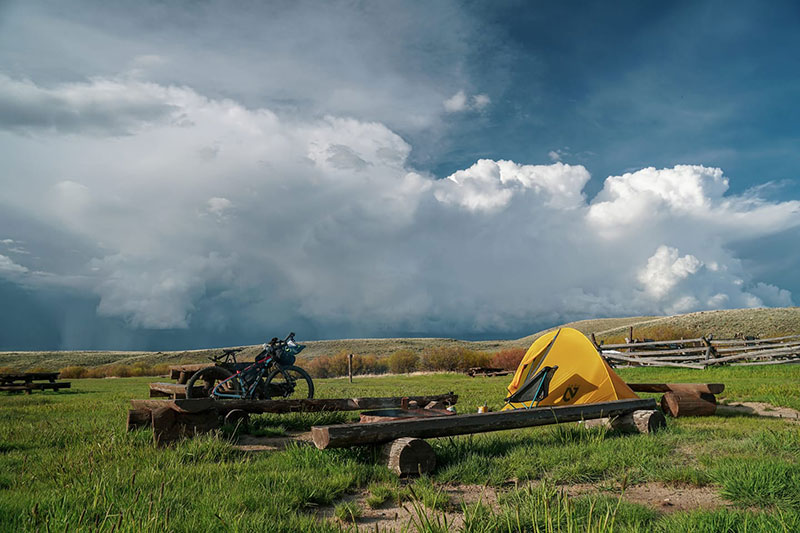
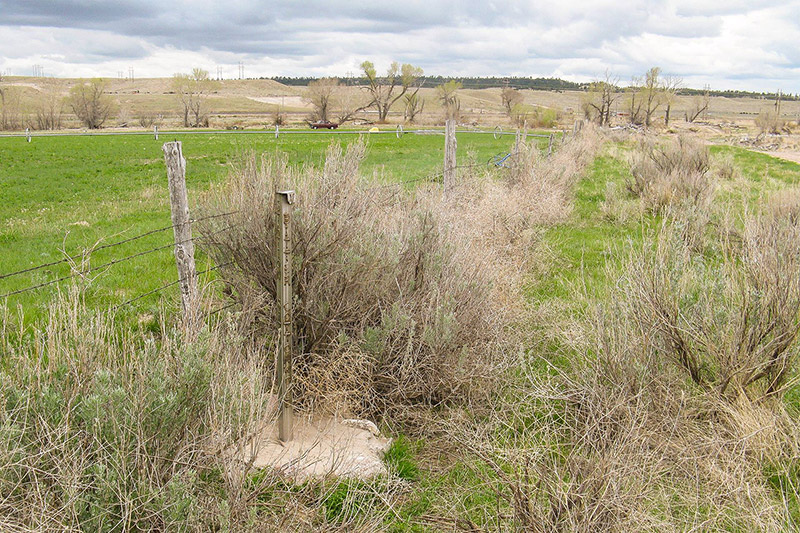


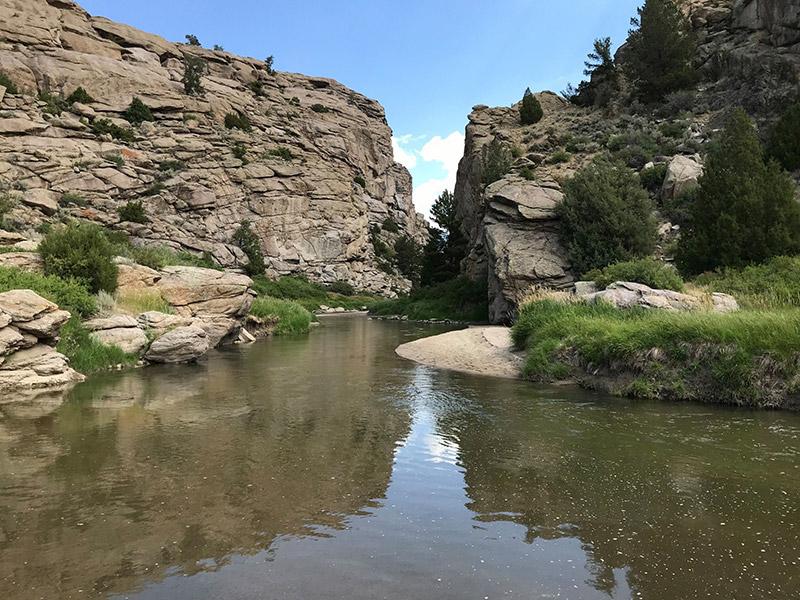
The Nebraska Historical Marker explaining the Susan Haile story was erected by the Kenesaw Centennial Committee and the Nebraska State Historical Society. The smaller marker is inscribed, “In Search of Pony Express Station Marker. Sand Hill.” It was dedicated June 8, 2002, by James Stretesky, Adams County Bank, Dorlene and Vern Hunt, Family of Leonard Osler, Pony Express Trails Association, and Joe Nardone, Historian.
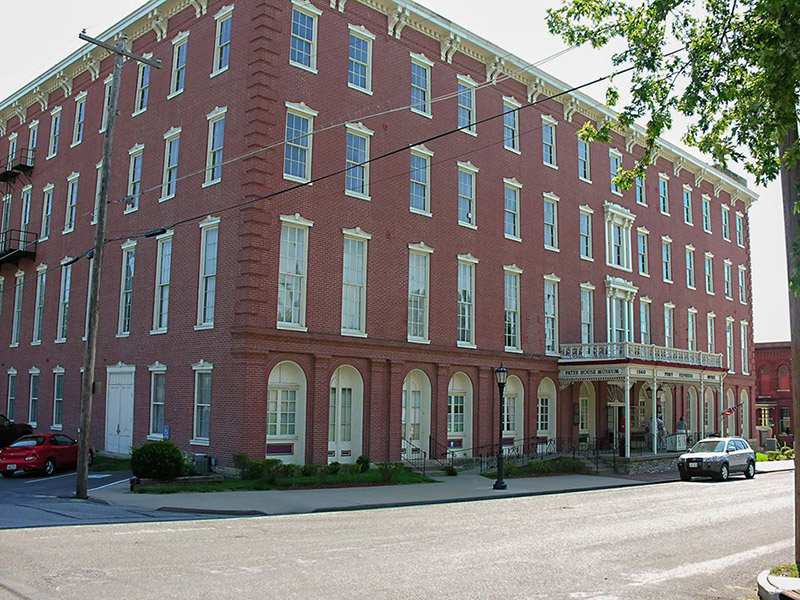

W.H. Stephens of Winnebago County, Illinois, left his name at Rock Avenue July 5, 1849. A day later, he carved his name at Independence Rock. Richard Collier, Wyoming SHPO.“It is a jagged, broken ridge,” Burton wrote, “of huge sandstone boulders, tilted up edgeways, and running in a line over the crest of a long roll of land … like the vertebrae of some great sea-serpent or other long crawling animal; and, on a nearer view, the several pieces resolve themselves into sphinxes, veiled nuns, Lot’s pillars, and other freakish objects.”


This location is almost exactly in the center of Adams County and the Thirty-Two Mile Creek Station name indicates the distance to Ft. Kearny. Russell, Majors, and Waddell formed the Leavenworth and Pikes Peak Express company in 1859 and most likely constructed the Thirty-Two Mile Station that year. Samuel Word kept a diary of his 1863 trip across the plains and the following words are from May 28: “We are now 32 miles from Fort Kearny. Am most anxious to reach Kearny for I expect to hear from home. Have just returned from a ranch close by, where immigrants and settlers to the number of 100 are congregated engaged in a genuine old-fashioned back woods dance. . . . The ranche was about 12 by 14 feet square covered with sod. . . . The house had what it would hold, the rest stood outside. . .many of the men were drunk from rifle whisky sold them by the proprietor of the ranche. His grocery was in one corner of the room. I left them dancing.” (Word in Renschler, 1997)