
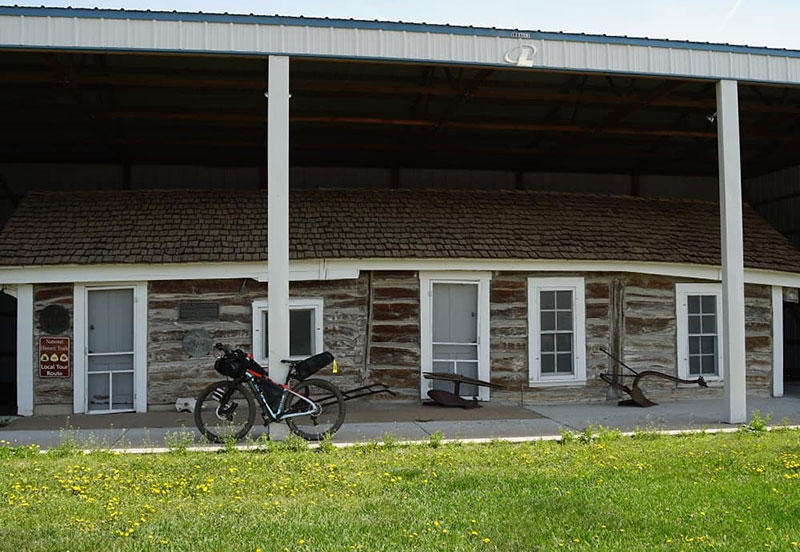
“The Midway Pony Express Station is still standing. Restored and covered with a serious awning, this station is tucked back behind some grain silos. It’s an easy one to miss and you’ll think you’re invading private property, but that’s not the case. Rush through here and you’ll miss a gem of the trail.”
[N.B. The station is “midway” between Atchison, KS and Denver, Co.]
Additional notes from the National Register of Historic Places Inventory – Nomination Form (1969):
This structure is Nebraska’s most important extant building known to have served traffic along the old Central Overland (or Oregon) Trail. It served this traffic in several capacities. Most importantly, the structure is one of some thirty-six Nebraska buildings which served as Pony Express stations during the brief existence of the Pony Express in 1860-61. Three of these stations are claimed to be extant: one structure at Cozad, another at Gothenburg, and Midway Station south of Gothenburg.
While the authenticity of at least one of these three buildings is uncertain, research thus far indicates that Midway is almost certainly an authentic Pony Express station. It is the most historically important and least altered of the three buildings, and only Midway remains on its original site. It has been reported that Midway was built as a fur trading post about 1850. However, it appears reasonably certain that the building was one of a series of some fifteen stage and mail stations constructed across Nebraska in 1859 by the Leavenworth & Pikes Peak Express Company to link the Missouri River with Denver and Salt Lake City. The firm of Russell, Majors and Waddell soon acquired these stations and early in 1860 built about twenty-one additional Nebraska stations. All thirty-six buildings, located at intervals of about fifteen miles, were soon used as Pony Express stations. In 1859 Midway was known only as U.S. Mail Station #17. However, travellers in 1860, including England’s Sir Richard Burton, began to refer specifically to “Midway” in their writings. The station purportedly derives its name from its position midway on the stage line between Atchison and Denver.
Midway’s importance was enhanced in 1860 when it became a Pony Express “home station,” which housed riders in addition to caring for their horses. (Most stations were “relay stations” caring for horses only.) Meanwhile, Midway continued to serve as a stage and immigrant supply station until the late 1860’s. During this period the building was located on the most heavily trafficked segment of the Central Overland Trail, which had served as the principal North American highway to the Rocky Mountains and the Pacific Ocean since the 1830’s. At Fort Kearny, some 66 miles east of Midway, traffic converged from various Missouri River towns. At Julesburg, some 136 miles west of Midway, traffic branched off to Colorado, California, Oregon, and Montana. Captain John R. Porter’s company of some fifty Union soldiers was headquartered at Midway late in 1864, during a period of severe Indian depredations in the vicinity.